A few weeks ago, my co-founder Nic and I got into an argument. Nothing serious, we just disagreed about the right way to approach something.
Nic did what any sensible person in 2026 would do, he put it into Claude. Claude thought he was right. So I did what any equally sensible person would do, I put it into my Claude. My Claude thought I was right.
We then started sending versions back and forth, each supported by an increasingly articulate AI explaining why its human had the better argument.
I have decided this is an AI Standoff: when two people disagree, consult their respective AIs, and both return with compelling evidence that they were right all along.
It was funny. It was also quite annoying. And I've realised we're having more and more moments like this.
Here's what I keep noticing, the same patterns we've been tracking in our Impact of AI research, now with names attached so we can actually talk about them.
Why does AI make it easier to procrastinate?
I have developed something I'm calling PROMPTCRASTINATION.
This is the act of leaving work until an objectively irresponsible time because you now know how quickly you can get it done. A presentation that I might once have started the day before can now, theoretically, be pulled together 15 minutes before a meeting.
The problem is the word theoretically. Because eventually you hit The AI CLIFF.
That's the moment, 11 minutes before the meeting, when you discover the presentation requires a number you don't have. Or the source document is incomplete. Or an assumption you've been merrily working from turns out to be wrong.
AI has compressed the time required to do the task. Unfortunately, I appear to have responded by removing all contingency from my life. Not always so productive.
What is a Prompt Hole?
AI has made it frictionless to follow any stray thought: "I wonder if it could do this?" Three minutes later you have an answer, which gives you another idea, and suddenly three hours have passed. That's a PROMPT HOLE. (Or perhaps undiagnosed ADHD.) I fall into them constantly.
Before AI, ideas had a natural cost, someone had to actually do the work, and that forced prioritisation. Now a thought becomes an artefact almost instantly, brilliant in itself, except when the cost of exploring an idea collapses, the number of ideas to explore explodes.
The scarce resource becomes something else: Attention.
Why might you be the bottleneck now, not AI?
This is probably the biggest change I've noticed. Our team can produce more, investigate more possibilities, and move from an idea to something tangible incredibly quickly.
But I can't just increase the number of things I can think deeply about. Or the number of decisions I can make well, or the amount of context I can hold in my head at once.
So I context-switch constantly, a product question becomes a marketing question becomes a customer question becomes a technical question, often within the same half hour.
AI has increased the throughput around me without increasing my brain's bandwidth. In some situations, I'm now the HUMAN BOTTLENECK.
That feels important because a lot of the discussion about AI and productivity assumes that if you make individual tasks faster, work itself gets faster.
I'm not sure it is that simple. Speed one part of a system up enough and the constraint simply moves somewhere else, or people get tired and drained.
How is AI changing team collaboration?
The AI Standoff isn't the only example. Sometimes I'll ask someone to review something and instead of getting comments back, I'll get a completely rewritten version.
Why? Because rewriting the whole thing now takes about the same amount of effort as explaining the changes. I call that The REWRITE REFLEX. But it creates a strange new collaboration problem.
I now have their version, my original version, perhaps the version their AI produced, the version my AI produces after reviewing their version, and several new suggestions neither of us asked for.
We've removed the cost of producing alternatives, but we haven't removed the cost of deciding between them. In fact, we may have increased it.
What AI skills actually matter once everyone can prompt?
We talk a lot about teaching people to use AI, prompting, tools, agents, automation. Of course those things matter.
But I'm increasingly interested in the skills that become more important after people get good at using AI.
Can you frame the problem properly? Can you recognise a bad assumption? Can you choose between five plausible options? Can you tell when something is actually finished?
AI makes producing things easier. It doesn't necessarily make choosing, prioritising, collaborating or thinking easier.
And those may increasingly be the skills that determine who is actually productive.
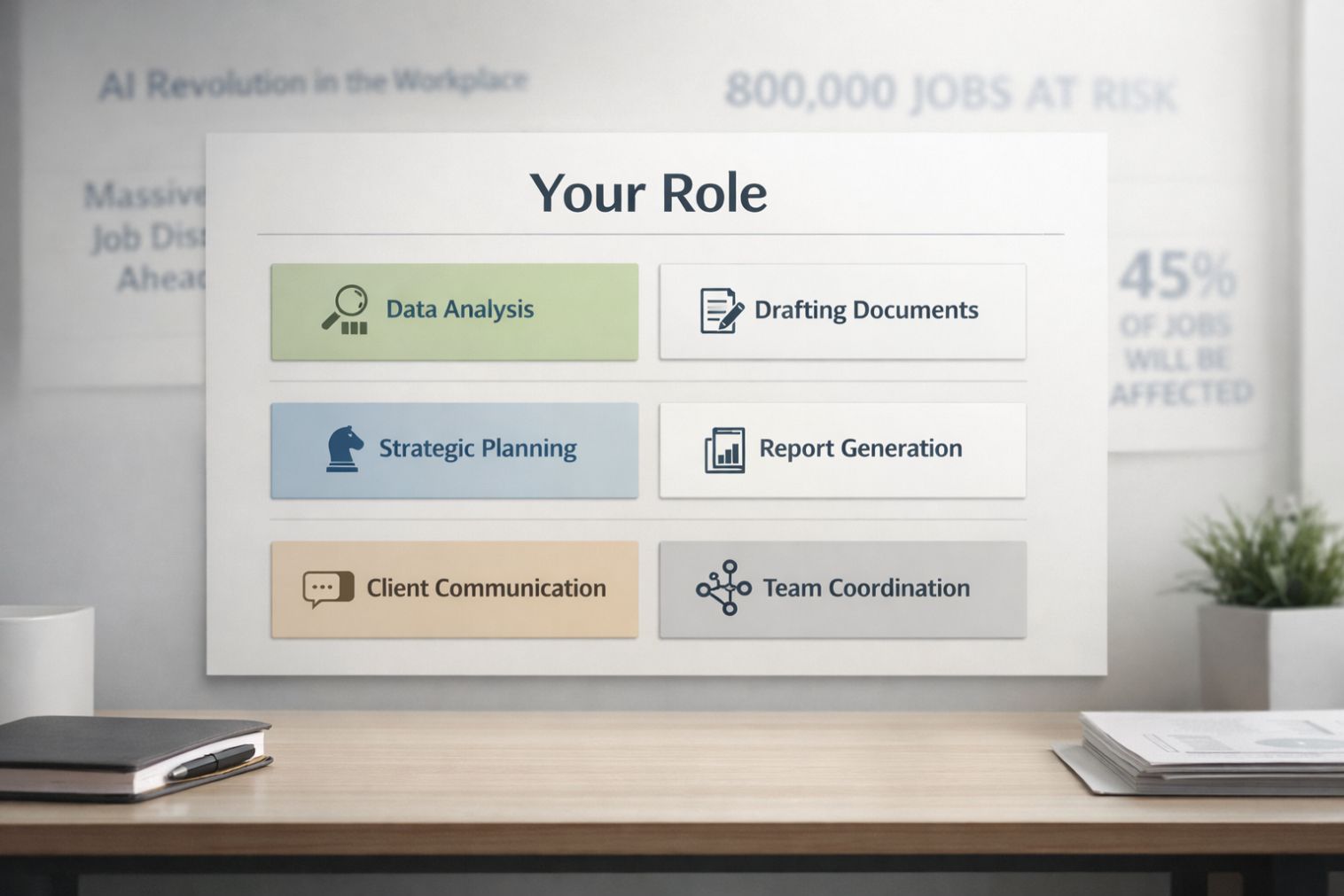
Why is AI quietly turning employees into managers?
Here's the one that actually worries me. My team isn't just using AI to do parts of their job anymore. Each of them now has their own resource to manage, something they have to performance manage, quality check, and correct when it gets things wrong. That's a real management skill, and not all of them needed it until an AI could do the work of a person. Nobody's given them the toolkit for it either, including me.
We're asking people to redesign their own jobs, with a pseudo-promotion to manager thrown in on top.
And there's more of this coming. For the next few years, most organisations are going to bolt some form of human-in-the-loop review onto every AI process, because nobody trusts it enough yet to remove the human. Reviewing AI output all day is a boring job, and boring jobs get less attention, not more. Less attention is exactly how you end up as what people are calling a MEAT PROXY, someone technically checking the AI's work who's actually stopped reading it properly and just forwards it on. That's not something a training course fixes, it's a job design problem, and it needs redesigning before boredom does the redesigning for you.
We've spent a lot of time asking which tasks AI will change. I'm starting to think the more interesting question is what happens to the way we organise work once those tasks change, and to the people now managing something for the first time with no instructions at all.
Are we going to do that deliberately, as organisations, or is it just going to happen to us, one small decision at a time?
Because from where I'm sitting, that change has already started.
Nic and I just haven't worked out how to end an AI Standoff yet.
Frequently asked questions
What is an AI Standoff?
An AI Standoff is when two people disagree, each consults their own AI, and both come back with confident evidence that they were right all along.
What is Promptcrastination?
Promptcrastination is leaving work until an irresponsibly late time because you know how quickly AI can help you finish it, until you hit a gap AI can't fill on the spot.
What is the AI Cliff?
The AI Cliff is the moment, often minutes before a deadline, when a task that seemed nearly done turns out to depend on a missing number, an incomplete source, or a wrong assumption.
What is a Prompt Hole?
A Prompt Hole is what happens when a stray question to AI gets answered instantly, sparks another question, and pulls you through hours of exploration you didn't plan for.
What is the Rewrite Reflex?
The Rewrite Reflex is the tendency to send back a full AI-assisted rewrite instead of comments, because rewriting now costs about the same as explaining the changes.
What is a meat proxy?
A meat proxy is someone whose job has quietly become checking AI output without really reading it anymore, because reviewing AI work all day is repetitive and gets less attention over time, not more.
Get in touch
If you'd like a proper, holistic view of how work is actually changing across your organisation, not just for one person, that's what we do. Try our free AI impact tool to see where it's already showing up in your team, or book an AI briefing with us directly.
.jpg)
Helena Turpin spent 20 years in talent and HR innovation where she solved people-related problems using data and technology. She left corporate life to create GoFIGR where she helps mid-sized organizations to develop and retain their people by connecting employee skills and aspirations to internal opportunities like projects, mentorship and learning.