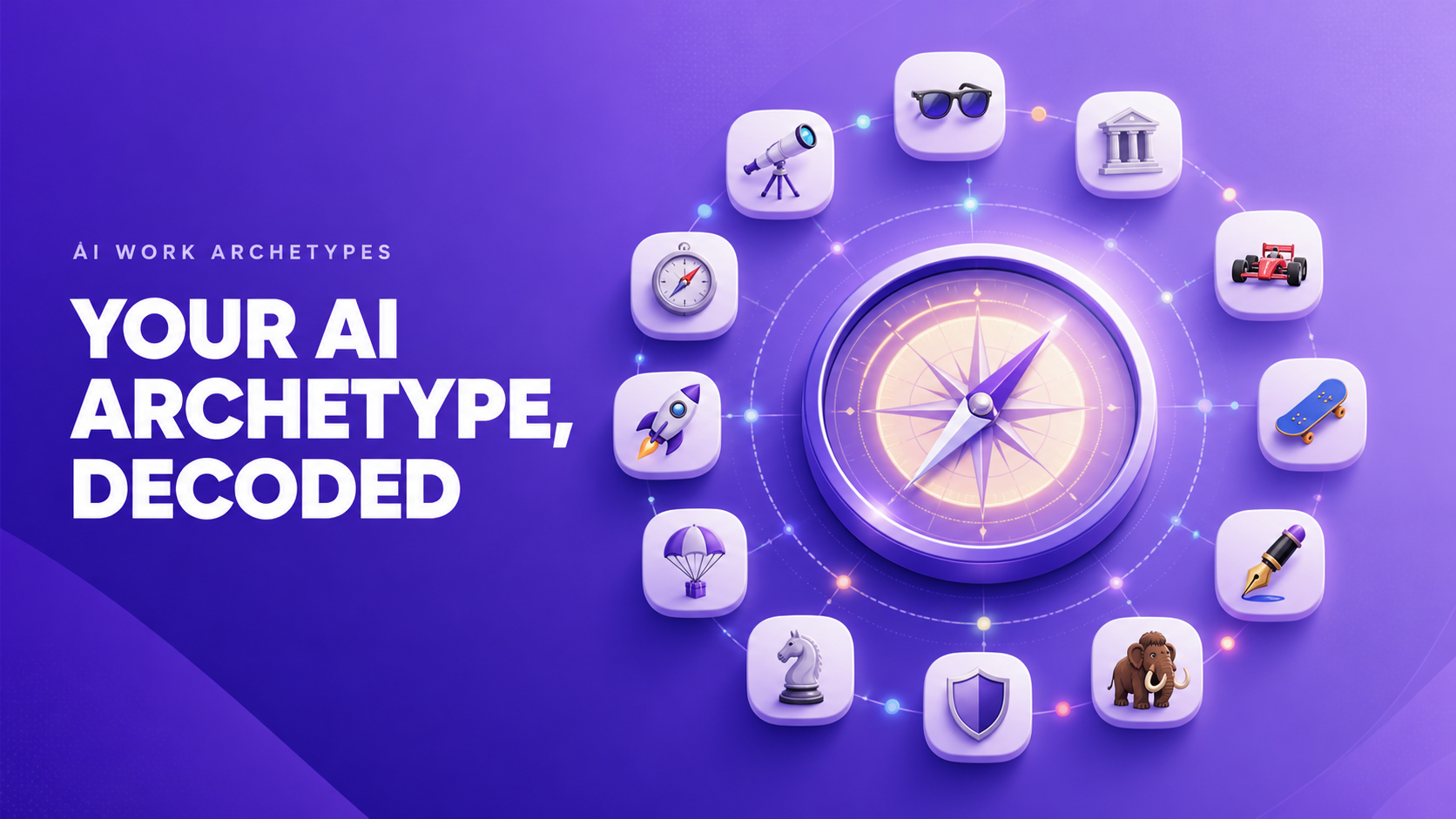
Your AI archetype, decoded
You just got your AI archetype back. Twelve names, what each one means, and who you're most compatible with.
Quick word on where it actually comes from, since it's not pulled out of a hat. Three things build it.
First, how much of your day-to-day could genuinely change. Tasks like drafting reports, summarising long documents, or pulling together data usually score high here. Work that depends on judgement calls, relationships, or being physically present usually doesn't.
Second, how much of that you'd actually be willing to hand over. That's a different question from the first one. You can have a role full of automatable tasks and still not want to let go of most of them, or you can be keen to hand over more than your current role even allows.
Third, how far you've already taken your own AI use. That ranges from barely having opened a tool, to using one for the odd task here and there, to having properly rebuilt parts of how you work around it.
Put those three together and you land on one of twelve archetypes. It's personal, not generic, so two people with near-identical job titles can easily land in different places.
Note: this is a deterministic model built from your actual tasks and habits, not a validated psychometric instrument. Treat it as a way to spot a pattern, not to diagnose one. Here's the fuller read anyway, tap yours to open it.
🔭 Quiet ObserverLow change, low personal AI use, no urgency yet. Archetype 1 of 12
Not much of your day-to-day is set to change yet, most of it still genuinely needs you specifically: judgement calls, relationships, hands-on work that AI can't touch. You haven't started using AI much yourself either, and you're not pushing to hand anything over. Your role's genuinely a bit more protected right now than most people's. Just don't mistake a slow start for a permanent exemption.
Low change, low personal AI use, and no strong urge yet to hand anything off. All three point the same direction, nothing about your work is pushing you to move.
Pattern spotting. You notice the shift before it's obvious to everyone else, partly because you're watching from a slight distance instead of scrambling in the middle of it.
Here's what "waiting too long" actually looks like in practice. If you haven't touched any of the tools by the time something forces the issue, whether that's new software rolling out, a colleague automating half of a job similar to yours, or the business deciding to move faster, you're starting from zero while everyone around you already has a head start. The learning curve you'll face at that point is steeper than it would be if you'd spent twenty minutes poking around now.
Fast Learner. Concretely, that means watching them cut something like a weekly report from two hours down to twenty minutes because they let AI draft the first pass and they just edit it. That kind of specific, visible saving is worth more to you than another keynote about disruption.
🕶️ Secret WeaponQuietly using AI regularly, ahead of what the role asks. Archetype 2 of 12
Your role hasn't officially caught up to how much you already use AI day to day, drafting first versions of documents, summarising long email threads, or getting through routine writing in a fraction of the time it used to take. You're ahead of what the job's actually asking for, and nobody had to tell you to get there.
Your role hasn't moved much yet and you're not pushing to hand more over, but you've quietly built up regular AI use anyway, well ahead of what the job currently needs.
Quiet experimentation. You try things on your own time, without needing permission or an audience, and you keep whatever actually works.
Here's the practical cost of staying quiet about it. If you never mention what you're doing, nobody on your team picks up the same shortcuts, and when conversations happen about where to invest time or headcount, the extra capacity you've quietly created for yourself isn't visible to anyone making that call. Invisible value doesn't get counted, no matter how real it is.
Selective Strategist. You've both already worked out where AI earns its keep in your own work rather than using it everywhere. Comparing the specific calls you've each made, what you automated and what you didn't, sharpens both without needing anyone else in the room.
🏛️ Silent ArchitectAlready rebuilt how you work. The role hasn't caught up. Archetype 3 of 12
You've already rebuilt how you actually work, not just using AI for one task here and there, but restructuring an entire chunk of your process around it: templates, connected tools, a new default way of getting from a blank page to a finished piece of work. The edge you're building compounds quietly in the background. The only real question is when you decide to make it visible.
Your role hasn't shifted much on paper and you're not pushing to hand work over, but you've gone further than most in actually working differently day to day, wiring AI into your own routine ahead of anyone asking.
Invisible leverage. What you've built quietly compounds, even before anyone's noticed it's there.
Here's what "building in isolation" costs you in practice. If you go on leave, move teams, or just get busy with something else, whatever you've built disappears with you, because none of it was written down or shown to anyone. Meanwhile a colleague doing similar work is stuck solving the exact same problem from scratch, because you never got round to sharing what you'd already figured out.
Work Rewriter. One of you has quietly rebuilt a personal workflow, the other's doing the same thing more visibly. Put together, the private edge gets turned into something the whole team could actually copy, instead of staying locked in one person's head.
🏎️ Untapped AcceleratorReady to hand work off. Just needs a credible route. Archetype 4 of 12
You already know exactly what you'd hand off if you could, that weekly report you compile by hand, the first draft of routine emails, the data entry nobody enjoys. Your role and your own AI experience just haven't caught up to how ready you are to let go of it.
You're still getting started with AI yourself, and not much about your role has shifted yet. But you're already clear on how much you'd hand over the moment you had a credible way to do it.
Real clarity about what to lose. You already know precisely what's worth handing off, which most people take months to work out for themselves.
Here's what frustration without action actually looks like. You keep doing the same manual task every week, getting more annoyed each time, without ever trying the obvious fix, because you're waiting for a proper rollout or a company-wide plan that may not arrive soon. The fix here isn't a strategy. It's picking one recurring task, like that weekly report, and just trying AI on it once to see what happens.
Human Firewall. You already know exactly what you'd hand off. They already know exactly which walls are real and which ones are just habit. Put together, you stop burning energy pushing against a rule that was never actually load-bearing.
🛹 Fast LearnerRegular AI use already, ready to hand over more. Archetype 5 of 12
You already use AI regularly, cutting the time on things like reports, summaries, or first-draft writing, and you're ready to hand over more of your role than it's currently giving up. The runway's opening, and you're the type to just start walking down it rather than waiting for an invitation.
Not much of your role has changed yet, but you've built real regular AI habits already and you're genuinely willing to hand more over. That combination is what's opening the runway.
Momentum. You learn fastest by trying something on a real piece of work, not by sitting through a training module first.
Here's what "moving without guardrails" looks like concretely. Sending an AI-drafted email or report out without properly checking it, and something factually wrong or oddly phrased gets through because nobody looked twice. Fast doesn't automatically mean checked, and the two aren't the same thing.
Quiet Observer. They need to see a specific, real result before they believe any of this is worth their time, something like "I used to spend two hours on this, now it's twenty minutes." You're the one who can actually show them that, not just describe it.
✍️ Work RewriterAlready redesigning the job, not just a task. Archetype 6 of 12
You're already redesigning your own job while most people are still testing prompts, restructuring how a whole piece of work gets done rather than just speeding up one step of it. Your willingness to hand things over and how far you've taken your own AI use are both about as high as they get, so the real opportunity here isn't shaving a few minutes off a task. It's reshaping the role itself.
Your role hasn't officially changed much, but your own appetite to hand work over and how far you've pushed your personal AI use are both near the top. Redesigning the job yourself was the natural result.
Workflow redesign. You don't just speed up a task, you rebuild how the job works end to end.
Here's the practical trap. If the process you're redesigning was already clunky or had unnecessary steps in it, using AI to speed it up just gets you to that same flawed outcome faster. It's worth checking whether you're fixing the actual process or just running a bad one at higher speed.
Silent Architect. One of you has quietly rebuilt a personal workflow, the other's doing the same thing more visibly. Put together, the private edge gets turned into something the whole team could actually copy.
🦣 Sleeping GiantHuge change potential, nothing feels urgent yet. Archetype 7 of 12
A genuinely large part of your role is exactly the kind of work AI is good at, things like repetitive reporting, compiling data, or routine writing, even though almost nothing about it feels urgent right now. That calm is buying you time. It isn't removing the change itself.
A big share of your day-to-day could realistically shift, but you're still just getting started with AI yourself and in no hurry to hand anything over. High change potential, low urgency, that's the gap you're sitting in.
Deep role knowledge. Nobody understands the actual shape of this work better than you do right now, which matters once things do start to move.
Here's what "false calm" actually costs you. Things feel fine because nothing's forcing your hand yet. But if your organisation adopts AI tools more widely, or a colleague in a similar role automates half their week, the size of the gap between you and them becomes obvious fast, and you'll have more ground to make up than someone who started early and quietly.
AI Trailblazer. You're sitting on the biggest untapped upside in the room. They're the person most likely to actually show you, step by step, how to start using it.
🛡️ Human FirewallComfortable with AI, selective about what stays human. Archetype 8 of 12
You already use AI regularly for some things, and a large part of your role could technically change. You're just fiercely selective about what actually should, keeping full control of anything involving decisions about people, compliance, or client relationships, while using AI more freely elsewhere. That instinct is genuinely valuable when it's protecting judgement, trust, or accountability.
A lot of your work is exposed to real change and you're already comfortable with AI. You're just not handing much over, because your instinct is to protect what needs a human in the loop.
Quality control. You know exactly which parts of the job can't afford to be handed off casually, and you hold that line consistently.
Here's what "guarding the wrong work" looks like in practice. Refusing to let AI help format a routine spreadsheet or draft an internal summary, purely because it feels like it should stay manual, when there's genuinely no risk involved. That habit costs you time you could be spending on the things that actually need your full attention.
Untapped Accelerator. They already know exactly what they'd hand off. You already know exactly which walls are real and which ones are just habit. Together, their momentum stops crashing into a rule that was never actually load-bearing.
♟️ Selective StrategistReady for the shift, won't surrender judgement calls. Archetype 9 of 12
Your role's changing fast and you already know how to move with it, having taken your own AI use further than most people at this level, using it for things like research or first drafts. You're just not willing to surrender the parts of the job that create real judgement, like sign-off, client calls, or decisions that need to be defensible later.
A large part of your role is genuinely exposed to change, and you've pushed your own AI use further than most people at this level. You're just deliberately holding back on handing over the parts that need a human call.
Choosing the boundary. You're precise about exactly where human accountability still earns its keep, not vague or nervous about it.
Here's the practical version of "becoming the bottleneck." If you're the only one who decides what gets automated and what doesn't, everything now waits on you personally to make that call, which can slow the whole team down even though you, individually, are moving fast.
Secret Weapon. You've both already worked out where AI earns its keep in your own work. Comparing the specific calls you've each made sharpens both of you without needing anyone else in the room.
🪂 Ready-to-LeapWilling to change the job before feeling equipped. Archetype 10 of 12
A large part of your role could change, and you're genuinely willing to hand plenty of it over, things like first drafts, summaries, or routine analysis, even though you're still just getting started with AI yourself. You're willing to change the job before you feel fully equipped to do it.
High change potential, high willingness to hand things over, but your own AI use is still early days. That gap between appetite and experience is exactly what puts you here.
Courage to let go. Most people wait until they feel ready. You're willing to move before that.
Here's what "leaping without practice" looks like. Handing over something genuinely high-stakes, like an important client email, as your very first attempt, with no smaller trial run behind it, and getting burned by a mistake that then puts you off the whole idea. Start with something low-risk instead, a draft nobody sees but you, before you hand over something that matters.
Rapid Riser. They already jumped and they're still climbing. Watching a specific example of that working for someone else closes the gap between thinking about it and actually doing it, faster than anything else will.
🚀 Rapid RiserThe work is moving fast, and so are you. Archetype 11 of 12
Your role is moving fast, you already use AI regularly, actively handing off chunks of your reporting, writing, or analysis, and colleagues have noticed you're doing things differently. You don't need convincing. You need a sequence that builds credibility without trying to transform everything at once.
High change potential, high willingness to hand work over, and solid regular AI use already under your belt. All three lined up, and you're already moving.
Fast adoption. You don't need to be talked into this. You just need the next right step.
Here's what "change overload" looks like in practice. Trying to switch every single task over to an AI-assisted process in the same month, instead of picking two or three genuinely high-value changes and bedding those in properly first. Moving on everything at once is how momentum turns into burnout, or into a mistake nobody caught because everything changed too fast to check.
Ready-to-Leap. You already jumped and you're still climbing. Being the specific, visible proof that it worked is one of the most useful things you can be to someone who's still on the edge.
🧭 AI TrailblazerNot waiting for the future of work. Prototyping it. Archetype 12 of 12
Your role, your willingness to hand things over, and how far you've taken your own AI use are all maxed out. You've built repeatable ways of working that other people are already copying, whether or not you've noticed. You're not waiting for the future of work. You're prototyping it.
High change potential, high willingness to hand work over, and you've already pushed your personal AI use as far as it goes. All three dimensions landed at the top at once.
Creating the path. Other people are watching what you do to figure out what's actually possible for themselves.
Here's what "leaving people behind" looks like. Talking about what you're doing in a way that only makes sense to someone already three steps ahead, so colleagues who are still getting started can't follow, and feel discouraged rather than inspired. Show people the small first step you took, not just the advanced result you're at now.
Sleeping Giant. They're sitting on the biggest untapped upside in the room. You're the person most likely to actually show them, step by step, how to start using it.
One rule applies to all twelve: none of this is a fixed trait. Run the assessment again in six months and there's a decent chance you've moved, blind spot and all. That's the whole point.

Helena Turpin spent 20 years in talent and HR innovation where she solved people-related problems using data and technology. She left corporate life to create GoFIGR where she helps mid-sized organizations to develop and retain their people by connecting employee skills and aspirations to internal opportunities like projects, mentorship and learning.

.jpg)