Most organisations trying to understand AI's workforce impact are working with the wrong unit of analysis. They're asking which jobs are at risk. GoFIGR asks which tasks are changing, and that distinction produces a completely different set of answers.
Key Findings
This piece explains how the GoFIGR AI Impact Assessment works, what it produces, and why it gives HR leaders and CHROs something traditional workforce planning approaches can't: a defensible, task-level picture of what AI is actually doing to work inside their organisation.
The problem with how organisations currently assess AI's workforce impact
The standard approach goes something like this. A leadership team reads a McKinsey or World Economic Forum report projecting that X% of jobs are at risk from automation. They match those projections against their own job families. They produce a heat map. They call it an AI workforce assessment.
The problem is that those projections are built on occupational data, averages across industries, functions, geographies. They treat every HR manager as if they do the same work, every financial analyst as if they have the same task mix, every customer service role as if the work is identical across organisations. It isn't.
Two HR managers at different companies can have the same title, the same pay band, and completely different AI exposure, because one spends most of her week on strategic advisory and leadership coaching, and the other spends most of his time on reporting, compliance documentation, and systems administration. An occupational risk score treats them identically. Task-level analysis does not.
The other limitation of traditional approaches is that they're static. They produce a single risk rating based on current AI capabilities, without accounting for the technology choices an organisation is actually making. A company deploying Copilot across its workforce has a different picture in 18 months than one that hasn't. Generic industry projections can't model that. A methodology built around your specific tech stack and AI roadmap can.
If you've noticed your organisation's AI strategy running well ahead of its people plan, this is the underlying reason. We wrote about why that gap opens and what it costs, the short version is that HR can't lead the business through a transition it hasn't mapped for itself first.
What task-level analysis actually means
Task-level analysis starts from a different question. Instead of asking "is this job at risk?", it asks: what are the specific tasks within this role, and what happens to each of them as AI capabilities develop?
A role is not a monolith. A senior HR business partner might have 40 distinct tasks in a given week, some interpersonal, some analytical, some administrative, some strategic. AI doesn't touch all of them equally. Some are highly automatable, some become AI-assisted, some become more valuable precisely because the routine work around them is being handled by AI. And some stay entirely human because they require judgment, relationships, or contextual sensitivity that AI doesn't replicate.
The task-level breakdown makes this visible. It turns "your role is 68% at risk" into a specific map of which tasks change, which stay, and which grow in value, and what that means for skills investment, role design, and workforce planning decisions. For a deeper explanation of how this differs from job-level analysis, and why the distinction matters for the decisions HR actually has to make, see our guide to task-level analysis for HR teams.
GoFIGR's AI Impact Model was built on this principle. Rather than scoring occupations, it decomposes roles into their component tasks and assesses each task independently against current and near-term AI capabilities, across three adoption scenarios.
The five ways AI changes a task
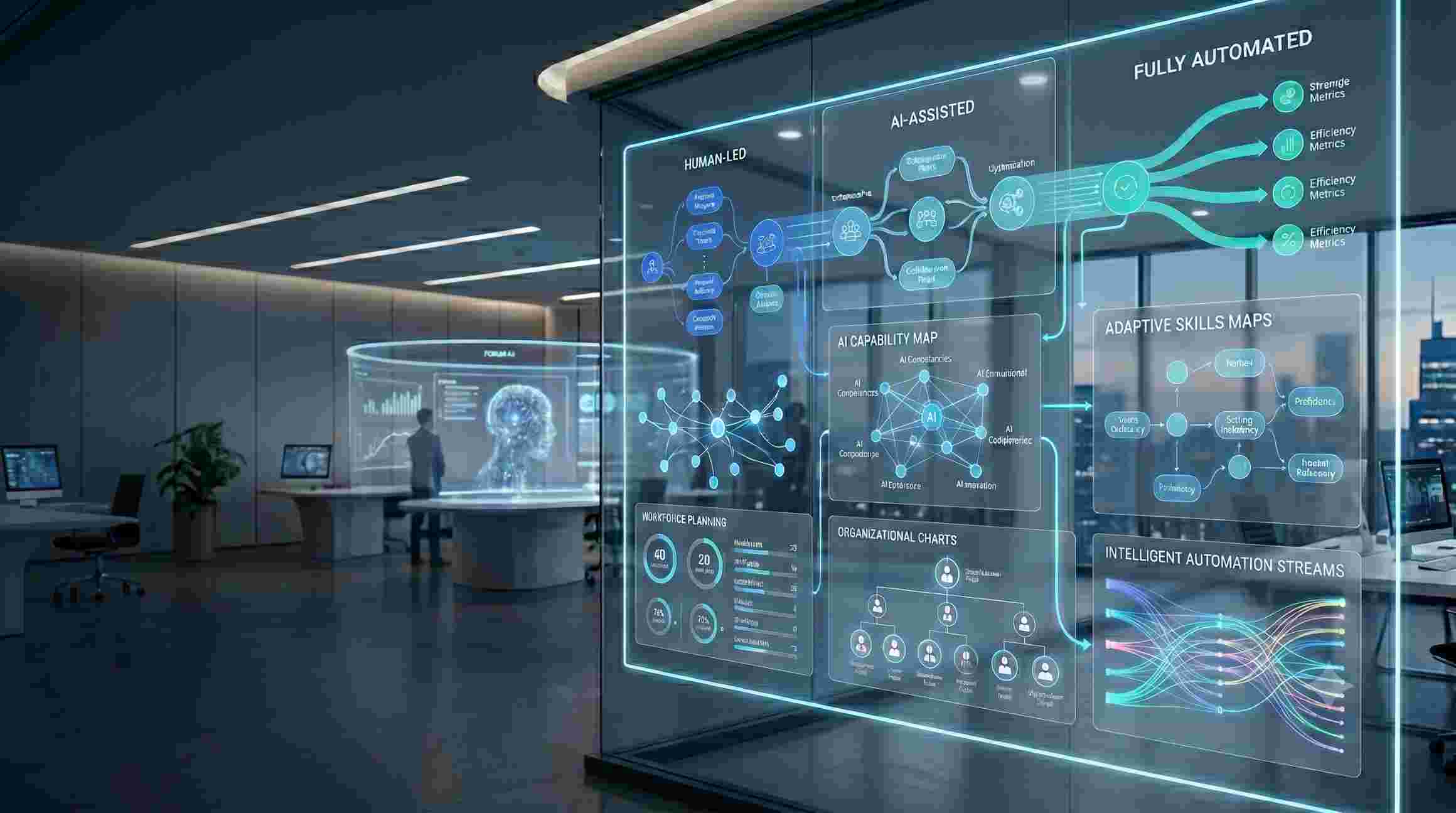
Each extracted task is assessed against current and near-term AI capabilities. Rather than producing a binary "automatable or not", the model places every task into one of five future states:
The distinction between these states matters for workforce planning in a way that a single risk score doesn't. "You lead, AI assists" and "AI leads, you guide" are not the same decision. One requires the human to remain capable of doing the work. The other requires the human to be capable of evaluating AI output. Those are different skills investment priorities.
How the GoFIGR methodology works
The GoFIGR AI Impact Assessment combines three components. Understanding how they work together is what distinguishes the output from a generic AI risk calculator.
Task extraction and normalisation
The starting point is your organisation's actual roles: position descriptions, job titles, job families, headcount data from your HRIS. No employee surveys, no interviews, no announcements required. GoFIGR processes variable-quality position descriptions into standardised task lists. Even organisations with inconsistent or outdated job descriptions have enough to start.
AI capability assessment across five states
Each extracted task is assessed against current and near-term AI capabilities and placed into one of the five future states described above.
Custom scenario modelling against your technology context
This is where GoFIGR's output diverges most significantly from generic assessments. The model produces results across three scenarios:
These scenarios are calibrated against your organisation's actual technology context, your current tech stack, your existing AI pilots, your declared AI roadmap. The Conservative scenario for a company already running Copilot across its workforce is not the same as the Conservative scenario for a company that hasn't deployed anything.
This is also why the Conservative scenario is not a safe position. Across GoFIGR's analysis of 100 HR roles and 1,800 individual tasks, 84.3% of HR tasks show some level of AI impact within three years, even under Conservative assumptions. AI is already embedded in the HRIS platforms, recruitment tools, and performance management systems most organisations already use. The disruption is arriving whether or not there's a strategy attached to it.
The skills output runs alongside the task analysis, showing which capabilities are declining in value, which remain essential, and which are emerging as AI changes what human contribution looks like. That's what turns a task-impact breakdown into a workforce planning tool: it shows specifically where L&D investment should go, and where continued investment in skills that AI is absorbing is a poor allocation of budget.
What the output actually looks like
GoFIGR's analysis of a real HR Generalist Manager role - drawn from a Big 4 firm job posting, broken into 18 tasks, run through all three scenarios - illustrates what the output produces:
The interpersonal and leadership tasks stay human across all three scenarios. Building and maintaining stakeholder relationships, providing ER advisory and coaching to managers, supporting change management for people initiatives - AI doesn't meaningfully touch these regardless of how aggressively the organisation adopts AI tools. The judgment, relational sensitivity, and contextual knowledge these tasks require isn't something a model replicates.
The administrative and operational tasks shift fast. Managing case workflows in ServiceNow and Workday, conducting onboarding coordination, executing offboarding and separation processes - these move to "AI leads" or "fully automated" even in the Conservative scenario.
The analytical tasks follow a more nuanced trajectory. Analysing people data to identify trends moves from "you lead" in the Conservative scenario to "AI leads, you guide" in Experimental. The task doesn't disappear - but the human's role in it changes from doing the analysis to directing it and being accountable for the conclusions.
The headline number: 83% of this HR manager's tasks are AI-impacted within three years. That's not a scare statistic. It's a design brief - a specific map of which parts of the role are changing and in which direction, which is a more useful answer than "this job is at risk."
Across the full 100-role, 1,800-task analysis, the pattern holds regardless of seniority. The type of work determines AI exposure, not the level at which someone sits in the hierarchy. An HR director who spends most of her time on reporting and systems administration has more AI exposure than a coordinator who spends most of her time on ER advisory and coaching. We published a full breakdown of the findings across all six HR sub-functions for anyone who wants to go deeper on the data.
This is an analysis of 100 HR roles to give you an idea of what the model can do across an entire department or workforce:
What makes this different from traditional workforce planning tools
Traditional workforce planning tools - including most HRIS-native analytics, most occupational risk calculators, and most consultant-led AI readiness assessments - operate at the role or occupation level. They produce risk ratings, heat maps, and scenario projections built on industry averages.
GoFIGR operates at the task level, against your specific technology context, using a structured methodology rather than an LLM generating opinions. Processing runs on enterprise grade technology, isnot used to train models, and no personally identifiable information is required. Find out more about AI Workforce Impact Assessment.
The practical differences in output are significant. A role-level assessment tells you that 40% of HR roles are at risk. A task-level assessment tells you that within your HR function, administrative and operational tasks automate at 60–90% in a transformational scenario, analytical tasks transform with humans retaining judgment, and interpersonal and leadership tasks grow in value as the work around them is automated. Those are different workforce planning inputs.
On speed: most initial analyses can be turned around same-day or within 24 hours of receiving HRIS data. The data requirements are light - role titles, job descriptions, job families, and headcount. No PII required, no employee involvement, no announcements necessary.
What organisations use this output for
Board-ready workforce planning. When the CTO walks in with a 40-page AI strategy and someone asks what the workforce implications are, the GoFIGR output is what makes it possible for HR to answer with data instead of estimates. Several enterprise clients have used it to secure additional transformation funding - because the data validated AI investment in some areas and challenged assumptions in others. For a practical framework on building the people plan to sit alongside the tech roadmap, the Human-Centred Workforce Planning Guide is the starting point.
L&D investment prioritisation. The skills output shows specifically which capabilities are declining, which are stable, and which are emerging. Continuing to develop skills AI is absorbing is a poor use of L&D budget when the higher-value investment is in the capabilities that AI doesn't replicate.
Role redesign. When a significant proportion of a role's tasks shift to "AI leads, you guide", the role doesn't disappear - but its design needs to change. The skills required to review and direct AI output are different from the skills required to produce it.
AI prioritisation - the majority of organisations we work with have a pragmatic approach to AI and want to seek and prioritise automation opportunities thoughtfully, whilst anticipating the people-impact. GoFIGR data supports this.
The entry-level pipeline question. The tasks most vulnerable to automation are also the tasks through which early-career professionals have historically developed. When that work automates, the development pathway needs deliberate redesign. IBM tripled its graduate intake after significant automation announcements - recognising that AI doesn't grow its own successors. The task-level data makes this decision visible before it becomes a pipeline problem.
How to see what it produces for your own role
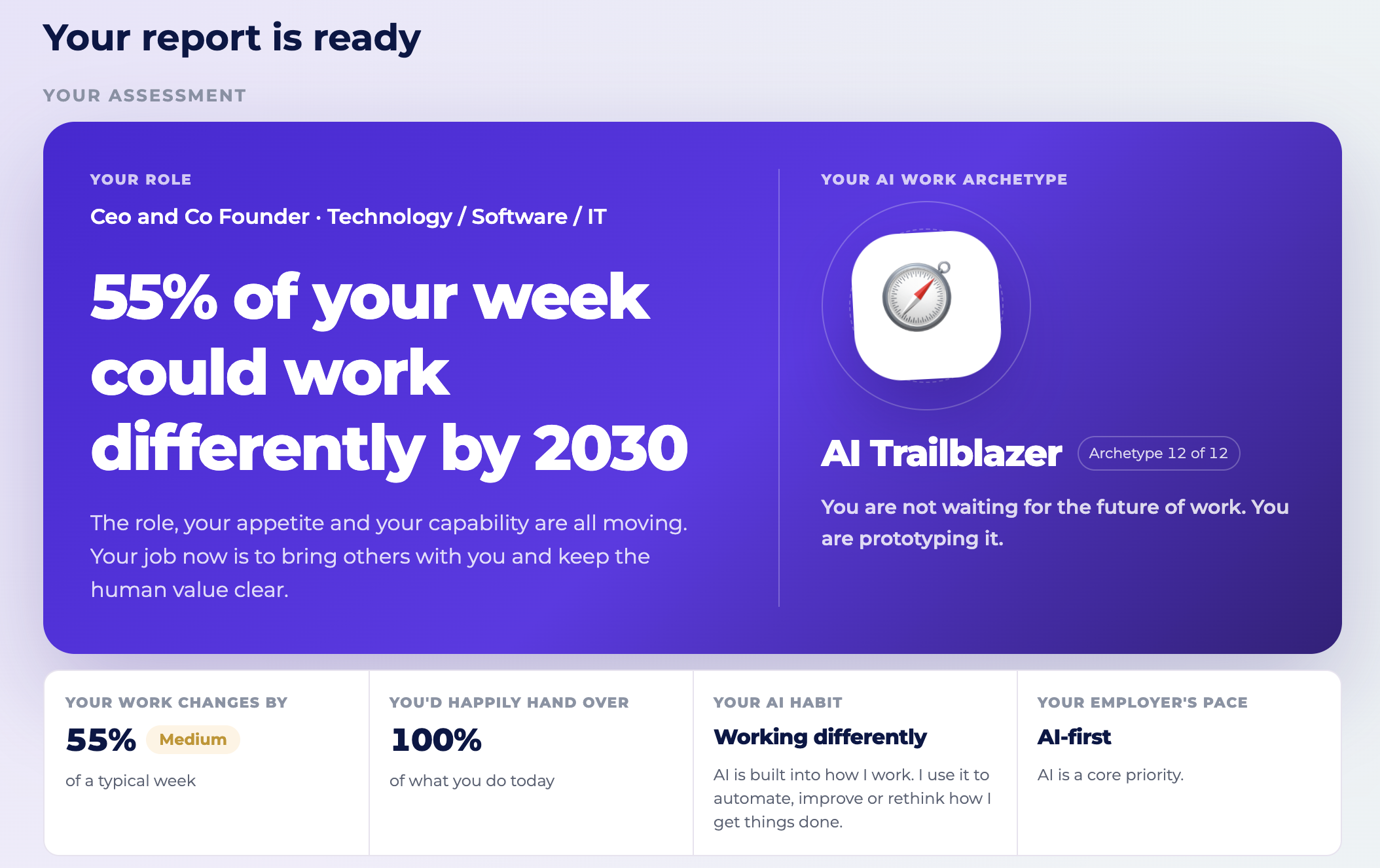
The free GoFIGR AI Impact Assessment takes about three minutes, requires no sign-up, and produces a personalised task-level breakdown of your own role. Thousands of people around the world have trie it.
For enterprise-scale analysis - your full workforce, against your specific technology context and AI roadmap, with executive-ready reporting - that's the paid GoFIGR platform. The same methodology scales from one role to thousands with consistent structure and output.
If you're a CHRO or People leader being asked to demonstrate what AI means for your workforce, the starting point is understanding what it means for your own role first. Take the free AI Impact assessment →
If you're ready to run this across your organisation, book a chat and we'll show you what the enterprise output looks like and share insights about how it's being used to accelerate responsible AI enablement.
Frequently asked questions
What is task-level AI analysis?
Task-level AI analysis assesses the impact of AI on individual tasks within a role, rather than scoring the role or occupation as a whole. Because different people in the same job title do different work, task-level analysis produces a more accurate picture of actual AI exposure than occupational risk calculators built on industry averages.
How is GoFIGR's methodology different from occupational risk calculators?
Occupational risk calculators use industry-average data to score job families. GoFIGR starts from your organisation's actual position descriptions, decomposes them into individual tasks, and assesses each task against AI capabilities across three scenarios calibrated to your specific technology context. The output is specific to your workforce, not an average across your industry.
What percentage of HR tasks are affected by AI?
Across GoFIGR's analysis of 100 HR roles and 1,800 individual tasks, 84.3% of HR tasks show some level of AI impact within three years, even under conservative assumptions where no deliberate AI strategy is in place. The disruption is already embedded in the tools most HR functions use today.
What are the five task states in the GoFIGR model?
The five states are: Stays with you (fully human), You lead, AI assists (human-led with AI support), AI leads, you guide (AI executes, human oversees), Fully automated (no human in the loop), and No longer needed (task disappears as surrounding work changes).
How long does an enterprise AI Impact Assessment take?
Most initial analyses are turned around same-day or within 24 hours of receiving HRIS data. The data requirements are light: role titles, job descriptions, job families, and headcount. No personally identifiable information is required and no employee involvement or announcements are necessary.

Helena Turpin spent 20 years in talent and HR innovation where she solved people-related problems using data and technology. She left corporate life to create GoFIGR where she helps mid-sized organizations to develop and retain their people by connecting employee skills and aspirations to internal opportunities like projects, mentorship and learning.
.jpg)