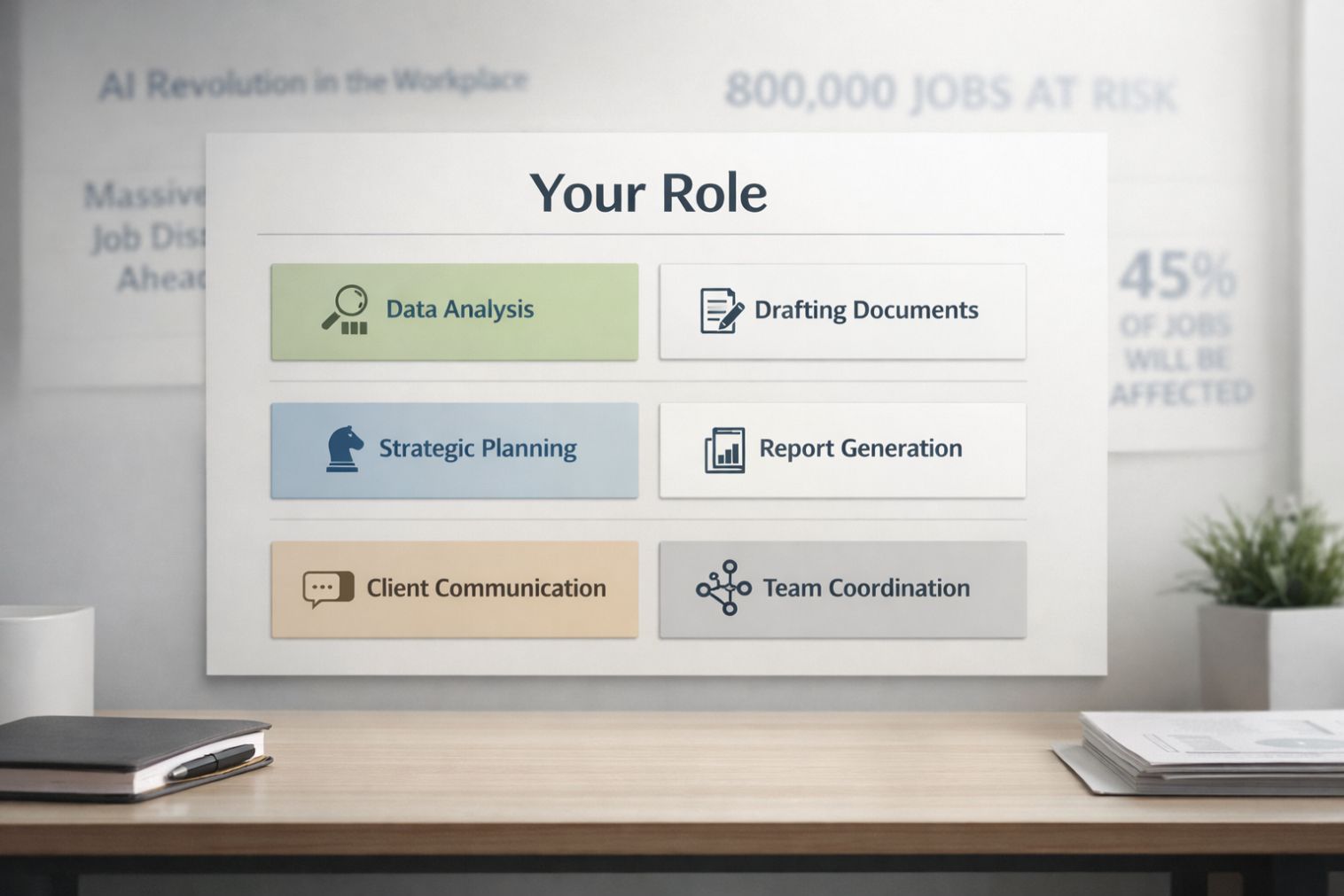
Which parts of your job can AI fully automate? For most people, the answer is: fewer than they think, and not the ones they'd guess. That's the finding that surprised us most when we started giving individual employees - not just leadership - direct visibility into their own task-level AI exposure.
We expected anxiety. What we got was a leaderboard.
The experiment nobody designed
The AI Impact Assessment was built as a leadership tool: run it, get a report, brief the board, allocate reskilling budget. Sensible, linear, top-down.
That's not what happened once individual employees got their own task-level breakdowns.
Instead of bracing for bad news, a meaningful number of people treated the exercise like a personal efficiency challenge. How much of my own job can I automate? Some went looking for every task in their breakdown that could plausibly be handed to AI, almost daring the data to prove them more replaceable than they felt. A few were oddly disappointed to discover less of their role was up for grabs than they'd hoped - as if the assessment had shortchanged them.
Why "AI risk" doesn't land the way you'd expect
The standard assumption in workforce planning is that individual-level automation data is threatening by default - that if you show someone which of their tasks AI can do, you're handing them a countdown clock.
But we’ve observed more of the opposite: a fair share of employees engaged with their own AI exposure as a game to win, not a threat to survive. Framed as "here's where you're spending time on things a tool could take off your plate," the data reads less like a threat and more like a shortcut - something to exploit for their own benefit, not something being done to them.
It's the difference between AI risk data that produces disengagement and your people creating their own AI action plan.
What this means if you're rolling out AI impact data
If you're an HR or people leader thinking about how - or whether - to give employees visibility into their own task-level AI exposure, a few things are worth taking from this:
- Task-level beats role-level. "Your role is 40% automatable" is a headline that invites dread. "Here are the six specific tasks in your week that a tool could take on" and some skills you can build to help you is something a person can actually act on.
- Framing is key. We asked one group of people to plot their tasks out on a grid of time/frequency vs value then propose which tasks they’d automate tomorrow if they could. Finally, we had them all think of one thing they’d love to do, achieve or build either a) because AI freed up time to do it or b) AI enabled them to something they couldn’t before - and watched the energy shift from anxiety to action.
- Some employees are already ahead of leadership on this. People are already using AI to automate the stuff they don’t enjoy or can see improved, functionally, doing the automation-scout work you might otherwise have to assign top-down. That's a resource you should enable.
The bigger pattern
This is one of several ways organisations have bent task-level AI impact data into shapes we didn't originally design for - validating a hunch for a board, scouting automation opportunities team by team, building a realistic counter to inflated AI-headcount claims. The personal race is the most human of the bunch, because it's the one where nobody asked permission. People just took the data and made it theirs.
If you're weighing whether to give your own people this kind of visibility, that reaction - competitive curiosity rather than dread - is worth planning for. It's not guaranteed. But it's more common than most rollout plans assume.

Helena Turpin spent 20 years in talent and HR innovation where she solved people-related problems using data and technology. She left corporate life to create GoFIGR where she helps mid-sized organizations to develop and retain their people by connecting employee skills and aspirations to internal opportunities like projects, mentorship and learning.
.jpg)