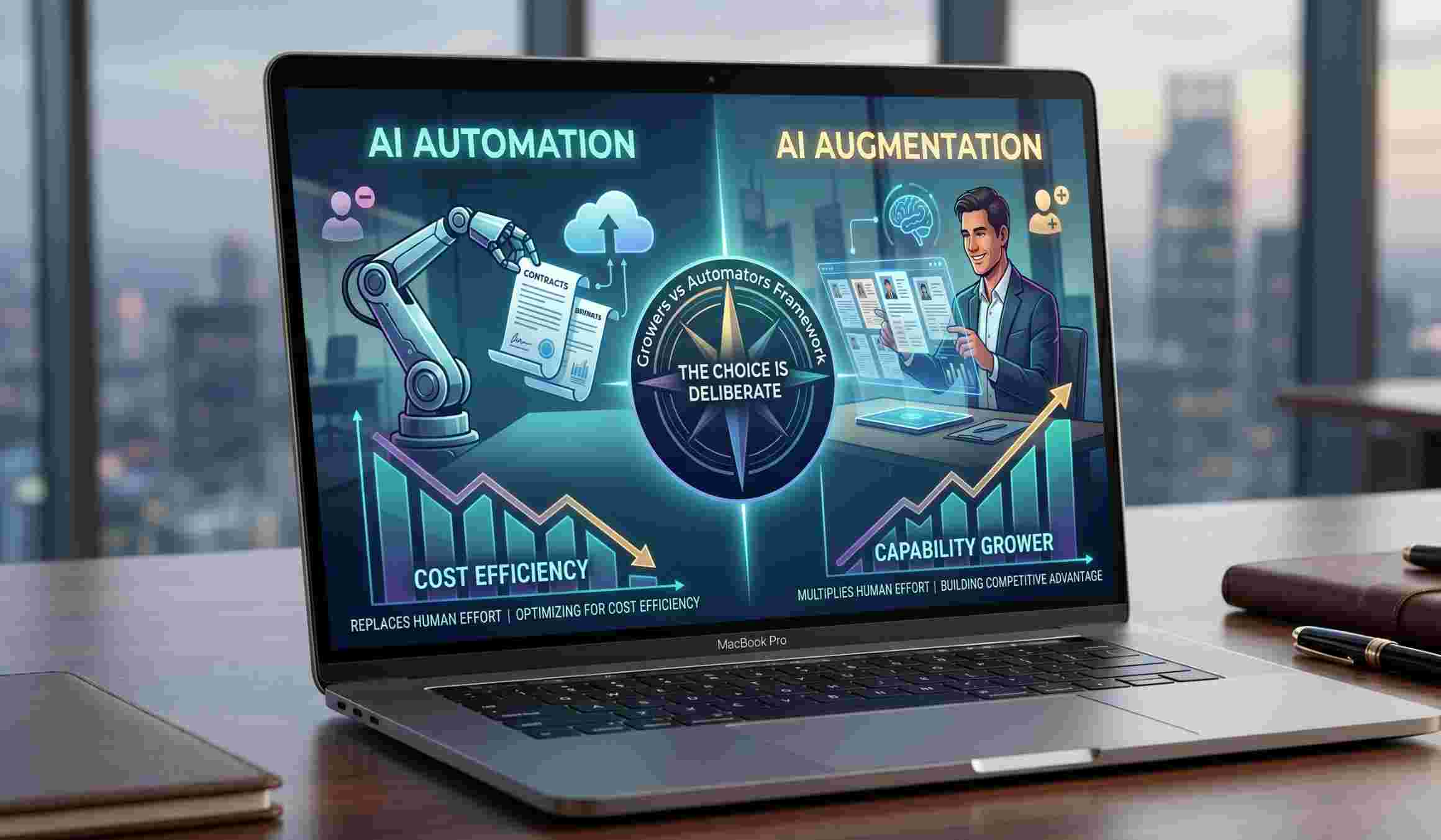
AI augmentation means using AI to help people do a task faster, more accurately or at greater scale, while a person stays accountable for the outcome.
AI automation and AI augmentation are both real. Both are happening right now, inside the same organisations, sometimes in the same function. The distinction matters because they lead to completely different workforce decisions, and most organisations are executing one while believing they are doing the other.
Here is the direct answer: AI automation replaces human tasks with AI-performed work, reducing the labour required to do them. AI augmentation uses AI to assist humans doing their work, making them faster, more accurate, or capable of doing more without adding headcount. One removes human effort from the equation, the other multiplies it.
What Is AI Automation in the Workforce?
AI automation refers to tasks that AI performs in place of a human. The human is no longer in the loop, or is reduced to a minimal oversight role. The work gets done; a person is no longer needed to do it.
Examples of automated tasks in knowledge work include:
- Generating first-draft documents, contracts, or reports from structured data
- Processing and categorising incoming requests without human triage
- Running compliance checks against a defined ruleset
- Scheduling, rescheduling, and confirming meetings without human input
- Extracting and summarising information from large document sets
When organisations talk about "efficiency gains from AI," they’re usually describing automation. Tasks come off a person's plate and that capacity either gets redeployed or the headcount gets reduced.
Klarna is the most cited example of an organisation pursuing aggressive automation. Its AI assistant handled the work of 700 customer service staff in its first month of deployment. The organisation chose to optimise for cost efficiency.
What Is AI Augmentation in the Workforce?
AI augmentation refers to AI that assists a human performing a task, without replacing the human's role in it. The person remains in charge. AI increases the speed, quality, or scale of what they can produce.
Examples of augmented tasks include:
- A recruiter using AI to screen CVs faster, then making their own judgment calls on candidates
- An HR business partner using AI to draft a performance improvement plan, then applying their knowledge of the individual to finalise it
- A people analyst using AI to run scenario models across workforce data, then interpreting the results for the leadership team
- A learning designer using AI to generate course outlines, then reshaping them for the organisation's context
The human's judgment, relationships, and contextual knowledge remain central. AI handles the lower-value, time-consuming parts of the task so the person can spend more time on the parts that require them.
IKEA is the counterpoint to Klarna, facing similar AI capability in its customer service function, they chose to redeploy those people into higher-value advisory roles in interior design rather than reduce headcount. It used AI augmentation to do more with the same workforce, not less with a smaller one.
Why the Distinction Matters More Than Most Organisations Realise
Most organisations are not consciously choosing between automation and augmentation. They are deploying AI tools and letting the default settings make the decision for them.
The cost of getting this wrong is already visible. Harvard Business Review surveyed over 1,000 executives and found that 60% had already reduced headcount in anticipation of AI's future impact - with just 2% tying large layoffs to actual AI implementation. That is what happens when automation runs ahead of a deliberate human-involvement strategy.
The difference is not the technology. It is the decision about which tasks go to AI and which stay with humans, and whether that decision is made deliberately or by default.
The Growers vs Automators Split
GoFIGR uses the terms Growers and Automators to describe the two organisational strategies emerging from this choice.
Automators are optimising for AI efficiency. They are identifying tasks AI can perform and removing human labour from those tasks. The goal is cost reduction - done well, this produces real savings. Done without a clear workforce strategy, it removes capability the organisation might need later and cannot easily rebuild.
Growers are using AI to expand what their people can do. They are removing low-value tasks from human workloads so that people can spend more time on higher-value work. The headcount stays roughly the same; the output per person increases. Done well, this builds competitive advantage through capability. Done without discipline, it becomes an expensive way to avoid difficult decisions.
Both are rational strategies, neither is universally right, but the mistake is not knowing which one you’re executing, or assuming you are doing one while the data would tell you something different.
A task-level AI impact assessment is how you find out which one you are actually doing, and whether it is the one you intended.
How Task-Level Analysis Maps Automation vs Augmentation
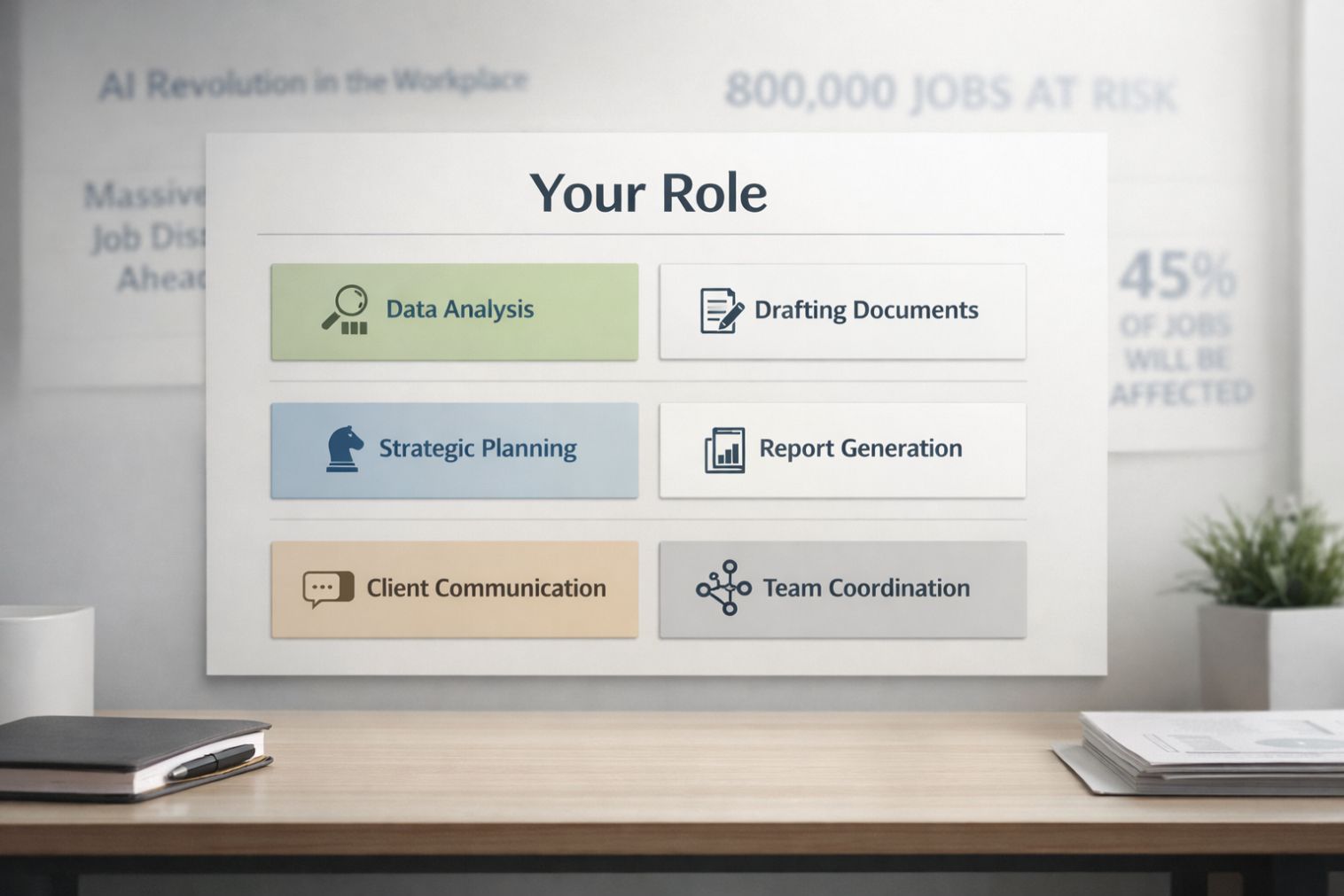
The automation vs augmentation distinction is not visible at the role level. A role can be described as "AI-assisted" while the majority of its tasks are actually being automated. Or it can be flagged as "at risk" while most of its tasks are ones AI genuinely cannot perform without human input. For a full explanation of how task-level analysis works and why the unit of analysis matters, see What is Task Level Analysis? A Practical Guide for HR Teams.
GoFIGR's AI Impact Assessment produces a breakdown across five categories for every task in every role:

Helena Turpin spent 20 years in talent and HR innovation where she solved people-related problems using data and technology. She left corporate life to create GoFIGR where she helps mid-sized organizations to develop and retain their people by connecting employee skills and aspirations to internal opportunities like projects, mentorship and learning.
Related Blog Posts
.jpg)

GoFIGR Newsletter
Sign up for the latest resources on how to keep your people engaged, happy and high-performing

