Most businesses answer this question by job title. As we've written about before, AI is changing tasks, not titles, which is exactly why the title-first approach keeps producing bad predictions. "Customer service will get hit. Engineering won't." "Admin roles are exposed. Sales is safe." It's a reasonable first guess, and it's usually wrong, not because the instinct is bad, but because it's aimed at the wrong unit of analysis. AI doesn't affect jobs. It affects tasks. And two people with the same job title can have almost nothing in common in terms of what AI can actually take off their plate.
Why role titles are the wrong lens
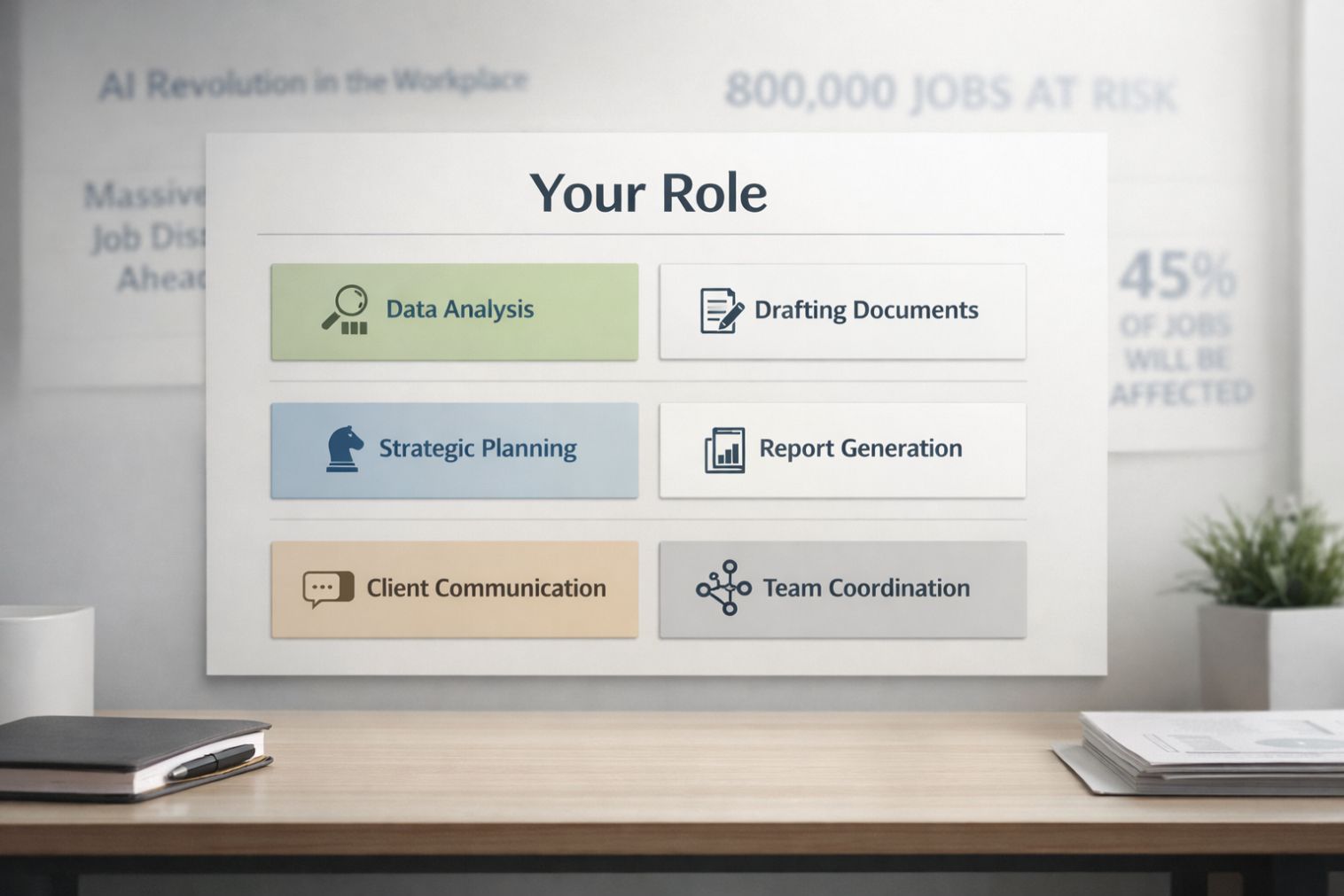
A job title is a bundle of tasks, and that bundle isn't fixed. Two "customer service representatives" at the same company might spend their week completely differently: one mostly answers repetitive billing questions, the other spends most of their time de-escalating angry customers and making judgment calls with no script covers. AI is very good at the first kind of task and still unreliable at the second. Same title, same pay band, wildly different exposure.
This is why so many AI-impact headlines feel simultaneously alarming and useless. "40% of marketing tasks could be automated" tells you something true and almost nothing you can act on, because it's an average smeared across a role that, in practice, is a dozen different jobs wearing the same name tag.
What task-level actually means
The more useful question isn't "is this role affected?" It's "what does this person actually spend their time doing, and how much of that is high-volume, low-judgment work versus the kind of decision-making that still needs a human?"
Broken down that way, a few patterns tend to show up in almost every business:
- High-volume, repeatable, low-judgment tasks (data entry, first-draft writing, scheduling, basic reporting) are the most exposed, regardless of which department they sit in.
- Judgment-heavy, relationship-dependent, or ambiguous tasks (negotiating, coaching, handling an unhappy client, making a call with incomplete information) are the least exposed, again regardless of department.
- Most real jobs are a mix of both, which is why "will AI replace X role?" is almost always the wrong question. The better question is what percentage of this specific person's week falls into each bucket.
Why this matters more than it sounds like it should
Getting this wrong in either direction is expensive. Over-estimate exposure and you either panic your workforce or over-invest in automation that doesn't fit how the work actually happens. Under-estimate it and you miss real efficiency gains sitting in plain sight, usually in the unglamorous, repetitive parts of otherwise "safe" roles.
There's also a trust cost. When leadership makes broad claims about which jobs are "at risk" based on title alone, and employees know from the inside that the claim doesn't match their actual day, it reads as either uninformed or self-serving. Task-level data doesn't have that problem, because it's describing the work people recognise doing, not a category they've been sorted into.
Where to start
You don't need a perfect model of every task in the business to get useful signal. Start narrow:
- Pick one team where you have a hunch, good or bad, about AI exposure.
- Break down what that team's roles actually do in a typical week, at the task level, not the job-description level.
- Sort those tasks by volume and judgment required.
- See where the picture matches your hunch, and where it doesn't.
The mismatches are usually where the real insight is. It's rarely the jobs everyone already suspected. It's the quietly automatable slice inside a role nobody thought to look at, or the "obviously exposed" role that turns out to be mostly judgment calls once you look closely.
If you'd rather skip the manual version of this exercise, GoFIGR's AI Impact Assessment does the task-level breakdown for you, role by role, so you're working from data instead of a hunch.

Helena Turpin spent 20 years in talent and HR innovation where she solved people-related problems using data and technology. She left corporate life to create GoFIGR where she helps mid-sized organizations to develop and retain their people by connecting employee skills and aspirations to internal opportunities like projects, mentorship and learning.
.jpg)