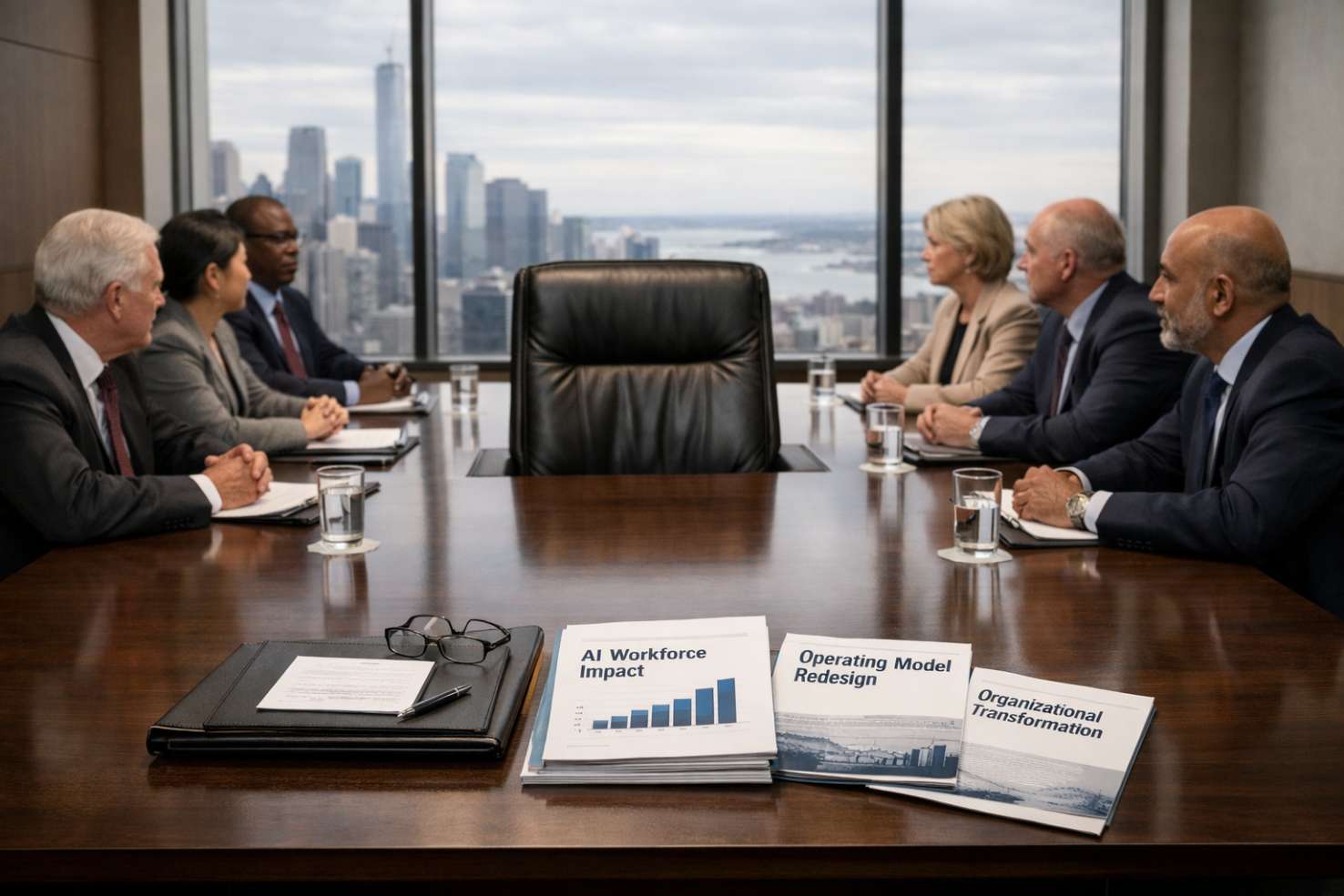
In September 2025, I wrote a piece called The Job No One Gave You (But Everyone Expects): From CHRO to Chief Human Transformation Officer. The argument was straightforward: AI makes every business decision a people decision, and the CHRO is being expected to lead workforce transformation without anyone officially giving them the mandate, the data, or the resources.
Five months later, I want to revisit that piece - not because I got it wrong, but because the speed at which it's playing out has surprised even me.
Here's what's happened since September.
BCG declared AI transformation "lives in HR" (February 2026)
BCG's report on the reinvention of the CHRO didn't hedge. Their headline: "AI transformation doesn't live in IT. It lives in HR, where work, roles, and culture are being redesigned."
Their key finding: most AI efforts stall not because the technology doesn't work, but because organisations fail to redesign roles, workflows, and governance for human-AI work. BCG estimates that 70% of AI's business value depends on getting the people side right.
That was the thesis of my September piece. Five months ago it was an argument. Now it's a BCG headline.
They also introduced the idea of the CHRO running a "two-speed agenda" - stabilising core HR functions while simultaneously reimagining roles, teams, and operating models for AI-first work. If that sounds exhausting, it's because it is. But it's also the clearest articulation I've seen of what the job actually looks like now.
Gartner surveyed 426 CHROs and the priorities are stark (October 2025)
Gartner's annual CHRO priorities survey landed a month after my piece, based on responses from 426 CHROs across 23 industries and four global regions. Their four priorities for 2026:
- Harness AI to revolutionise HR
- Shape work in the human-machine era
- Mobilise leaders for growth in an uncertain world
- Address culture atrophy to drive performance
The most striking finding: 29% of AI-driven productivity gains come from redesigning HR's own operating model - not from training employees or improving AI literacy. In other words, the biggest lever for AI value isn't what you do to the workforce. It's what you do to HR itself.
That's the bit I underestimated in September. I focused on the CHRO leading transformation across the organisation. I should have spent more time on the fact that HR's own function needs transforming first - and that this internal reinvention is actually where the most immediate value sits.
82% of boards expect AI-driven workforce reductions (Korn Ferry, 2025)
Korn Ferry's CEO and Board Survey found that 82% of boards and chief executives expect to reduce up to 20% of their workforce because of AI in the next three years. That's still a massive shift.
If HR isn't already in the room with workforce intelligence - task-level analysis, reskilling business cases, redeployment scenarios - those cuts will be made on spreadsheets by people who've never had a conversation with an employee about their career.
Korn Ferry also flagged the unintended consequences: eliminating middle managers and entry-level roles "looks attractive on a spreadsheet but quietly destroys your future leadership bench." That's exactly the kind of insight that only comes from the people side - and exactly why the CHRO needs to be in the room when those decisions are being discussed, not informed after.
Companies are already regretting AI-driven layoffs (Forrester, October 2025)
Forrester reported that 55% of employers already regret AI-driven layoffs. Not future layoffs. Layoffs they've already made.
Harvard Business Review put it more bluntly in January 2026: companies are laying off workers based on AI's potential, not its actual performance.
This is what happens when technology planning runs ahead of people planning. Decisions get made on assumptions about what AI can do, without anyone checking whether it actually does it well enough to replace the humans who were doing it before.
IKEA saw this coming and chose a different path - reskilling 8,500 call centre workers into interior design advisors, turning a cost centre into a €1.3B revenue engine. Klarna took the opposite approach, cut aggressively, and had to reverse course.
The difference wasn't the technology. It was whether someone with workforce data was in the room when the decisions were made.
Only 21% of HR leaders are closely involved in AI strategy (AIHR, November 2025)
This stat hasn't improved since I first cited it. If anything, the gap between expectation and involvement has widened - because the expectations have grown faster than HR's seat at the table has.
AIHR's research confirmed what I keep seeing with our clients: CHROs know transformation is coming. They can feel it. But they don't have the data infrastructure to quantify it, the mandate to lead it, or the tools to move at the pace of the technology decisions happening around them.
The CTO has vendor roadmaps, proof-of-concept results, and measurable ROI projections. The CHRO has engagement surveys and instinct. That's not a fair fight - and it's not a competence problem. It's an infrastructure problem. Linda Chai and I wrote about this dynamic - the forced marriage between HR and IT as they try to co-parent AI together.
What I'd add to my September piece now
If I were rewriting it today, I'd make three changes:
1. HR's own transformation comes first. You can't credibly lead workforce transformation across the organisation if your own function is still running on 2015 processes. The Gartner finding - that 29% of productivity gains come from HR model redesign - should be the starting point, not an afterthought.
2. The data gap is the credibility gap. I mentioned this in September but I'd make it the centrepiece now. Every CHRO I've spoken to since knows what's coming. The problem isn't awareness - it's evidence. Task-level workforce data is what closes the gap between "we think this is important" and "here's what we should do about it."
3. Speed matters more than perfection. The biggest mistake I see is CHROs waiting for a comprehensive workforce strategy before engaging. By the time it's ready, the technology decisions have been made. Start with five roles. Map the tasks. Use that as the basis for a conversation with the CTO. A good starting point beats a perfect plan that arrives too late.
What you can do this week
If you haven't started: Try our free AI Impact Assessment on your own role. It takes two minutes and shows you what task-level analysis looks like. Then try it on three roles in your organisation that you suspect are most affected by AI. That's enough to start a conversation.
If you're mid-journey: Download the Human-Centred Workforce Planning Guide. Five working sessions with templates and AI prompts - from assessing exposure through to communicating change and building iteration rhythms.
If you need enterprise-scale analysis: Talk to us. We've done this for organisations with 3,000+ people and delivered board-ready reporting in days.
The pace isn't slowing down
Five months ago, the CHRO-as-transformation-officer was a trend. Today it's an expectation. Five months from now, it'll be table stakes.
The CHROs who move now - who build workforce intelligence capability, reinvent their own function, and earn their seat at the strategy table - won't just survive this shift. They'll define it.
The ones who wait will spend the next three years cleaning up decisions they weren't in the room to influence.
Which one will you be?
This is a companion piece to The Job No One Gave You (But Everyone Expects): From CHRO to Chief Human Transformation Officer, published September 2025.

Helena Turpin spent 20 years in talent and HR innovation where she solved people-related problems using data and technology. She left corporate life to create GoFIGR where she helps mid-sized organizations to develop and retain their people by connecting employee skills and aspirations to internal opportunities like projects, mentorship and learning.

.jpg)