Let's be honest, HR and IT have spent the last two decades living relatively separate lives. Cordial, professional, occasionally collaborating on a system implementation or a data migration. IT builds the platforms and employees use them. They attend the same town halls, nod at each other in the lift, and go back to their respective floors to solve their respective problems.
And now? Now they’re having a baby together
That baby is called AI or more specifically, the digital worker. And it’s about to disrupt everything - not just the work, but the relationship between the two functions that have to figure out how to raise it.
Welcome to the unholy matrimony your organisation didn’t plan for.
Two Functions, Two Languages, One Very Confused Translator
Here’s the thing about HR and IT: they’ve been solving fundamentally different problems for so long that they’ve developed entirely different operating systems.
IT speaks in systems. Architecture, integrations, data schemas, security protocols, scalability. When IT looks at AI, they see infrastructure and platform decisions. Which LLM? On-prem or cloud? How do we govern the data? What’s the API strategy? They’re thinking about pilots, POCs, and technical debt.
HR speaks in humans. Culture, capability, change readiness, career development, employee experience. When HR looks at AI, they see workforce transformation. Which jobs change? How do we reskill people? What happens to the employee value proposition? They’re thinking about adoption curves, manager capability, and whether anyone’s actually going to use this thing.
Neither of them is wrong. Both of them are incomplete.
And here’s the kicker: AI doesn’t care about your org chart. It doesn’t respect the neat boundaries between “technology decisions” and “people decisions.” It gleefully tramples across both, demanding that someone figures out how to make these two worlds talk to each other.
That someone, increasingly, is everyone. But especially HR and IT.
The Baby Doesn’t Come With Instructions
Most organisations are approaching AI like IT did with every other technology wave: as a series of tool deployments. Pick a vendor, run a pilot, train people and roll it out. Done.
Except AI isn’t a tool. It’s a capability shift.
When we gave people email, we gave them a faster way to do what they were already doing. When we gave people Slack or Teams, we gave them a chattier way to do what they were already doing. When we give people AI, we’re fundamentally changing what they do.
Tasks disappear, new ones emerge and jobs morph. Skills that mattered yesterday become table stakes. Skills that didn’t exist become essential. The whole notion of “the job” starts to wobble.
This isn’t an IT problem, nor is it an HR problem. This is a “we’d better figure out how to think about work differently” problem. And that requires both parents in the room.
IT can deploy the digital workers, but they can’t redesign the work for a blended workforce or coach the managers on how to make it work. They can’t help people navigate the identity crisis that comes with watching a machine do something you spent ten years getting good at in a fraction of the time.
HR can champion the humans, but they can’t architect the data and integration resources a digital worker needs to be effective. They can’t evaluate which AI technologies and protocols are nice theories and which ones are genuinely transformative. They can’t translate “we need better prompts” into technical requirements that can be built.
The baby needs both parents. And right now, too many organisations have IT setting up the nursery while HR writes the birth announcement.
They’re not actually parenting together.
What Good Co-Parenting Looks Like
So how do you get two functions with different languages, different incentives, and different reporting lines to actually collaborate? Here’s what we're seeing work:
1. Start with the work, not the technology
The biggest mistake we see is leading with tool selection. “We’ve chosen Copilot, now let’s figure out who gets licenses.” It’s not entirely wrong, but it’s incomplete.
The better question is: What work do we actually want to transform?
This is where HR brings genuine value. Not just “change management” in the patronising sense. But actually understanding how work gets done, where the value or friction is, what capabilities people need, and which parts of the organisation are ready to experiment.
When HR and IT work with the business to jointly map the work - the tasks, the skills, the processes, the problem to be solved - before anyone picks a vendor, magic happens. IT starts to understand that this isn’t about deploying a platform; it’s about enabling new ways of working. HR starts to understand that this isn’t about comms plans and training decks; it’s about building infrastructure that makes new behaviours and new value chains possible.
Real example: One organisation had IT ready to roll out a coding assistant to their entire engineering function. HR asked a simple question: “Have we talked to engineering managers about what this means for how they develop junior engineers?” Turns out, no one had. And it was a genuinely important question - because if AI writes the straightforward code that juniors used to learn on, what’s the new developmental pathway? That conversation led to a completely different rollout strategy, with deliberate choices about which tasks to automate and which to preserve for learning. IT would never have thought to ask and HR wouldn’t have known it was technically possible to make those choices.
2. Create a shared vocabulary (or at least a translation layer)
HR and IT literally use different words to describe the same things. IT talks about “use cases.” HR talks about “job redesign.” IT talks about “adoption.” HR talks about “capability building.” IT talks about “composible MCP design.” HR talks about “trust.”
Neither side is going to learn the other’s full vocabulary, but you can create a shared space where translation happens.
Some organisations are doing this through joint AI steering committees. Others through embedded roles - HR business partners who sit in on technical decisions, or IT architects who participate in workforce planning sessions. The mechanism matters less than the commitment: we will not make major AI decisions without both perspectives in the room.
Practical tip: Build a shared artifact - for example, a capability model.
In enterprise architecture, a capability model is the translation layer between what the business needs to do and what IT needs to build. It's derived from the organisational value chain: what capabilities does this organisation need to manifest in order to deliver value?
That same artifact can become the bridge between HR and IT with AI.
Here's how: take your capability model and overlay two lenses. IT assesses the likelihood that AI can perform each capability (technical feasibility, maturity, data readiness). HR assesses the workforce exposure (how many people, what proportion of their role, what's the reskilling complexity).
Plot them on a simple 2x2:
- High AI potential + High workforce exposure → Urgent transformation priority. This is where you need joint investment now.
- High AI potential + Low workforce exposure → Quick wins with minimal disruption. Let IT run.
- Low AI potential + High workforce exposure → Protect and develop. These are your human differentiators.
- Low AI potential + Low workforce exposure → Business as usual. Don't over-engineer it.
Here’s an example for a retail organisation:
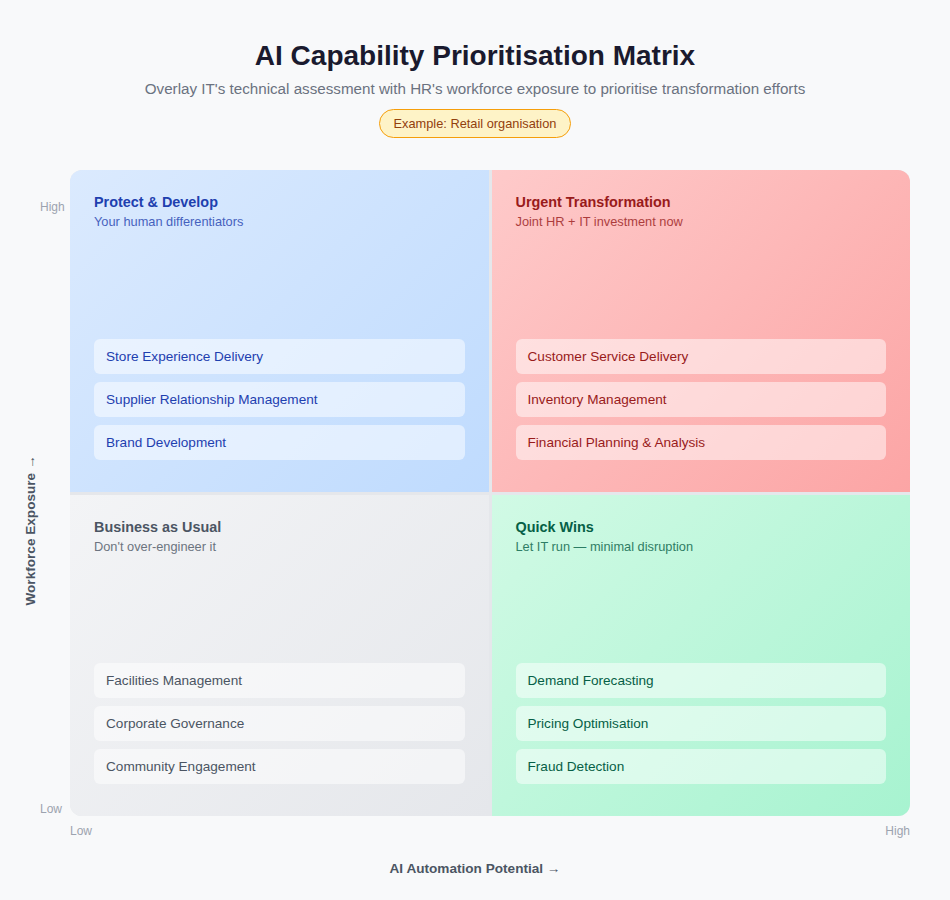
When both functions are looking at the same model, arguing about the same data, they develop shared language naturally. The capability becomes the unit of analysis that both sides understand - not "jobs" (too broad) or "tasks" (too granular for strategic conversation), but the organisational capabilities that actually drive value.
Not sure where your workforce exposure sits? Getting the workforce exposure data is often the harder part - and this part does require decomposing roles into tasks. Task-level AI impact assessments can accelerate this analysis, giving HR the granular data they need to bring to the capability conversation
3. Align on what success looks like (it’s not just adoption metrics)
IT tends to measure success in deployment terms, licenses activated, features enabled, uptime achieved.
HR tends to measure success in people terms, engagement scores. Retention rates. Training completion.
The business? They're measuring revenue, margin, and competitive advantage. They don't care how many licenses you've activated if it's not showing up in productivity.
They don't care about training completion rates if customers aren't seeing the difference.
Neither of these actually tells you whether AI is transforming work or more importantly, the business, in valuable ways
Good co-parenting means agreeing on shared outcomes. Not IT's outcomes and HR's outcomes and the business's outcomes running in parallel. Shared outcomes that connect the dots and make a meaningful positive impact.
What does AI-enabled productivity actually look like for this team - and how does it show up for customers? How do we know if people are genuinely working differently, or just using AI as a fancy autocomplete? What's the leading indicator that we're building capability, not just creating dependency? And how does any of this translate into results the business actually cares about?
This requires both sides to let go of their favourite metrics and invent new ones together. It’s uncomfortable but it’s also essential to unlocking the productivity promise of AI.
4. Accept that you’ll parent differently (and that’s OK)
Here’s where the marriage metaphor gets real: HR and IT don’t need to become the same function. Right now they don’t need to merge, or report to the same person, or suddenly agree on everything. (Though there are early cases of IT and HR merging: Novartis recently announced the union of its functions into a single reporting line).
What they need to respect is that they bring different things to the table. And that the child benefits from both.
IT will always be more comfortable with technical risk. HR will always be more attuned to human risk. IT will tend to push for speed and scale, HR will push for readiness and adoption. These tensions are features, not bugs. They’re what keep you from deploying too fast and breaking trust, or moving too slow and missing the moment.
The goal isn’t alignment in the sense of agreeing on everything. It’s alignment in the sense of knowing what the other parent is optimising for, respecting it, and finding ways to work with it rather than around it. Just like every partnership, there is strength in embracing the differences.
The Parenting Stages You’re About to Go Through
Like any new parents, HR and IT are going to go through phases as this AI baby grows up.
Here’s what to expect:
The “We Just Had a Baby and Everything Is Chaos” Phase
This is where most organisations are now. Pilots everywhere, no coherent strategy. IT is experimenting with tools while HR is fielding anxious questions from employees who read a scary article about job losses. Nobody’s sleeping well.
Survival tip: Focus on communication and retaining trust. Not perfect strategy - you don’t have one yet - but transparent communication about what you’re learning and how decisions will be made.
The “We Have Very Different Ideas About Screen Time” Phase
At some point, HR and IT will have their first real disagreement about AI. Maybe IT wants to move faster than HR thinks is responsible. Maybe HR wants to slow down in ways IT finds frustrating. This is normal. This is healthy.
Survival tip: Name the disagreement explicitly. "We want different things from this - let's work out how to get both". The worst thing you can do is pretend the tension doesn’t exist.
The “Actually, You’re Pretty Good at the Things I’m Bad At” Phase
If you’re lucky - and intentional - you’ll reach a point where HR and IT genuinely appreciate what the other brings. IT starts to see that HR’s concerns about readiness and trust actually make deployments more successful. HR starts to see that IT’s technical rigour protects against the workforce risks they care about.
Survival tip: Celebrate wins together. When something works, resist the temptation to claim credit for your function. Say “we” a lot and recognise the partnership you have built.
The “This Kid Is Smarter Than Both of Us” Phase
Eventually, AI will mature to the point where it’s doing things neither HR nor IT fully anticipated. New capabilities and risks. New questions about what work even means.
Survival tip: Stay curious together. The organisations that do this well will be the ones where HR and IT have built enough trust to say “I don’t know what this means, but let’s figure it out together.”
The Real Talk
Here’s what we want to say to every CHRO and CIO reading this:
To HR: You cannot sit this one out. AI is not just “a technology thing” that IT will handle while you focus on the people-side. The people side is the AI side. If you’re not in the room when technical decisions get made, you’re going to spend the next five years cleaning up messes that didn’t need to happen. Get curious about the technology. Ask IT to explain it to you like you’re smart (because you are) but not technical (which is fine). Your perspective is not optional - it’s essential.
To IT: You cannot do this alone and get meaningful results. You can deploy all the AI you want, but if people don’t adopt it - or adopt it in ways that actually transform work - you’ve just added expensive complexity to the organisation. HR knows things you don’t. They know which managers are ready to experiment and which ones will quietly sabotage anything new. They know which parts of the organisation have the psychological safety to fail and learn. They know how to help people through change that feels threatening. Let them in earlier than feels comfortable and fess up if you’re already piloting AI.
To both of you: Your CEO and boards are watching. And increasingly, what they’re watching for is whether the organisation can move on AI in a way that’s both fast and responsible, both technically sophisticated and deeply human. And that you deliver results. That requires partnership between you that perhaps doesn’t exist yet.
The Vows
If you’re serious about this AI co-parenting thing, here’s what you’re signing up for:
“I will not make major AI decisions without consulting you.”
Not informing you after the fact. Consulting you before decisions get made.
“I will learn enough about your world to ask intelligent questions.”
Not become an expert. But know enough to engage meaningfully.
“I will assume good intent when we disagree.”
You’re optimising for different things. That’s not a character flaw.
“I will share credit when things go well and share responsibility when they don’t.
This child belongs to both of us.
“I will keep showing up, even when it’s hard.”
Because the alternative - fighting for custody, making decisions in silos, weaponising the child to prove points - helps no one.
The future of work is being built right now. Not in the abstract but in the specific decisions your organisation is making about AI - what to deploy and why, how to deploy it, and how to help people navigate what comes next.
Those decisions are too important to leave to one function. They require a partnership that doesn’t come naturally, between two groups that speak different languages and have different instincts.
It’s awkward, it’s uncomfortable and it's absolutely essential.
The baby’s already here - welcome to the marriage.
Now to figure out how to successfully raise an incredibly bright and capable child together.
Need a mediator?
If you're looking for help with IT strategy and architecture, reach out to co-author Linda Chai at IQ Consulting. If you want to understand your workforce exposure before the conversation starts, try this free AI Impact Assessment.
And if you want the full framework for workforce planning in the age of AI, download our free Human-Centred Workforce Planning Guide - it covers how to assess your exposure, map transition pathways, make the business case, and communicate without creating panic.
About the Authors:
Linda Chai is Co-Founder of IQ Consulting, specialising in IT strategy, architecture, and integration. She helps organisations build capability models that translate business needs into technical roadmaps.
Helena Turpin is Co-Founder and CEO of GoFIGR, a workforce intelligence company that helps organisations understand how AI will impact their people through task-level analysis and skills mapping.

Helena Turpin spent 20 years in talent and HR innovation where she solved people-related problems using data and technology. She left corporate life to create GoFIGR where she helps mid-sized organizations to develop and retain their people by connecting employee skills and aspirations to internal opportunities like projects, mentorship and learning.