Is your board talking about AI adoption but missing the workforce impact?
Most boardrooms focus on AI technology and ROI, but overlook the critical question: what happens to your people? At the task level, AI will reshape how work gets done and boards need data-driven insights, not hype.
Here's what executives and CHROs need to know in 2026.
AI is no longer a conversation about the future.
It’s a present-day reality, reshaping how organisations operate and how work gets done.
Across industries, C-Suite Executive teams are being asked to:
- uncover automation opportunities
- validate AI investments
- boost productivity
- reduce costs
- accelerate innovation
Yet, despite this urgency, there’s a leadership blind spot: limited visibility into how AI will ACTUALLY reshape the workforce.
That blind spot is where the real risk is; not in AI itself.
The real risk isn’t AI disruption. It’s not knowing how.
In most organisations, AI activity is already underway.
- CIOs are presenting AI roadmaps.
- Transformation teams are piloting automation projects.
- Marketing functions are experimenting with generative tools.
YET few leadership teams have a structured, task-level view of:
- which roles are most exposed to automation
- which tasks can be efficiently handled by AI
- where skills gaps will emerge
- how investment can generate meaningful leverage
Without that AI-job task level of insight, decisions are made in confusion and silos.
In some cases, AI initiatives are quietly pushed “into the closet”,
out of concern for employee backlash or public perception.
What emerges is shadow experimentation on the quiet, AI guess-and-check trials and projects that are disconnected from true workforce AI readiness.
That isn’t a strategy. That’s unmanaged exposure.
AI workforce impact must be assessed before it’s managed correctly
In my experience, organisations that take an informed approach to AI workforce impact gain far more than just predictive insight.
For example, at GoFIGR, we ran a company-wide AI workforce assessment mapped directly to the organisation’s technology stack, future goals and automation roadmap.
We included three core factors:
- Position descriptions including role titles, job descriptions, job families and headcount.
- The organisation’s current technology stack, including existing AI tools.
- The AI roadmap, including planned investments and pilots underway.
That allowed us to model realistic, context-specific future scenarios and AI readiness tests rather than generic industry projections.
This unique approach provided:
- Data-backed visibility into AI’s impact on every role and task.
- Insight into where automation should be applied strategically.
- Clarity on where hiring decisions could be paced.
- Evidence to validate AI investment choices.
The result wasn’t panic. It was CREDIBILITY.
The team presented their findings to global executives, secured additional funding and strengthened their strategic position.
With this AI-job assessment, they were able to evolve from
AI assumption to AI evidence.
Here’s the honest conversation: cost pressure vs competitive advantage
Let’s be realistic.
Boards and CEOs are under pressure to find greater efficiencies. So, AI is often framed as a cost lever to do just that.
So, if a report suggests that a job function is 70% automatable, some will interpret that as headcount reduction.
However, that’s only a very shallow assumption.
What it actually can reveal is:
- Where automation can free up teams to focus on higher-value work.
- Where AI investment can drive real revenue growth.
- Where clusters of automatable tasks justify technology spend.
- Where natural attrition may be preferable to aggressive restructuring.
In one case, GoFIGR found that a business’ highly automatable tasks validated that a business’ AI investment was justified. However, in other areas, it actually challenged assumptions and redirected AI spend.
Basically, without task-level AI insight, boards are funding AI adoption based on optimism or pressure.
Yet with it, they are funding based on evidence.

Before you approve another AI investment, try this
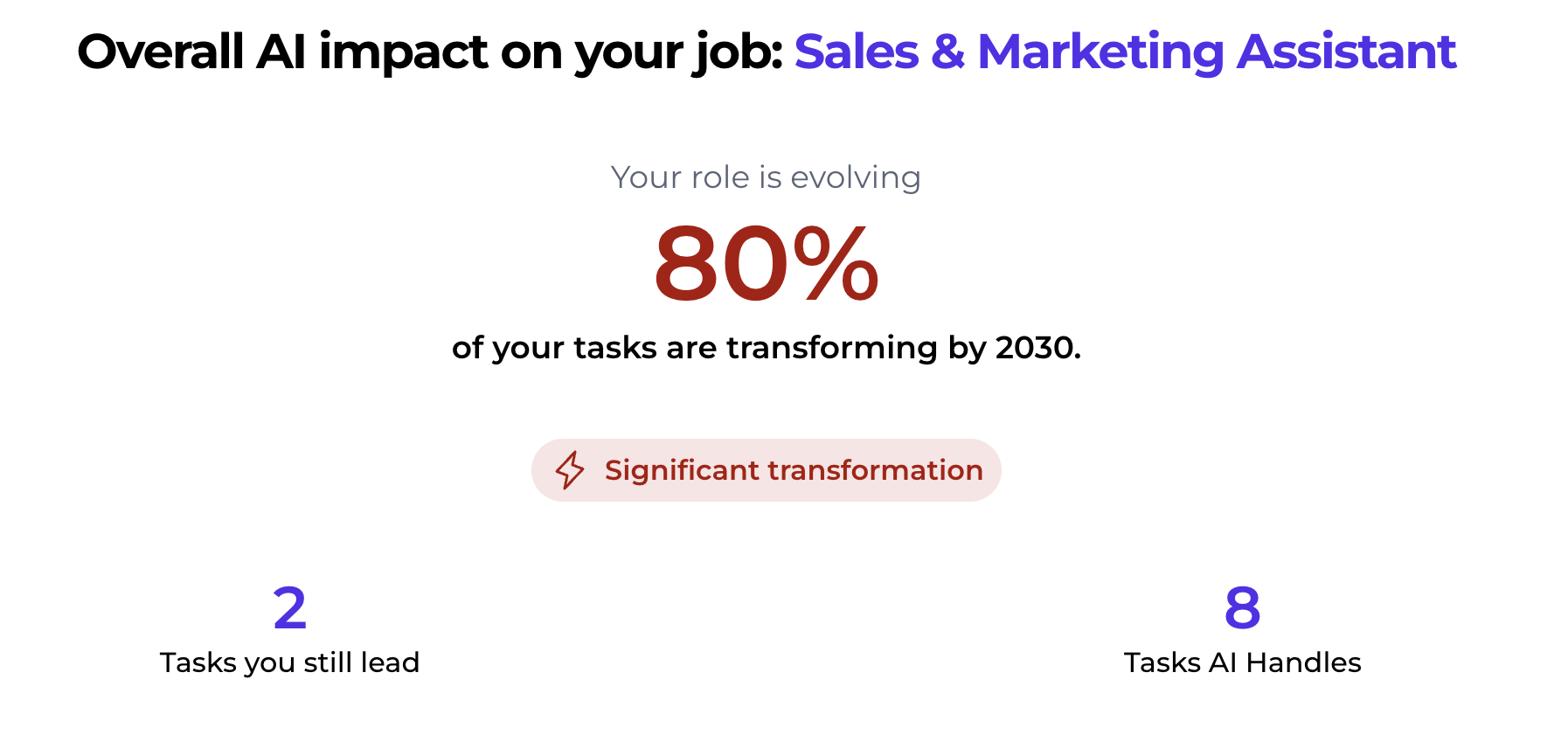
Before rolling out AI investment and initiatives across your organisation, start by AI-scanning your own job role with our latest tool.
Our AI Impact Assessment tool allows business leaders to see:
- how their own roles are evolving
- which specific tasks AI can increasingly handle
- which capabilities remain distinctly human
- which skills are worth strengthening
This isn’t about replacing anyone. It’s about understanding how AI reshapes leadership, decision-making, analysis and communication.
This tool can assess your technology stack, your automation roadmap and your transformation priorities to model how your specific AI investment decisions reshape roles and tasks over time.
It will show you what job tasks:
- you need to use AI for
- you need to develop
- you need to maintain
Suddenly, with this AI-job information, you’re prepared, informed and ready to adapt, rather than being confused, assuming or blind sighted.
If it changes how you view your own work going forward with AI, imagine what it might reveal across your entire workforce.
From personal AI career insight to enterprise AI strategy
When the workforce impact of AI
When scaled across an entire organisation, the AI Impact assessment generates granular, time-based projections for each role and every function in your business.
So, instead of asking, “How is AI changing jobs in general?”, you are asking: “How will AI change our jobs, given our investment choices?”
This distinction is crucial. It allows you to:
- Identify and prevent strategic blind spots.
- Validate or challenge AI spending decisions.
- Prioritise transformation initiatives.
- Prepare the workforce proactively, rather than reacting to disruption.
More importantly, it shifts AI from a technology discussion to a leadership and workforce strategy priority.
Here's a practical starting point for how to actually prepare your workforce for what AI is bringing.
When the workforce impact of AI is assessed early, leaders gain clarity, and clarity enables deliberate, confident change rather than reactive AI restructuring.
AI will reshape work. The question is: how will you respond?
AI will definitely reshape many tasks across every organisation, whether that impact is formally assessed or not.
The question for business owners and the C-Suite is simple: will that impact surface reactively through disruption and uncertainty, or proactively through visibility and planning?
AI will not reward the fastest investors.
It will reward the clearest thinkers.
This is where the GoFIGR AI Impact Assessment comes in.
It was built to provide structured visibility at the task level, not generic job predictions, but a breakdown of how work actually changes:
- Tasks that remain human-led.
- Tasks where AI assists.
- Tasks where AI leads.
- Tasks that diminish over time.
Using your position descriptions, technology stack and AI roadmap, we show realistic scenarios based on your context, not market averages.
It’s time to see what AI means for you, your team and your business
If you’re wondering how AI will actually change your organisation, the first move isn’t guesswork – it’s insight.
When you understand AI’s effect at the task level, the picture becomes clarity:
- where transformation concentrates,
- which skills are emerging or declining and
- how your investment choices shape workforce impact over time.
For Directors and C-Suite leaders: start the AI Impact Assessment yourself. See how AI reshapes your own role.
From there, the same methodology can scale across the whole business, informing investment, sequencing and workforce strategy before change accelerates.
At GoFIGR, we make AI’s impact practical and visible, so leaders can move from uncertainty to informed decisions. So, you see how roles and tasks are evolving and where to focus your investment.
Because the organisations that lead this transition won’t be the fastest investors. They’ll be the ones acting with the clearest understanding of how work is changing underneath them.
Start by taking the AI Impact Assessment, or contact GoFIGR to see how we help leaders navigate AI with confidence.

Helena Turpin spent 20 years in talent and HR innovation where she solved people-related problems using data and technology. She left corporate life to create GoFIGR where she helps mid-sized organizations to develop and retain their people by connecting employee skills and aspirations to internal opportunities like projects, mentorship and learning.