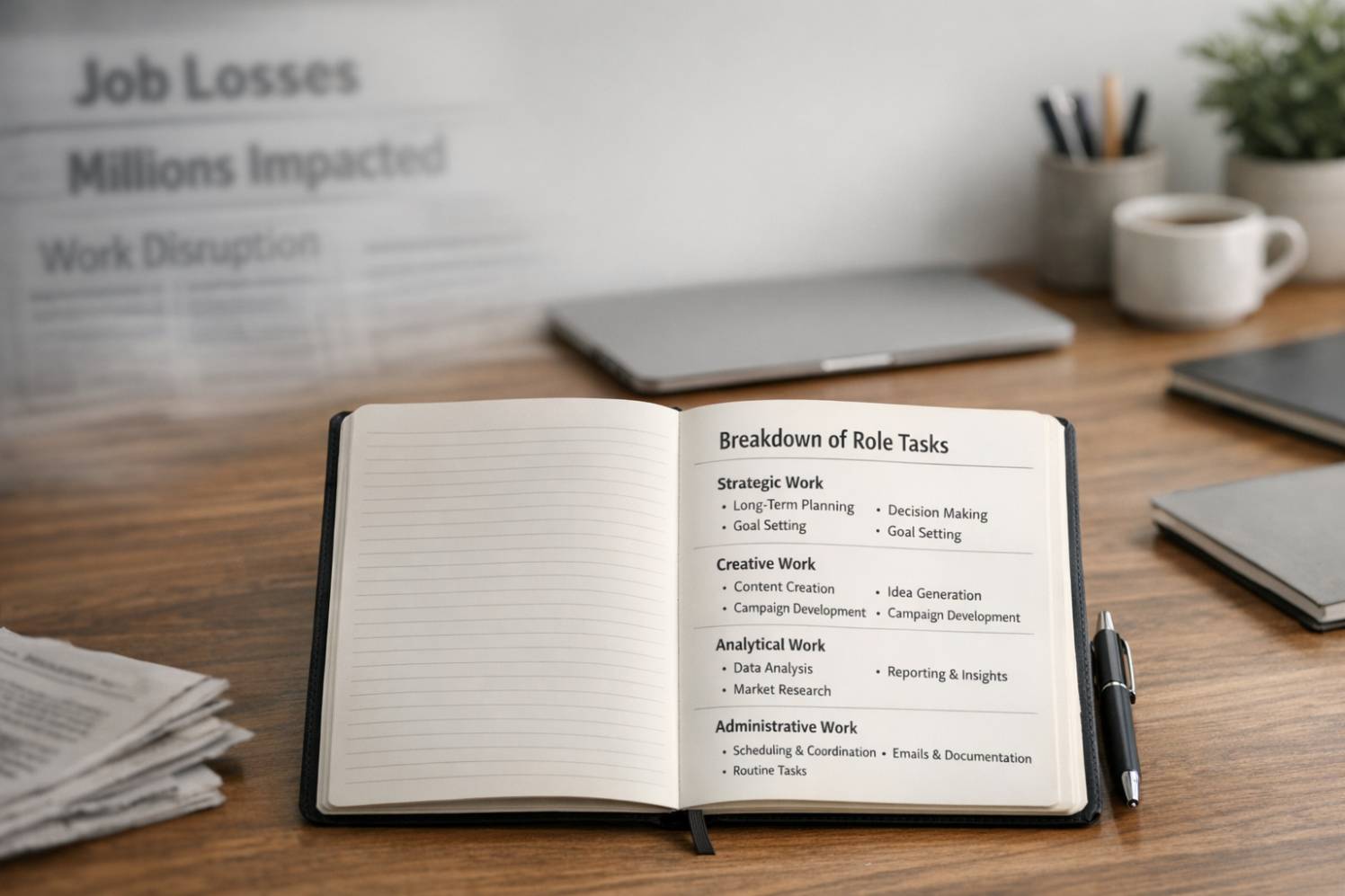
You've read the headlines.
"AI will replace 300 million jobs." "AI won't replace you - someone using AI will." "85 million jobs displaced." "170 million new jobs created."
Helpful, isn't it? Like being told "the weather will change" and being handed an umbrella and sunscreen.
Here's the thing nobody's saying: the answer isn't the same for everyone, even people with the same job title. It depends on what you actually do all week. And until now, there hasn't been a simple way to find out.
That's what we built. A free tool that looks at your actual role - not just the title, but the work - and shows you which parts AI will likely change and which won't. Try it here. It takes two minutes.
If you want to understand why this matters and what to do with your results, keep reading.
Why the headline predictions don't help you
You've probably already Googled this and found a scary percentage. "Accountants: 69% chance of automation." "Financial analysts: 77% risk."
Those numbers are based on job titles. They treat every accountant as if they do the same work. They don't.
An accountant who spends their week on data entry and reconciliation has a very different future from one who spends it on client advisory and strategic tax planning. One of those is highly automatable. The other isn't. Same job title, wildly different answer.
The same is true for almost every role. Two "Marketing Managers" - one's a brand strategist, the other's basically a data analyst. Two "Project Managers" - one's scheduling and status reporting, the other's stakeholder negotiation and team dynamics. A "Customer Service Rep" might be reading from a script or might be solving complex problems that require judgment and empathy.
A single scary number can't capture that. Which is why it leaves you feeling anxious but no better informed.
What actually helps is looking at the work itself. Not the title, not the department, not the industry - the things you actually spend your time doing. Because AI doesn't replace jobs wholesale. It changes specific parts of what you do while leaving other parts untouched - or making them more important. This approach, called task-level analysis is how HR leaders can get a structured view of AI exposure across their workforce.
What AI actually does to your work
AI doesn't walk in on a Monday and take your desk. What it does is shift the mix of what you spend your time on. Some of your work gets automated. Some gets faster. Some becomes more valuable precisely because the routine stuff has been handled.
Here's roughly how it shakes out:
Work AI will likely handle for you: Things like data entry, scheduling, first-draft writing, report generation, basic analysis, routine customer queries, and document review. If something is repetitive and mostly about processing information, AI is getting very good at it.
Work that gets faster with AI helping: Research, financial modelling, campaign analysis, project tracking, performance reviews. You're still in charge - but AI does the heavy lifting. The skill shifts from doing the work to knowing what to do with the results.
Work that becomes more important because it stays with you: Managing relationships, making judgment calls, creative problem-solving, coaching people, navigating ambiguity, communicating complex ideas, and making decisions where context and empathy matter. These are the parts of your job where being human is the whole point.
The interesting part isn't which category sounds like your work - it's the proportion. If most of your week is spent on things AI can handle, your role is about to change shape. If it's a small slice, you might not notice a big shift.
And that proportion is different for every person - even people sitting next to you with the same title.
That's how AI is changing tasks, not just titles, is what actually determines your exposure.
This is why we built the assessment
We wanted to give people a specific answer instead of a vague one.
The AI Impact Assessment looks at your role and breaks it down into the things you actually do - then shows you which of those things AI will likely automate, which it will help with, and which it won't touch.
It's free. No signup. No sales pitch on the other side.
It takes two minutes. You enter your role, you get your results.
It's specific to you. Not a generic percentage for your job title. A breakdown of your actual work.
Hundreds of people across 30+ countries have tried it. The most common reaction isn't panic - it's clarity:
"The surprise wasn't that my job is at risk. It's that the parts I spend the most time on are the ones most likely to shift."
"It gave me words for something I could feel but couldn't explain."
"I shared it with my team and the conversation afterwards was more useful than any strategy document."
→ See how AI will affect your work
What to do with your results
Once you see your breakdown, here's a simple way to think about it:
Double down on the parts of your work where you add something AI can't - judgment, relationships, creative direction, complex problem-solving. These are your strengths. Get even better at them.
Not sure what to do once you have your AI impact results? We've got a guide for that
Learn to work with AI on the parts where it can help. This isn't about being replaced - it's about getting faster. The people who learn to use AI as an assistant for research, analysis, and drafting will have a real advantage over those who don't.
Stop clinging to work that AI will handle better than you. This is the hard one. Some of us have built our identity around being fast at things AI will be faster at. The time you free up is time you can spend on work that matters more.
That's it. No twelve-step framework. No expensive course. Just: know which parts of your work are changing, and point yourself toward the parts that aren't.
Share it with someone
Here's the thing: this gets more useful when it's not just you.
If you find it helpful, send it to a colleague. Compare results over coffee. Talk about what surprised you. If you're a manager, run it with your team - it's the fastest way to have an honest conversation about AI that doesn't trigger panic.
The best conversations we've seen aren't "oh no, my job is at risk." They're "oh - that's the bit that's going to change. Now I know what to focus on."
→ Try it now - free, 2 minutes
If you're thinking "my company should do this, too"
You're probably right.
Individual insight is useful. But when hundreds of people across an organisation do this, patterns emerge - which functions are most affected, where the skills gaps are, where people can be redeployed instead of let go.
We've done this with organisations analysing thousands of roles - and delivered the full picture in days. If that sounds like something your company needs, we should talk.
For a do-it-yourself framework on building a workforce plan for AI - including templates and a 90-day action plan - read our Human-Centred Workforce Planning Guide.
FAQs
What do I actually get? A breakdown of your role based on the work involved - which parts AI is likely to handle, which parts it'll help you do faster, and which parts become more important because they need a human. You also get personalised recommendations on skills to develop, advice on what to focus on now to stay relevant, and a summary you can share.
Will AI actually replace my job? For most people, no - not the whole thing. What changes is the mix of what you spend your time on. Some parts get automated, some get faster with AI helping, and some become more important. The assessment shows you which is which for your specific role.
How is this different from those automation risk calculators? Most tools give you a single percentage based on your job title. That doesn't account for the fact that two people with the same title can do very different work. Our assessment looks at the actual work within your role and breaks it down - which parts change, which don't, and what to focus on.
Is the assessment really free? What's the catch? It's genuinely free — no email, no signup, no credit card. The catch, if you can call it one: we're a company that helps organisations do this at scale. When a hundred people from the same company try the free tool, sometimes that company calls us. That's the business model. The individual assessment is free because we think everyone deserves a specific answer, not just people whose employers can afford consultants.
Is my data private? Does it get sent to an AI? We use AI to power the assessment, but no personally identifiable information is sent to any language model. We ask for your email if you want the full report - and yes, we'll invite you to our newsletter. You can opt out and you'll never hear from us again. But you'll miss out when we add new updates if you do 😇
What if my results look scary? Most people are surprised by what they learn, but not in a bad way. Knowing specifically which parts of your work are shifting is far less scary than a vague headline about millions of jobs disappearing. And it gives you something to actually do about it.
Should I share this with my manager? If you have a good relationship with your manager - yes. Walking into a conversation with "here's how I think my role is evolving and here's what I'd like to focus on" is a powerful move. It shows initiative and self-awareness, not vulnerability.
What skills should I develop? That depends entirely on your results. Generic advice like "learn AI" or "develop soft skills" isn't helpful because it's not connected to your actual work. Your assessment will show you which parts of your role are growing in importance - those are the skills to invest in.

Helena Turpin spent 20 years in talent and HR innovation where she solved people-related problems using data and technology. She left corporate life to create GoFIGR where she helps mid-sized organizations to develop and retain their people by connecting employee skills and aspirations to internal opportunities like projects, mentorship and learning.

