Helena Turpin • 00:00
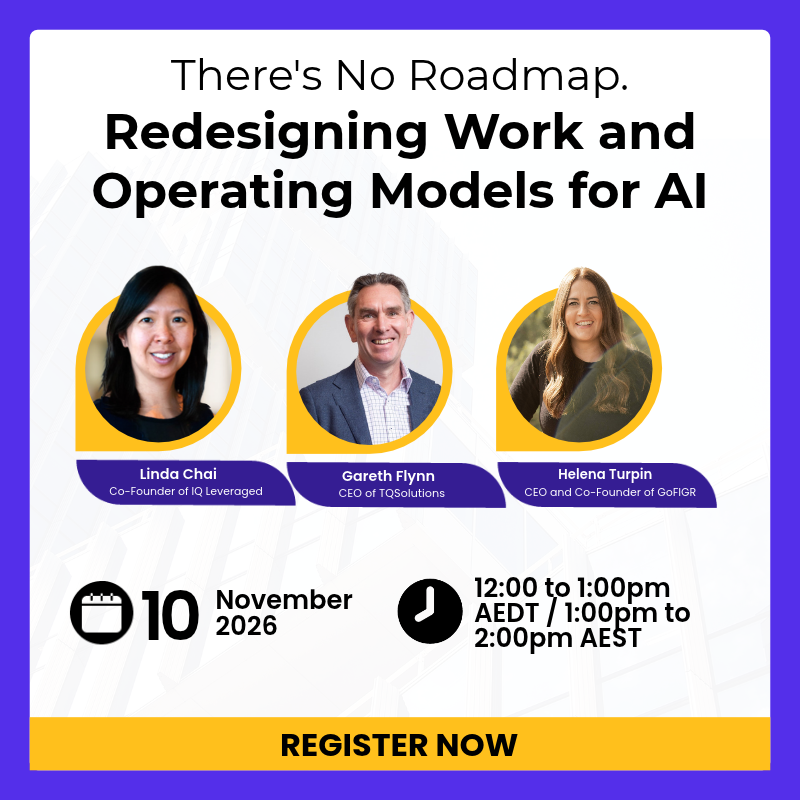
Welcome to our session on AI operating models and redesign. And we decided just to have some fun with this and rename it, i.e., how do you redesign work when everyone's just flat out doing it? So I guess I'll start with a bit of a confession. Of the three speakers here, none of us actually has the answer to this question. Sadly, there aren't really companies out there sort of three to five years ahead of us all that we can copy. We've looked. There isn't a roadmap, but what there is are a lot of leaders being asked to redesign work while they're flat out doing it.
Helena Turpin • 00:33
So effectively rebuilding the plane whilst we're mid-flight with a new engine, it feels like arriving every six weeks. And I expect that most of you turned up to this webinar today because you already know AI is changing work. You're probably less impressed by writing faster emails now. But far fewer of us can actually say how it's changing roles inside organisations. And that gap and brainstorming that is what the next hour is about. So for those of you who don't know me, I am real life. I'm not an AI avatar.
Helena Turpin • 01:06
My name is Helena Turpin. I am the co-founder of a platform called GoFIGR. And I'm joined here today by Gareth Flynn from TQ Solutions and Linda Chai from IQ Leverage. We'll do a formal introduction in a 2nd . But between us, we've got the evidence, the experience we've architected, we've got the bruises. And I guess as we go through your workout, who's who? About 120 people registered for this session, which I guess is testament to the fact that this is something we're all grappling with at the moment.
Helena Turpin • 01:35
And you sent us some pretty sharp and pointy questions. So we've built our panel session around the questions that you wanted the answers to. We're going to try our best to leave you with three pieces of plain advice and one way to start tackling this problem come Monday, rather than more sort of frameworks that you can admire and grow dust on the shelf. And maybe before we go any further, and Jenny, my good colleague, is going to monitor the chat for us, maybe if you could just drop one word into the chat how AI is landing in your organization right now. I am posh. Speedily, yep, quickly, rapidly, yeah, that resonates. Pockets of brilliance, Janice, I should follow up with you there.
Helena Turpin • 02:23
Costly, yeah. Yeah, everywhere. Inconsistently, yeah, I'm going to talk a bit about that myself in a 2nd . Patchy, yeah. These are these are all words that, interestingly, okay, Gordon, we'll have to follow up with you there. Okay, so this doesn't really sort of shock me at all. And we're going to focus our session on this.
Helena Turpin • 02:45
So, just quick housekeeping, as I've already mentioned, we're recording. Feel free to turn your video off if you'd rather not be recorded, but we will issue you the recording and the transcript. And I think many other people signed up to receive that later. Feel free to pop your questions in the chat if you haven't submitted them already. And we'll make sure that we leave plenty of time towards the sort of half to three quarters of the way throughout the session to tackle them. All right, so here's what the hour is going to look like. I'll do formal introductions in a 2nd .
Helena Turpin • 03:13
I've left space for three provocations from the panel. I'd like to talk to you very briefly about how you examine work and the AI impact. And then we'll go to the panel takeaways. Like I said, plenty of room for QA's. So I'll introduce myself in a 2nd , but Gareth, let's start with you, if that's okay. Over to you.
Gareth Flynn • 03:33
Sure. Hi, everyone. And thanks, Helena and GoFIGR for hosting today. Super excited to be here. For those that don't know me, I'm CEO of TQ Solutions. We're a work and workforce advisory business. Day to day, I lead our consulting practice and for the last 18 months have led our work redesign projects.
Gareth Flynn • 03:53
So we've probably taken about a dozen clients through work redesign at a functional level using work analysis, which I'll unpack with you a little bit today. So we've seen the challenges and some lived experience of redesigning work and redesigning the functions that that work sits in. Happy to share some of that today. And as Helena's picked up from one of my slides in my keynote, yes, I do have a full AI operating system that runs my day. And my AI chief of staff, who keeps me honest, is someone called Clara. And yes, we're rapidly adopting AI as a business ourselves and heavily using the Claude Code platform for our AI operating model, which is super exciting. So that's me.
Helena Turpin • 04:41
Linda.
Linda Chai • 04:43
Hi everybody. So I've basically spent my entire career working with organisations to help them make better decisions about technology and transformation. So I guess I'm the resident geek for today's session as a result of that.
Helena Turpin • 04:58
Well Gareth and I'll fight you for that title.
Linda Chai • 05:02
We'll go fist to cups to see who wins. But as a sucker for punishment, I've always worked at the leading edge of technology and went 2 ft into AI in the early days as well as a result. I now am the co-founder and CEO of IQ Leverage. We essentially implement AI solutions for people and we advise organisations on where to start with AI and how to get the technology into that organisation as well. So what I'll be talking to everybody about today is essentially what we're starting to see in market in terms of the classes of AI solutions and how that lands with not just people, but operating models and the like as well. Because we are starting to see some clusters of different approaches that are being that are being taken by different organisations in market. And they all have really different impacts on how you ingest them well into an organisation as well.
Helena Turpin • 06:00
And by way of an introduction, I've already mentioned I'm Helena. I'm one of the co-founders and CEO of GoFIGR. I have a background in HR tech, people analytics and human-centered design. And I'm wearing, I guess, two hats today. I'll be sort of emceeing this conversation, talking about our AI impact assessment capability and admitting what this shift feels like from inside a team that is, I guess, drinking our own champagne or eating our own dog food, whichever way you want to describe it. And we are literally shifting the way that we work. So we're feeling this sort of shift ourselves.
Helena Turpin • 06:33
So, like I mentioned, about 120 people registered for this session and will be watching about the recording. I'm actually blown away by how many people have shown up for the live session, which is really exciting. And about 15 people submitted questions in advance, including one question that was just Linda Rawls, not technically a question, but we'll take it. And a theme that came up a lot today is around ownership. Someone who might be here today, our deputy managing director, asked how CPOs can lead the AI transformation alongside the CTO. Linda, we wrote a fun piece on this a while ago, didn't we? Yes, who owns this?
Helena Turpin • 07:09
And I want you to hold that thought because all three of us have a view on this and we'll come back to it. But Gareth, you're kicking us off. Just tell me when you want me to move the slides over. But I'll hand to you 1st of all, if that's okay.
Gareth Flynn • 07:21
Yeah, no problem. Love the idea of the provocation. So we're going to share with you a few thought starters just to get you thinking. And please, if there's anything we share, whether it's Linda, myself or Helena, please contribute in the chat. My 1st provocation is something that I'm deeply researching in at the moment. I'm actually writing a book on this topic at the moment. And the 1st provocation is that we're actually managing this change poorly, and we're managing this transformation in the wrong places.
Gareth Flynn • 07:51
We're seeing companies investing heavily in systems, structures, processes, and trying to tweak the technology, the workflows, and the tooling that they have. And they're under investing in leaders and the criticality of the leaders in the organizations through this transformation. And I think importantly, we're seeing very few companies actually considering the individual at a very human level who is going to need to change largely their identity at work. Particularly in white-collar roles where you may have been an expert for 20 years, that expertise is going to become less and less valuable as AI gets more powerful. And I feel that we're going to embark on a future identity crisis in white-collar work. And we need to bring those individuals on quite a deeply human change journey at the self-level. They're going to need to fundamentally change the work that they're doing.
Gareth Flynn • 08:50
And the value they bring to their organizations is going to shift. That is going to be enormously uncomfortable for people. And we need leaders to be able to help and guide them through that journey. And we also need to bear in mind that leaders are also going to go through that identity shift. So for me, my 1st provocation is we're over-indexing on technology systems, processes, and structures. And we're massively under-indexing on the very human change that this is going to make and need. And we need to do way more of that.
Gareth Flynn • 09:26
Thanks, Helena. Next one, please. Sort of linked to this. We have a workforce that's terrified. And every piece of research you look at, one of my colleagues is on this call, RJ is currently trying to find some new research for me on this at the moment. But every piece of research you look at, we're seeing workers digging their heels in. We're seeing, in some cases, workers actively sabotaging or seeking to sabotage a company's AI strategy.
Gareth Flynn • 09:58
And that can take many, many different forms. It's actually a higher number amongst Gen Z. So 31% of workers in a writer workplace intelligence study last year said that they have actively worked against the company's AI strategy. With Gen Z's, that number was 41%. So younger workers are really digging their heels in. But what that study also found is if you can get those younger workers on side, they'll become your champions. Another great piece of research that came out last year from Fractional Insights and Harvard Business Review, basically Maslow's basic needs for security and stability are not being met.
Gareth Flynn • 10:44
So we're seeing the very foundational needs of humanity not being met in the workplace. Numbers you'll see on there, the expectation from the workers is that that number should be nearer 100%. And at the moment, 47% are saying those needs are met. So our workforce is in a very precarious state psychologically. And so when we think about AI transformation, my personal view, we have to take our employees on that journey with them rather than doing it to them. And we really need to understand the psychosocial risks of some of this change as we embark on this transformation. Thanks, Helena.
Gareth Flynn • 11:27
The other ones, I just, again, talking about individuals here, cognitive atrophy is a big risk. I'm actually currently reading a book by Eric So, who's writing on this topic, and is talking to the fact we've got to be way more intentional with the work we give to AI. And actually, we need to, when we're thinking about work redesign, we actually need to design in some friction to keep our cognitive capabilities sharp. So, we've got to be very intentional with the work we give to AI and the work we retain ourselves. And there are a number of studies starting to come out where we're seeing the effects of cognitive atrophy. CBA is doing some interesting work with MIT at the moment on this, and they're really staying close to it. The other one I can talk to firsthand, number two, cognitive burnout.
Gareth Flynn • 12:20
With an AI operating system in Claude Code, which is what we use, I can be running five, six, seven different sessions with teams of agents doing lots of high cognitive work, and it is exhausting. And whilst we can use AI to remove all our engine room work, all our menial tasks, I don't think it's feasible for workers to be working at high cognitive load 8 h a day, five days a week. I think we'll face an increasing amount of burnout in the workforce. And again, this is critical for when we're designing future work. We have to start designing in breaks. We've got to start designing in some decompression time. I've started taking what I call my clawed walks, where I load up a whole load of sessions.
Gareth Flynn • 13:09
My agents are doing loads of stuff for me, and I go and take a dog for a walk. 15 minutes, decompression, fresh air, come back. The work's been done by the agents. But I think we've got to start factoring that in. And then the only other one that I'll just mention here as well: this is going to be a pretty lumpy transition. We're going to see pockets of the workforce affected 1st . We are seeing effects at the obviously lower end in the early careers market at the moment.
Gareth Flynn • 13:37
But equally, you know, there's in Finn Review with the Qantas announcement today. It's looking very likely all of our corporates are moving roles over to Southeast Asia and India, where they will be AI-fied by their outsourcing partners like Accenture. And we are going to see different workforce strategies depending on the type of workers you have. But it's going to be pretty lumpy and I think pretty challenging for the next five years. I think, oh no, one more. Sorry.
Helena Turpin • 14:07
More.
Gareth Flynn • 14:08
This is kind of a summary slide. You know, TQ talks to the fact we've got to architect this transformation. We can't just let it happen. When we think through our work analysis and work design, we've got to really be super intentional on where we use AI and we've got to be very focused on the human aspects of this transformation. And I think from the 1st two years of early movers, it was all about the tech and it was not about the people. The 2nd movers, what we're trying to suggest, it's all about the people. The tech is just the tech.
Gareth Flynn • 14:44
And I think we've got to understand how people feel. We've got to invest in the change management, particularly, and that's a behavioural and mindset perspective. I'm not talking about ad car change and pro-side change. I'm actually talking about human change. And we've got to get our work redesigned right and our data in order. The Stanford study showed that to be successful with this, it was all about the non-tech aspects. And to Helena's point, who's responsible?
Gareth Flynn • 15:16
I just shared with Helenia, another one of my CPO clients, has now been given the role of transformation lead on top of her portfolio. We're seeing that happen a lot at the moment, and I think it's really well needed because we've got to have that human lens on this transformation.
Helena Turpin • 15:31
I'm seeing a lot of AI enablement roles pop up in HR teams at the moment. That's one job I'm really keeping a close eye on. Thanks, Gareth. Now, we're going to be moving to questions in a 2nd . So we'll bring you back into the panel in just a 2nd . Linda. So, Gareth, talk about what happens to people.
Helena Turpin • 15:49
I'd like to hand over to you now to talk about what we are actually pointing the AI at.
Linda Chai • 15:55
Yes, so AI gets used to describe a lot of things and it's like a huge grab bag of things at the moment. But what we're starting to see is actually three classes of AI solutions that are coming to bear. So the 1st is the one that I think most people will be familiar with in their organizations. It's where a majority of the AI deployments today live. And they're in that co-pilot or automation. bucket. So this is a class of AI that essentially is going to speed up an existing task.
Linda Chai • 16:24
It will write an email for you, it create a spreadsheet for you. It will make the hamster wheel turn faster effectively. But in this world, the human still carries the workflow. The human still carries the workload as well. And we talk about human in the loop and this is where a lot of those concepts come from. I suppose one of the big problems with this class of AI solution is that you do get productivity savings. You're getting, depending on who you read, somewhere between a 10 to 20% uplift in productivity.
Linda Chai • 16:54
But there are a couple of problems that come with that uplift in productivity. Oftentimes, the human still carries the work. And so the bottleneck just moves from one place to another place itself is what we're finding. Most people don't design what they do with that 10 to 20%. And so while there is a saving that you can quantify, even that ROI is often expended not intentionally, but on the next thing that is screaming at you instead. And so we're spending this money to get this productivity upload, but we're not actually channeling it into an intentional ROI that is valuable to us. And the last thing is this class of AI solution tends to be LLM 1st in nature.
Linda Chai • 17:43
So it is the co-pilots that are helping you or the core codes that are helping you. And they tend to be very token intensive in nature as well. And we're seeing an increasing number of CFOs who are counting the costs of this token spend itself. So at the other end of the scale, we get what we like to call ontological AI solutions. So this is kind of the other side where you're using all the data in an organization. You're harnessing all of that to create a model of the organization that acts as context for an AI solution. Typically, it needs to be clean data for it to be good context as well.
Linda Chai • 18:25
And then what people are creating are essentially bespoke AI solutions that reason or act within that context. And as a result, this class of AI solution can actually optimize your whole organization, make it run faster because it knows the work that is happening in the organization. But with a payback time of typically somewhere between three to five years or investments of in the magnitude of $10 to $100 million, not always within the reach of the average organization that we see here in Australia in particular. So there's an emerging class in the middle, which I think actually holds the key to ROI. And this is where we're starting to orchestrate AI workflows or we start to create more AI native workflows within an organization. So we have AI acting as a digital co-worker for somebody. They work alongside the human co-workers.
Linda Chai • 19:23
They use the enterprise systems that exist within an organization. They work within the teams and the functions that exist at the moment. But in creating this style of AI solution, you do get the potential to get ROI out of it, but you've got to actually ask the question: what is good human work versus what is good agentic work? So that's probably the biggest challenge with this class of AI this class of AI solution, but it's also where you have the biggest chance of actually harvesting ROI. To make that a bit more concrete, can we go to the next slide, Helena? I thought I'd share an example that we're actually working with a customer on at the moment. It is a recruitment example because I thought that would be appropriate for this cohort.
Linda Chai • 20:17
But essentially, in this instance, we're creating a recruitment agent. Now, for many of you, I'm sure that you've seen AI being used for things like conducting screening interviews or even doing interviews itself. As we were looking at this recruitment process and how we could apply agents to the recruitment process, we came to a view that agents could and should run the process, but the humans could and should continue to own the decisions and actually do the process. And what we mean by that is we've focused the agent on essentially keeping the time from application offer as short as possible. So it does the legwork in a recruitment process. But we've kept the work of deciding who joins, deciding what sort of culture we want to build in the organization as a conscious human workload. Because we decided that this work was too important and it was only a human who could do things like have a hunch about a person.
Linda Chai • 21:24
And this is work that is exploiting what is uniquely human or valuing what is uniquely human about us. Whereas everybody was more than happy to let an agent figure out when to schedule a meeting or when to re how to reschedule a panel interview that included three very busy people, a room booking and an interviewee who actually had a lot of things going on in their lives as well. When we actually did this work, it was interesting that we found the recruitment team that we were working with, and we actually used the recruitment team to do this work. It wasn't just the leaders, we used the people on the ground who were doing this work to help us figure out what was the right answer here. They actually estimate that they're going to say 50% FTE. So it's not the 10, 20%, but it's actually 50% FTE. But more importantly, it wasn't just the time saving.
Linda Chai • 22:22
They decided that by focusing the agent on the goal of getting that timeframe from application to offer as short as possible, they got a whole bunch of intangible benefits out of it as well. So they got things like they have the best chance of getting to the best candidates now because they can produce a credible offer faster than the next person. They have a really good chance of getting the best people into their own team because they can get there faster than the next person. They can actually build the type of organization that they want to create in the future because they have somebody who's looking after the administrative work that nobody actually really wanted to do. But there is a catch with this. And the catch is as human work became more judgment focused, we really don't have the answer for how much humans can sustain in that. And it's something that I think is really important for us to continue monitoring as we deploy this into production as well.
Linda Chai • 23:31
But the ability to sustain this level of work is something that I know from personal experience is actually really hard to do. I've come to a position in my own work, and we run agents as part of our work as well, that actually recovery is part of my job now. It's not something that I do outside of hours. The recovery cycle is actually a really important part of how we design work for ourselves in this brave new world that we're going into. And yes, that 50%, they're repointing, they're deliberately repointing to higher value work, not just what screams next, but they're going, actually, what is the work that we should have been doing that we aren't doing at the moment and actively choosing to repoint that energy in that direction. So they have a much better chance of actually harvesting that 50% in a really valuable way as well. So next slide, Helena.
Linda Chai • 24:28
Thank you. My advice. Each of the classes of AI solution that we are seeing in market has a very different impact on your people, on your operating rhythm, on the way that you need to put together work and organisations going forward. And it's important to understand what's the goal that you're driving for in order to pick the class of AI solution that you're going to be buying into. And then you actually need to match your deployment process to that class. A co-pilot doesn't fundamentally change work. It's a much different rollout to one where you are actually going to be changing the nature of work that somebody does.
Linda Chai • 25:12
And when you're changing the work that somebody does, you're actually confronting some very personal things that you need to work through with them as well. And lastly, I think being really deliberate about what work humans do keep and then what work you channel the additional saving towards should actually be a really intentional thing, not a choice that gets left to whatever screams loudest at you. There's actually, I kind of describe this as there's an arms race that's happening in market at the moment that I'm certainly seeing with a lot of customers where people are working to deploy AI faster than the next person because they believe that the race is, I want to get there 1st . I want to plant my flag in AI 1st . I actually think the people who are chasing that goal are actually chasing the wrong race. The race that I think will sustain people is the one where if we can build an organizational capability to continue ingesting the newness that comes with AI without killing our workforces and our people, those guys are the ones who are going to win this race. And you don't have to be a 1st mover to do that.
Linda Chai • 26:26
You just have to be really conscious about how you deploy AI in your organization. The other thing that I will add to this as bonus is not all AI solutions will be there forever and a day. We have had situations where we've actually built quick disposable automations because everybody has a BAU job to do. And sometimes you need to create space for somebody to think more intentionally about what the nature of work will look like in the future. And so we can create automations that just pick up at least a piece of somebody's work that gives them space today in order to give them space to actually design that bigger change for the future as well. Great.
Helena Turpin • 27:11
Thanks, Linda. Well, it's sort of sounding like AI is making all of our work judgment all of the time now, which is kind of a polite way of describing my work now or my job. So Gareth and Linda have given you evidence here and described the architecture. I'm going to talk to you now about the bit that's harder, I guess, to put in a business case, and it's what it feels like when it's happening to you. And I mentioned in the opening here that we're in this slightly odd position at GoFIGR where our job is to analyze how AI changes other people's work. But at the same time, we develop software. And you probably know enough about the world of software development to understand that the way that we work ourselves is being changed by AI at a really breakneck and rude speed.
Helena Turpin • 28:02
So I guess I want to talk about some of the things that I've noticed in my team. And I sort of talk about this as the AI change curve. And we're all somewhere on this line. So for me, the 1st feeling I experienced was delight. It was like, hang on, it can do that. And I am constantly amazed at the new things that AI is capable of doing. I will admit that AI had a hand in the slide design here.
Helena Turpin • 28:28
Stage two for me is acceleration. It's a bit addictive, right? You start thinking, well, what else can I give it? And this is where it starts to get really addictive, but it leads naturally to stage three, which is overload, where you kind of believe that you can do everything now by yourself, which leads to inevitable stage four, which is the identity wobble that Gareth mentioned before. So when AI is taking the thing that you spent years getting good at and it does it in about 40 seconds, there's a voice in your head going, well, what the heck am I here for? And then stage five, if you finally get there, is agency, which is what do I actually want my job to become? And that's the one that you actually get a say in.
Helena Turpin • 29:12
But the awkward bit that we've observed for anyone leading this change is that you've probably got people at all different stages in your organisation at the same time. And your job, often in people's team, people teams are in leadership, as I know many of you are on this call, which is we're having to help someone who's at every different stage of this curve. And you've got people who are leaps and bounds ahead. My co-founder's on the call. I probably put him there. But one change plan won't fit all of these different kinds of people. So maybe I'll just quickly ask you as I transition to the next slide on how would you rate yourself from one to five?
Helena Turpin • 29:48
Where do you feel that you're at personally? Between one to five. Three, okay, two, yeah. Okay, Gareth, yeah. Gareth, you're probably quite rare. Five. Janice, a five as well.
Helena Turpin • 30:14
And this sort of echoes what's been said before. This is a kind of recent week of mine. I built some NAN automations. I'm really enjoying getting into automation with NAN. I did some customer success. I ran some marketing automations with Jenny on the call. I helped redesign our website, which is ongoing as websites always are.
Helena Turpin • 30:34
And my side job is running a company. AI has made me feel quite superhuman, but it's also left me feeling, as we've said before, completely exhausted because AI has now kind of removed the limit on what I can do, or at least what I believe I can do dangerously. But it hasn't done really anything to the limit of how many things I could think about properly all at once. And so the bottleneck of speed in terms, especially in terms of software design, hasn't necessarily disappeared. It's just moved to someone like me. And it's not just me, Nick. I hope it's okay to share this story, but I went to the UK a few weeks ago, towards the beginning of the year, and Nick needed some data, some marketing data from me, but I was in the UK.
Helena Turpin • 31:18
I was out of reach. So Nick built a marketing agent. And now marketing is technically my job. And we've never sat down and deliberately redesigned this, but AI has kind of made things possible. And we as a team have caught up afterwards. And it's fine at an organization of my side, my size, we can adjust quickly. But maybe in the size of organization you have, if people start automating other people's jobs, you're going to end up in carnage.
Helena Turpin • 31:44
So when we talk about freeing up capacity, the question isn't just how much we're freeing up, but it is, of course, where it goes. So my advice is to start with your North Star. So if there's no roadmap, where do you start? My advice is to start with your North Star. The instinct, I guess, is to grab the org chart. This is the thing that we understand the most. Maybe think about what boxes we need or who should report into whom.
Helena Turpin • 32:11
But I'd leave that alone for a minute because the org chart is probably one of the last questions to think about now, not the 1st . So what do you in this team need to make possible? Not what should it look like, but what should you be there to make possible for this business? Then look at the work. What work actually needs to happen to get there? Then who or maybe now what does each piece of the work? It could be a human, it could be an agent, it could be an AI-enabled human system, or in fact, something that we're increasingly thinking about in our organization is nobody should be doing this thing because we're doing something that should actually never exist in the 1st place.
Helena Turpin • 32:55
Then, the question that a lot of people skip, although I'm starting to notice this a bit more and more now, which is what should our people actually be brilliant at? And what should actually get more human at work because AI exists? And then only then do you think about drawing boxes around that? But sadly, you don't just get to do this once because six months later, the technology is going to keep moving and you're going to keep having to go around steps two to five again. And it sounds exhausting, but it could be liberating. You don't necessarily need to have, I guess, the perfect answer here. But as Linda says, you need a way to keep getting to the best answer faster than your competitor.
Helena Turpin • 33:36
So, step two is where a lot of organizations get stuck because it is difficult to see work. And if you can't see work, it's difficult to see how you should automate. So, I'm going to dive into that very quickly. So thinking about all jobs being the same, I guess, is the wrong unit of measurement now. A job title is a bundle of different tasks. And AI doesn't necessarily replace whole jobs, or at least not yet, but it does pick off tasks one by one. So when we break every role down into its component tasks, and then what we do in our technology is sort each one into five different buckets.
Helena Turpin • 34:14
There are the tasks that stay with you, and typically what we see are they are judgment-heavy, they are centered around relationships, maybe ethics, and certainly creativity. There are tasks where you lead and an AI assists, think co-pilot type work. And then we go all the way through to tasks where AI leads a new guide. This is the sort of human-in-the-loop concept that we're hearing more and more about. And I'm starting to see jobs advertised for that increasingly as well. There are tasks that are fully automated, and even those that are no longer needed, those are tasks that get completely eradicated as they become obsolete. So, many of you probably came to our previous webinar where we ran this AI impact analysis across 1800 different HR tasks, which was representative of about 100 different HR roles.
Helena Turpin • 35:02
And we found that 84, just over 84% of HR tasks will be AI impacted, even in the most conservative AI adoption future scenario. And to be clear, impacted doesn't mean that the work gets done. Most of it shifts between those middle buckets of being AI assisted and AI enabled. And this is a function of whose job work is changing, not necessarily the job titles changing. And that function might be yours. AI is being asked to lead this transition, but also go through it. And Gareth, you've been working on this sort of task type analysis for quite a while now.
Helena Turpin • 35:35
Is there anything that you're seeing that's a bit different or how people are thinking about it?
Gareth Flynn • 35:42
Yeah, look, I think, well, firstly, I don't think many companies are thinking about it is a problem at the moment, Helena. And I think I completely agree with your recommendations of analyze the work 1st . I think there's two ways to view work analysis and task intelligence. There's to use what we call top-down methodology, where you're using open source data sets to analyze the work and understand AI's impact. That's really handy, really helpful to give you a lens on what could be the impact. And I know your AI impact analysis uses that kind of methodology, Helena. And then we are seeing as well a bottom-up approach where we're starting to get the perspective of the workers.
Gareth Flynn • 36:26
So, you know, what do they see as opportunities for AI? What's the type of work they want to get rid of? That's a great place to start as well. And I know you're building out some capability to assess that too. So I think if you can get. That kind of top-down, bottom-up analysis of the work, it leads to better decisions because you're actually thinking about the humans when making those decisions and bringing their data point into view. So we're starting to see that happen an awful lot now, Helena, as well, which is good.
Helena Turpin • 36:57
Jenny, I'll ask if you could put the, if you'd like to see how AI is going to impact your own work, and this QR code is probably a little bit too small for you to scan because I think my pin face is probably too small. Jenny's going to pop a link to a free app here if you want to have a look. At how AI will impact your own role. Now, Gareth, I'll hand to you very quickly and then we'll go straight to questions if that's all right. If you could rush up with this one, if that's okay.
Gareth Flynn • 37:20
Yeah, no problem. I wanted to share, we talk a lot about work analysis and we talk a lot about capacity unlock. And I wanted to bring to life an example from a client of ours. So, what you're looking at here is a summary slide of a quite large project we ran with a people function that was over 100 FTE. So it was a sizable people function. And we went through, as Helena described, a new North star for this function and we analyzed the work and we built for them a roadmap of transformation. And you'll see here, once we'd done that task analysis, we started to think through: okay, what are our humans going to be doing or what is AI going to be doing?
Gareth Flynn • 38:03
And it's basically going to unlock for this organization within 18 months 25,000 hours of capacity. Now, this organization is not going to reduce headcount. That was never the plan. It was going to move that effectively 14 heads to different types of work for the organization. You'll see at the bottom the things that are in our roadmap. So they're looking at a people hub and shared service center. They're going to go really hard on things like ServiceNow.
Gareth Flynn • 38:34
They're looking at systems and process staff. They're bringing in AI in Agentic. Mindset, behavior, and adoption is going to be really key for this team. And they need to upskill the people function as well. So the unlockers are essentially the work plan. And what they're going to do with this new capacity is all the stuff you see at the top. So helping the rest of the organization transform.
Gareth Flynn • 38:59
Intelligence and insights for business decision making. They are going to become the architect of work experience and the workforce experience. They're going to help develop the leader capability of the future. And they're going to go very, very big on org design. So, this is a classic case of PNC putting its oxygen mask on before helping others. And it goes very much in line with what we're recommending: PNC needs to be one of the 1st functions to transform.
Gareth Flynn • 39:28
But this just gives you an example of what is possible in terms of do the work analysis, identify the agentic opportunities, and/or other could be process streamlining or getting rid of the work, and you will get this enormous capacity unlock. And it's then a question of what you do with that unlock.
Helena Turpin • 39:48
Well, let's move straight to that because that was a question that was submitted, and I can see a few questions that are similar to that in the chat, which is HR often has low visibility into work, teams lack the capacity to take on new work. Where are you seeing companies start? Gareth, I guess to a degree you've already answered that question. Linda, is there anything else you'd like to add to that one?
Linda Chai • 40:10
Some of the other places that we're seeing people start is in tech, because obviously the techs do it to themselves. But the other place that we are starting to see some of this agentic workloads come through is in customer service, actually, because a lot of times the customer services teams just can't cope with the volumes that they're getting and they only work certain hours, whereas some of these functions actually need to run 24-7. And so while agents aren't used all the time, they can be used in the off hours to essentially meet the load when people aren't necessarily working.
Helena Turpin • 40:50
Gareth, is there anything else you'd like to add to this one?
Gareth Flynn • 40:52
Yeah, look, I think our advice to customers, well, outside of P and C, which I think needs to be one of the 1st calves off the rank, we are suggesting to clients, you know, what is your organisational strategy and priorities? Based on that, where makes sense to start? I agree with Linda. Technology is often a key corporate function that is started early, but you may find that it's more customer-facing parts of the business where they can drive more value quickly and more revenue value quickly. So I think I'd always urge people to anchor back to the org strategy and priorities. But I would underline the importance of getting P and C transformed as soon as possible.
Helena Turpin • 41:39
All right, I'm going to skip to this one. I guess this is two in one. How do you actually redesign a role? And what does an agentic HR operating model look like in practice? Who would like to take that one?
Linda Chai • 41:54
I'll do the redesigning role. We often start with the work itself. And one of the biggest questions that we will ask is: just because I can do the work, should it do the work? And I think being conscious about that is actually really important because You know, we can get AI to do a whole bunch of things, but it does it more mechanically than what a human would do. And there is a danger that you lose some of these softer components of actually doing the work if you don't genuinely look at whether AI should be applied to a given workload or not. And a lot of times we do see people will put up a workflow process diagram with the swim lanes and just go, okay, what if we get rid of this?
Linda Chai • 42:44
It doesn't quite work like that. It's often tasks and bits of tasks that we end up working through. And it's only after we look at the work and go, actually, what should the work look like in the future that we can then start to actually go through and look at, well, what does that mean to the jobs people hold, the titles that we have in the organisation, and what people are responsible for. But then we could be a lot more sensible.
Helena Turpin • 43:10
We're all going to be mini managers, I think, soon, aren't we? I sort of having an AI assistant or an AI that we supervise smells suspiciously like, you know, management to me. But, Gareth, you have a view on this as well. I remember we've talked in the past about taking away things that people enjoy and the value of engaging people in this process of redesigning roles. Would you like to share a bit more on that one?
Gareth Flynn • 43:33
Yeah, sure. Firstly, just want to echo Linda. I scribble down here on don't redesign roles, think redesign work. So totally echo your view there. Yeah, look, I think, again, going back to my key theme today around human-centricity, we have to understand work at a task level, all well and good, but we also need to understand the perception of the humans involved in executing that work. So we did have one customer, won't mention who it was. We were analyzing their people and culture function, and they were considering outsourcing a particular activity.
Gareth Flynn • 44:10
And because we took a human-centric approach to analyzing the work and tasks, we uncovered that that activity was the activity that they enjoyed doing most. And if we had removed that or we had agreed that that needed to be outsourced, we would have disengaged the workforce. So the data point around what the teams enjoy doing, what energy, what gives them joy at work, is a really important data point when you're thinking about what work to outsource to AI or to outsource or to keep with the team. And again, a lot of companies are not doing that and they're not engaging with their workforce on this analysis and redesign. Obviously, if you know, if you analyze tasks and you deem what tasks are critical and you understand whether your teams enjoy doing that work or not, that bottom left-hand quadrant, which is critical work the team don't like doing, is your prime candidate for AI. So yeah, having that human-centric bottom-up approach to this work analysis can make for very, very good decision making. And a lot of companies are not being that intentional at the moment.
Helena Turpin • 45:23
I'd echo that. I think we've worked with customers, quite a few, who've been rolling out some kind of AI initiative and who have assumed the worst. They've assumed that people will be scared, won't adopt it, won't like it. But there's generally consensus. When you engage the workforce, there's generally consensus into the sort of low value, low energy tasks that they would happily get rid of. And I always watch sort of leaders' eyes light up when they realize that there's unanimity, but it does involve involving people and not doing it to them. All right, I'm going to skip to one of the last questions and then just make sure that we've covered the questions that have come through in the chat.
Helena Turpin • 46:03
We've had some questions submitted earlier about how do you measure ROI against the decision to adopt AI for a process. I have an opinion on this, but Linda, would you like to offer some opinions here?
Linda Chai • 46:18
ROI is a really difficult one because most people just go, I'm going to save X amount of hours, then I multiply X amount of hours by Y dollars, and you get a value at the end, and that becomes the business case. I do think that we need to look beyond just that simple financial metric. I mean, if we look at some of the best Agentic builds that we've done, the target has not just been a labour arbitrage of substituting digital work for human labour. The value often comes with actually doing something better and delivering a better outcome, solution, better something for everybody involved. There's a lot of intangibles for that. And I do think that actually looking at that is what actually makes you define the automation that you're going to do in a far more sensitive way, one that actually looks at the human actors and the participants in the process as well.
Helena Turpin • 47:25
I was invited to speak at the Institute of Internal Auditors a few weeks ago, and I tried to put something together on this. I'm looking at my screen here to remind myself of what I wrote. So, because I think if you ask a board or a CEO what they want to do, what's the purpose of AI, what's the return, they're going to say yes to all of these. But I think you're right, Linda. I think the conversation that hits the headlines is about reducing costs. That's the stuff we keep seeing on the news: there's all these job losses and stuff where people are trying to save money. There are probably teams that are looking to grow, to continue growing without increasing costs at the same rate that they've had to in the past.
Helena Turpin • 48:04
There are teams looking to improve quality and maybe manage risk. There are people wanting to transform or change how the business operates, creating new products, services, or revenue, or remaining competitive. And I see less people talking about this, about what it is that AI, who's going to be the AI native that comes in and sort of eats your lunch. I see far less companies talking about threats to business model than being able to save 10 or 15 minutes with a co-pilot.
Linda Chai • 48:33
But we're certainly saying that standing still is a risk. There is an opportunity cost that comes with simply standing still.
Helena Turpin • 48:39
I agree.
Gareth Flynn • 48:40
Helena, can I just touch on one point? Sorry, can I just touch on one point on the ROI?
Helena Turpin • 48:44
Yeah.
Gareth Flynn • 48:45
I think, so we've got one customer who is so again, we use the expression engine room work and value room work. And they have baselined their current state. So they know the work that's being done today by humans. They also have a kind of customer satisfaction score from the business operations, and they have employee engagement numbers. So hard metrics that they have. They're going to transform and they want to divert more of their effort towards value room work, which is going to be the work activities that we think will drive more value to the end customer or the business. And their ROI metric is going to be anchored on the CSAT scores that the business gives them as a central service, but also the engagement of their workforce.
Gareth Flynn • 49:34
So are they moving the needle on employee engagement? And are they improving the customer value or perceived value of the function? I think they're really good metrics when you go through this transformation. And yeah, that's how one of our clients is approaching it at the moment.
Helena Turpin • 49:50
I've just, I've seen earlier Claire Hatton join us, who's the host of a podcast called Don't Stop Us Now AI Edition. And I was listening to her latest episode that just came out on this. There's a wonderful podcast with a lady called Ola who talks very much about business value. So Don't Stop Us Now AI Edition. Claire, if you're here and still on the call, drop your link in and everyone can listen to that podcast. We'll just do our quick takeaways and then we'll make sure that everyone, all the questions have been answered. So five things maybe to take away to your team as you leave us.
Helena Turpin • 50:20
Feel free to screenshot this. We will make sure that we distribute this content to you. So start with your North Star. I think we're all aligned on that, everyone, right? Gareth and Linda? Start with your North Star. What are you here to do?
Helena Turpin • 50:32
What's your business here to do? Your team, what's your role here to do? Get some visibility on your work before you try to redesign it. There are heaps of tools out there, GoFIGR being amongst them, to help you with task level analysis. Buy space with quick wins, those disposable automations that Linda, we talked about. Design rest and breaks into the work. Let's not burn out our entire workforce.
Helena Turpin • 50:56
Let's not have to create a new HR team to counsel us all as we all become completely AI brain fried. And change with people, not to them. Now, I'm going to let everyone unmute in just a 2nd and ask their questions, but there's some QR codes on the screen here that people can use to connect us. Linda, Gareth, is there anything? How can people reach you if they want to?
Gareth Flynn • 51:21
LinkedIn is probably a great start for me.
Helena Turpin • 51:25
All right, feel free to unmute if we haven't covered your question.
Gareth Flynn • 51:31
Susie's got an interesting question. I'd be happy to take, Helena.
Helena Turpin • 51:35
You go for it.
Gareth Flynn • 51:37
Yeah, Susie, it's a really good question. We know that the core HCMs are really starting to dial up their AI. You've got your plugins who are all dialing up theirs, and then you've got all your kind of AI tooling, single point tools. I think what if I project five years out, I think to answer your question, companies, especially like the one you're in at the moment, Susie, I think will have built and designed their own mega agent, which will be your single front door into your HR tech stack. And you will own that orchestration layer. And that orchestration layer is going to interact with a blend of core HCM agents and point solution agents. But ultimately, you'll control that interface layer with your workforce.
Gareth Flynn • 52:26
And I think they're going to be custom. We've got one client in particular at the moment who wants to be quite ambitious on that whole Agentic layer. And I think we'll go deeper into owning more of that Agentic stack. And therefore, the SaaS products or SAPs or workdays or whatever it may be literally become data repositories that no one goes into. And therefore, we don't need their AI. We're going to build our own. I actually think five years out, that's where we'll be heading.
Gareth Flynn • 52:55
And then for others, it will be probably using their core HCM products if they haven't got the technical now to build their own. But we are starting to see companies really think hard and fast about the buy versus build on the Agentic layer on top of the HR tech stack.
Linda Chai • 53:13
So, my $0.02 in that is architecturally, I do think there will be an agentic layer in the tech stack that actually doesn't exist at the moment. And that agentic layer essentially represents a way that we get access to the systems that we have within the organization itself. I don't think that agentic layer will be part of, I suppose, the existing tech solutions that are out there, even though all of the SaaS vendors are putting agentic technologies into their solutions. I think the fundamental mismatch there is you don't always work in one application for your work. You work across applications. Your workflows actually span more than one thing. And that's where I think an agentic layer will actually need to come to the fore because that agentic layer will reflect
Linda Chai • 54:09
The nature of the work that you do yourself in your organisation, in your specific context. So, I do have a hypothesis of what that actually looks like architecturally. More than happy to have that conversation with you, but it is a much longer conversation that we can have.
Helena Turpin • 54:28
We'd like to thank you again for giving up your time today to come along and join this interesting discussion. Hopefully, you've got all our contact details on the screen here. We will be sending out the recording for anyone who'd like it. You can message me if you want a copy of the slides, and we're thrilled to have had you here. Thank you so much, Linda and Gareth, for a wonderful session.
Linda Chai • 54:45
Thanks, everybody. Thank you all.