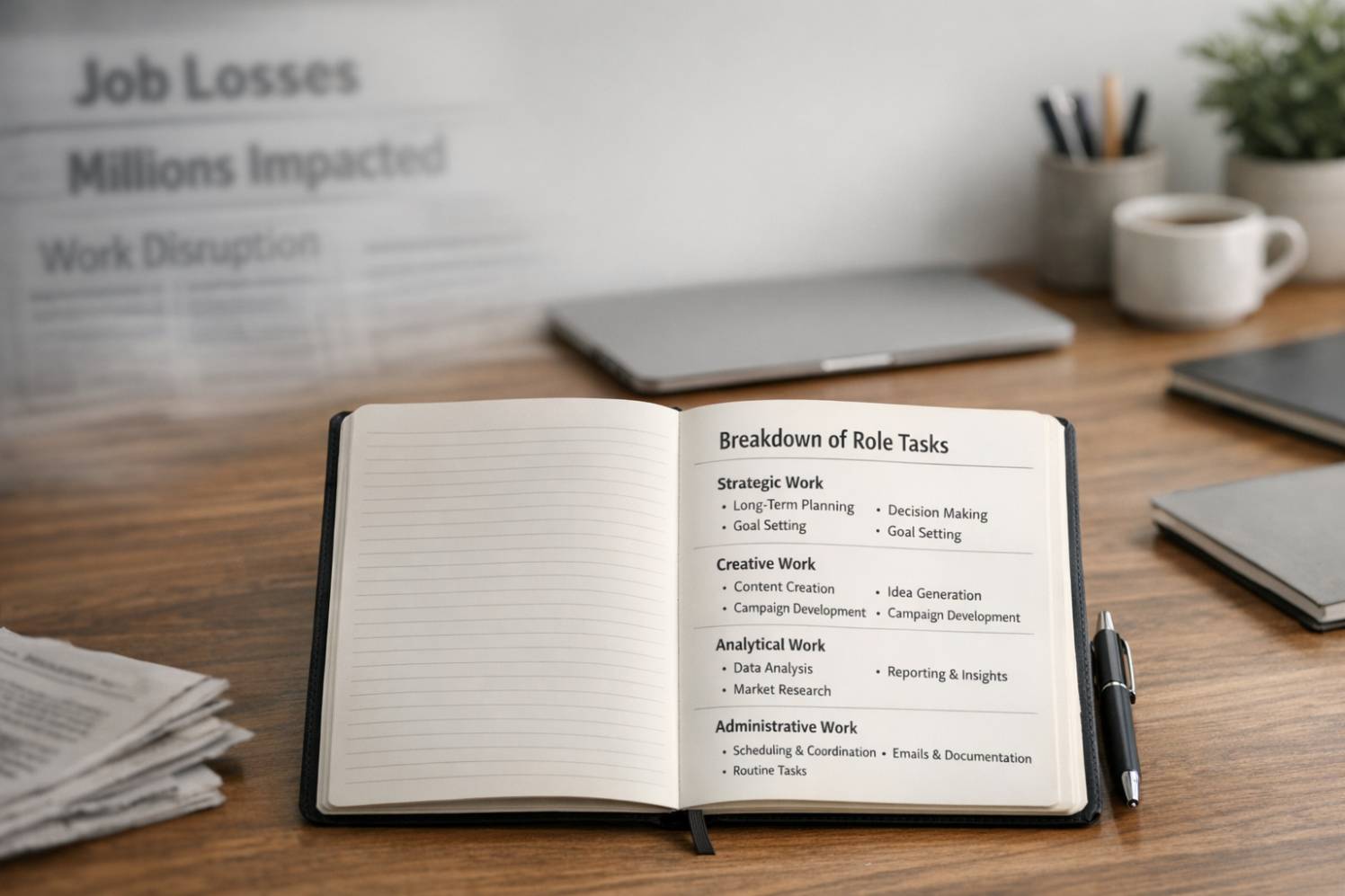
Will AI replace software engineers? It's one of the most-searched questions in tech right now and for good reason. At the World Economic Forum in January 2026, Dario Amodei, CEO of Anthropic (the company behind Claude), said software engineers might have just 6-12 months before AI can do "most, maybe all" of what they do. But here's what the viral clips didn't show...
What's actually happening right now
Let's separate what's real from what's hype.
AI is already writing a lot of production code. GitHub Copilot, Claude Code, Cursor, and a growing list of AI coding assistants are being used daily by millions of developers. These aren't toys - they're generating real code that ships to real users. Google, Amazon, and Microsoft all use AI to write portions of their codebases. Amodei says Anthropic's own product Cowork "was written in like a week and a half, almost entirely with [Claude] Code."
Non-developers are building real things. The term "vibe coding" has entered the vocabulary - describing people who give instructions in plain language and let AI turn them into working applications. The Netlify signups bear this out. People who couldn't write a line of code six months ago are deploying functional web applications.
Junior and entry-level roles are feeling it first. This is the pattern across every profession AI touches, and software engineering is no different. The routine coding tasks that used to be assigned to junior developers - templated features, boilerplate code, bug fixes in well-understood systems - are exactly the kind of work AI does well. Several companies have already slowed graduate hiring in engineering, not because they're cutting staff but because AI has compressed the work that justified those roles.
Senior engineers are becoming more productive, not less employed. The developers who understand systems architecture, can define what needs to be built, and know how to evaluate whether AI-generated code actually works - they're having a very different experience. For them, AI is a multiplier. They ship faster, take on more complex projects, and spend less time on the parts of the job they didn't enjoy anyway.
But here's what the headlines miss
Amodei said something else at Davos that didn't make the viral clips:
"There's a lot of uncertainty, and it's easy to see how this could take a few years."
He also listed constraints - chip manufacturing, model training time, the physical infrastructure of computing - as things that can't be automated away. And crucially: his own engineers are not unemployed. They've shifted from writing code to directing and validating AI-generated code. That's a genuine transformation, but it's not elimination.
Here's the thing nobody building or funding AI tools is going to tell you: there's a massive difference between AI generating code and AI shipping software.
Shipping software means understanding the business problem. Talking to users. Making tradeoffs between speed, cost, and quality. Dealing with legacy systems that don't behave the way documentation says they should. Navigating team dynamics. Knowing when the "right" technical answer is the wrong business decision. Debugging something at 2am that only breaks under conditions nobody anticipated.
AI can write a function. It can't yet understand why that function exists in the context of a business that's pivoting its strategy while migrating off a system that was built in 2014 by a team that no longer works there.
As one analysis put it: "Even Amodei's own engineers - at the company building Claude, one of the most capable AI coding assistants - are not unemployed. They have changed what they do."
This is the core insight: AI is changing tasks, not whole jobs. At least not yet.
The question that actually matters
You already know the answer isn't "all developers are fine" or "all developers are doomed." So skip the generalisations and think about your actual week.
How much of it is implementation you could describe to an AI in a paragraph and get back working code? And how much is the stuff that's hard to even explain to another developer - the tradeoffs, the context, the "we tried that in 2022 and here's why it broke"?
Be honest. Most developers do both. You might spend Monday morning in a design review making judgment calls about tradeoffs nobody's documented, and Monday afternoon grinding through a feature that's basically wiring up an API endpoint to a spec someone already wrote. The first part is getting more valuable. The second part is getting automated.
The developers most at risk aren't bad developers. They're developers whose roles have gradually narrowed to the kind of work AI handles well - well-scoped tickets, clear specs, predictable patterns. That can happen at any level. A senior developer who's spent five years maintaining a stable system and mostly shipping incremental changes might be more exposed than a mid-level developer who's constantly navigating ambiguity on a fast-moving product.
What matters isn't your title or your years of experience. It's the proportion of your work that requires judgment AI can't yet replicate - understanding messy requirements, making architectural calls with incomplete information, knowing when the "correct" approach is wrong for this specific situation, and all the human context that doesn't exist in any codebase.
The more of your week that looks like that, the more AI works for you. The less of your week that looks like that, the more AI competes with you.
Take two minutes to find out how AI will actually affect your role specifically.
Everyone saying "coding is dead" has something to sell
This matters. Let's name it.
Dario Amodei is CEO of Anthropic, which makes Claude - one of the most commercially successful AI coding tools. If software engineers keep their current workflows, his market is limited. If they adopt AI-assisted development, his revenue grows. He's not lying, but he has a financial interest in this narrative being true.
The Netlify CEO runs a platform that benefits enormously from non-developers building and deploying applications. More "vibe coders" means more Netlify customers. His signups data is real, but his enthusiasm is shaped by what those signups mean for his business.
The a16z partners and other vocal VCs are investors who fund AI companies. Their portfolio increases in value when AI adoption accelerates. They're hosting the podcasts, choosing the guests, and framing the narrative.
None of this means they're wrong. The trend is real. But when someone tells you your profession is about to be disrupted, check whether they're selling the disruption.
The most honest voices in this debate are the developers themselves - in forums, on Reddit, in Hacker News threads - who say something much more measured: AI is incredibly useful for routine tasks, still unreliable for complex ones, and the real risk isn't replacement but a gradual compression of the workforce where fewer people are needed to ship the same amount of software.
What to actually do about this
If you're a senior engineer or architect: You're probably fine - and probably already using AI to move faster. Your value is judgment, systems thinking, and knowing where the bodies are buried in your codebase. AI makes you more productive. Lean into that.
If you're a mid-level developer: This is your window to move up. The gap between "writes code" and "makes technical decisions" is the gap between vulnerable and valuable. Start owning more of the problem definition, not just the implementation. Mentor others. Understand the business context, not just the technical spec.
If you're a junior developer or student: This is the hardest position. The entry-level tasks you'd normally learn on are exactly the ones AI does well. That doesn't mean there's no path - it means the path is different. Focus on understanding why things work, not just how to make them work. Learn to evaluate AI output critically. Build things end-to-end so you understand the full picture, not just your assigned ticket.
If you're a non-technical founder or business leader: Be cautious about the "anyone can code now" narrative. Yes, AI makes it possible to build an MVP without an engineering team. But building something that scales, stays secure, handles edge cases, and can be maintained by someone other than the person who prompted it into existence - that still requires engineering judgment. The entry cost has dropped. The quality bar hasn't.
The part nobody's talking about: AI is also creating new paths
It's easy to read all of the above and feel like the walls are closing in. But there's another side to this that the doom-scrolling misses.
The Netlify CEO made a point on the a16z podcast that stuck with me: when development becomes a skill instead of a profession, it doesn't just threaten existing developers - it opens the door for people who were never developers in the first place.
Think about what that means in practice. A product manager who can now build a working prototype instead of writing a spec and waiting three sprints. A designer who can ship an interactive concept, not just a Figma file. A domain expert in healthcare or logistics or finance who can build the tool they've always wished existed - without needing to hire a team or learn to code in the traditional sense.
The Netlify numbers - from 17 million developers to 3 billion potential users - aren't just a threat to professional engineers. They're a sign that software creation is becoming accessible to people who understand problems deeply but couldn't previously build solutions.
For experienced developers, this is actually good news. Someone still needs to architect the systems these new builders are deploying on. Someone needs to build the platforms, the APIs, the infrastructure. Someone needs to look at AI-generated code and know it'll fall over at scale. The demand for that kind of thinking doesn't shrink when more people can build - it grows.
The career paths that are emerging aren't "coder" and "not coder." They're more like: people who build with AI (the new 3 billion), people who build the things AI builds on (platform and infrastructure engineers), and people who make sure what gets built actually works (the quality, security, and architecture layer). If you're a software engineer today, you have a head start on all three.
Find out where you actually stand
The headlines give you a feeling. We can give you a specific answer.
Our free AI Impact Assessment looks at your actual role - the work you do, not your job title - and shows you which parts AI will likely handle, which parts it'll help you do faster, and which parts become more valuable because they need a human.
You also get personalised recommendations on skills to develop and what to focus on now.
Two minutes. No signup. No catch - we explain the business model here.
If you're an HR or people leader, here's how to prepare your organisation for AI at the workforce level.
→ See how AI will affect your engineering work
Share it
If you're a developer, send this to a colleague and compare results. If you're a CTO or engineering manager, run it with your team - it's the fastest way to have an honest conversation about what's changing without triggering a panic.
If you're thinking "we should do this across the whole engineering org," we should talk.
FAQs
Will AI completely replace software engineers? Not all of them, no. But "software engineer" covers a huge range of actual work - from routine CRUD development to complex systems architecture. The routine end is being automated fast. The judgment end is becoming more valuable. Where you sit on that spectrum determines your future more than any headline.
Didn't the CEO of Anthropic say engineers have 6 months? He said AI could do "most, maybe all" of what software engineers do end-to-end within 6–12 months. He also said "there's a lot of uncertainty" and listed several constraints. And his own engineers haven't been fired - they've shifted from writing code to directing AI that writes code. The headline is scarier than the full quote. But the full quote is still worth taking seriously, especially given who said it and where.
What about "vibe coding" - can anyone really build software now? Anyone can build a prototype. Shipping, maintaining, and scaling production software is a different thing entirely. The gap between "it works on my laptop" and "it works reliably for 100,000 users" hasn't been automated away. But the gap between "I have an idea" and "I have a working prototype" has collapsed - and that changes who enters the market.
I'm a junior developer. Should I still learn to code? Yes - but not for the same reasons as five years ago. The value of knowing how to code is shifting from "I can write the code" to "I understand what the code does, whether it's correct, and what the tradeoffs are." Think of it like learning to write well even though AI can generate text. The skill becomes about judgment, not production.
What skills should software engineers focus on? Systems thinking. Architecture. Problem definition. Business understanding. Communication. Security awareness. The ability to evaluate whether AI-generated code is actually good - not just whether it compiles. These aren't new skills; they've always mattered. They just used to sit alongside "and also write the code." Now they're the main event.
Is this different from previous waves of automation in tech? Yes. Previous tools (IDEs, frameworks, Stack Overflow, cloud platforms) made developers faster at writing code. AI changes who can write code at all. That's a qualitative shift. When the Netlify CEO says his audience went from 17 million developers to 3 billion spreadsheet users, that's not a productivity tool - that's a market expansion that redefines who competes with you.
Sources cited:
- Dario Amodei at Davos, January 2026 - via Entrepreneur, Fortune, The Economist
- Sridhar Vembu response on X - February 2026
- Netlify CEO on a16z podcast - "Anyone Can Code Now", 30 January 2026
- 365i analysis of Amodei's claims - January 2026
- Fortune Davos coverage - January 2026

Helena Turpin spent 20 years in talent and HR innovation where she solved people-related problems using data and technology. She left corporate life to create GoFIGR where she helps mid-sized organizations to develop and retain their people by connecting employee skills and aspirations to internal opportunities like projects, mentorship and learning.
.jpg)