If you've Googled "will AI replace accountants," you've probably found a scary percentage and a reassuring article that says "no, but your role will change."
Neither of those is particularly useful. The percentage doesn't tell you which parts of YOUR work are affected. And "your role will change" doesn't tell you what to actually do about it.
So let's get specific.
What's already being automated (right now, not "in the future")
This isn't theoretical. These tools exist today and firms are using them:
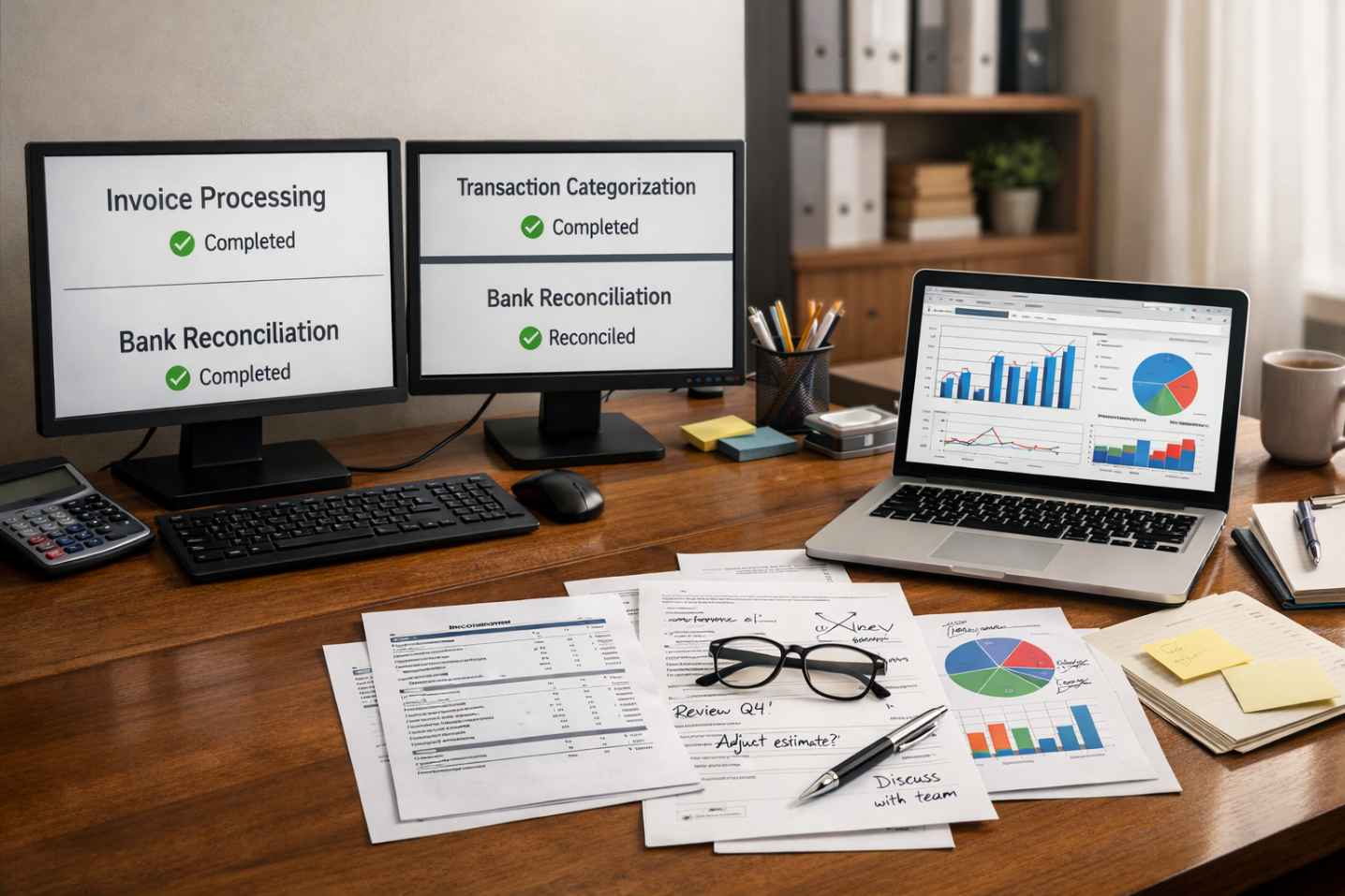
Invoice processing and accounts payable. Vic.ai claims a 355% improvement in invoice processing productivity. It reads invoices, codes transactions, routes approvals, and learns your vendor patterns over time. BILL uses optical character recognition to extract data from supplier invoices and push it straight into your accounting system. These aren't pilots - they're production tools handling real money. You can find out how AI will affect your specific role in under two minutes.
Bookkeeping and transaction categorisation. Botkeeper combines AI automation with human review to handle categorisation, reconciliation, and reporting. Docyt connects to bank feeds, QuickBooks, and over 30 POS systems - its AI agent "GARY" automates everything from document extraction to financial variance analysis. Startups like Kick, Pilot, and Puzzle are automating the entire bookkeeping pipeline.
Tax preparation. Robo1040 automates manual tax prep workload. TaxGPT and Thomson Reuters are building AI tools that help with tax research, compliance, and return preparation. The Big Four have their own: Deloitte's DARTbot helps auditors research complex topics, PwC's Risk Link uses AI to analyse regulations.
Month-end close. FloQast lets accountants build auditable workflows to automate accruals, journal entries, and reconciliations. Numeric pulls transaction-level data every minute for real-time reconciliation and AI-written variance explanations.
Spreadsheet analysis. Even the spreadsheet - the accountant's natural habitat - is being transformed. Anthropic's Claude in Excel (currently in beta) lets you use AI as a spreadsheet agent, analysing data, writing formulas, and building models inside the tool you already live in. Microsoft's Copilot does similar things across the 365 suite.
Fraud detection. MindBridge uses machine learning to analyse 100% of transactions in real time, flagging anomalies that humans would miss in a sample-based audit.
This isn't a list of things that might happen. These are tools in production, being used by your competitors and maybe even your own company, today.
What the research actually says
The most rigorous study on AI in accounting comes from Stanford and MIT, published in 2025. Researchers analysed hundreds of thousands of transactions from 79 firms and surveyed 277 accountants. Here's what they found:
Accountants using AI support 55% more clients per week. Not by working longer hours - by spending less time on routine processing and more time on client-facing work.
Month-end close was 7.5 days faster. Firms using AI finalised monthly statements within about two weeks of month-end. Non-AI firms took over a week longer.
8.5% of time shifted from routine data entry to higher-value work. That's roughly 3.5 hours per week redirected from transaction processing to business communication, quality assurance, and advisory work.
Reporting quality went up, not down. AI-using firms saw a 12% increase in ledger granularity - meaning more detailed, more informative financial records. Instead of broad categories like "payroll," AI helped break expenses into specific categories like bonuses, benefits, and meals.
Billable hours increased by 21%. AI didn't reduce work - it converted previously non-productive time into client-facing, billable work.
But here's the finding that matters most for your career:
Experience determines how much you benefit. Senior accountants treated AI as a collaborator - stepping in when the system's confidence dropped, applying judgment where it mattered. Junior accountants were more likely to accept AI outputs at face value, even when flagged as uncertain. Result: senior accountants saw bigger productivity gains. Junior accountants saw smaller gains and more errors.
The takeaway isn't that AI replaces accountants. It's that AI rewards the accountants who bring judgment, and exposes the ones who were only ever processing.
The two accountants problem
This is where it gets personal.
Two people with the title "Accountant." Same firm, same salary band. Completely different AI exposure.
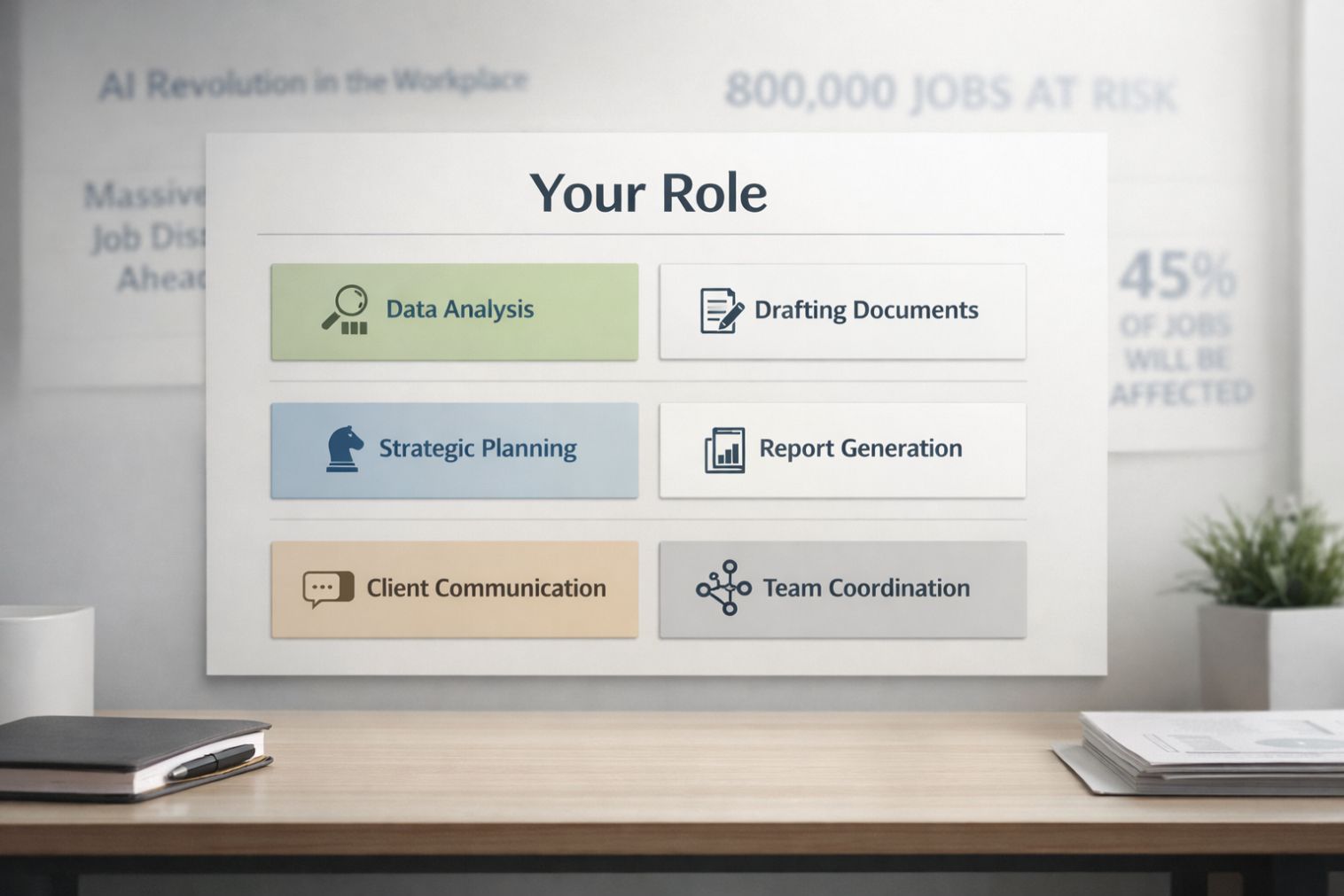
Accountant A spends 70% of their week on data entry, transaction categorisation, reconciliation, and basic report generation. They're fast, accurate, and reliable. They're also doing work that Vic.ai, Botkeeper, and Docyt can now do in a fraction of the time.
Accountant B spends 70% of their week on client advisory, tax strategy, complex compliance, and stakeholder communication. They use spreadsheets and systems as inputs to their judgment, not as the work itself.
Accountant A's role is about to shrink dramatically. Not disappear - there'll still be oversight, exception handling, and quality checks. But the volume of routine processing work will collapse.
Accountant B's role is about to grow. Because when AI handles the data processing, the value shifts entirely to interpretation, advice, and relationships. Clients don't pay for categorised transactions - they pay for someone who can tell them what those transactions mean and what to do about it.
Same title. Same firm. Opposite futures.
And this is exactly why a single "69% automation risk" score for "accountants" is meaningless. It depends entirely on what you actually spend your time doing.
Let's be honest about something the industry isn't saying out loud: there aren't enough advisory seats for every accountant currently doing processing work. When AI handles the reconciliation, the data entry, and the month-end close, firms don't need the same number of people doing those things. Some roles won't "transform into advisory" - they'll shrink. Fewer people, fewer hours, fewer graduate hires. The question isn't whether this is happening. It's whether you'll be the accountant who moved early or the one who found out too late.
What the Big Four are telling you (and what they're not)
Deloitte, PwC, Ernst & Young, and KPMG have all said publicly that they won't use AI to replace human accountants. That's partially true - and it's also not the full picture.
What they're actually doing is restructuring the work. AI handles the routine processing. Humans handle the judgment, advisory, and client relationships. The headcount doesn't necessarily drop - but the job description changes fundamentally.
If you're in a Big Four firm (or any firm paying attention), the expectation is shifting from "can you process this accurately?" to "can you advise on what this means?" The accountant who can do both will thrive. The accountant who can only process is in a race against software that gets better every quarter.
What to actually do about this
If most of your week is advisory, strategy, and client-facing work: You're well-positioned. Learn to use AI tools to speed up the routine parts of your work so you can serve more clients or go deeper with existing ones. The Stanford study shows that's exactly what the highest-performing AI-using accountants are doing.
If most of your week is processing, data entry, and reconciliation: Start shifting now. Not panic-shifting - strategic shifting. Pick up advisory skills. Learn to interpret data, not just process it. Get comfortable presenting findings to clients. The processing work isn't disappearing overnight, but it is shrinking quarter by quarter.
If you're a junior accountant or student: This one's important. The traditional apprenticeship - learning by doing the routine work that senior accountants have graduated from - is being disrupted. If AI handles the data entry you'd normally learn on, you need to develop judgment and critical thinking earlier than previous generations did. The Stanford study found that junior accountants who over-trusted AI outputs made more errors. Your advantage over AI isn't speed - it's knowing when something doesn't look right.
Regardless of where you sit: understand YOUR specific exposure. Not "accountants in general." YOUR work.
If you manage a team, here's how to prepare your workforce for AI before the pressure hits.
Find out where you actually stand
We built a free AI Impact Assessment that analyses your role based on the work you actually do - not your job title.
It breaks down which parts of your work AI will likely handle, which parts it'll help you do faster, and which parts become more valuable because they need human judgment. You also get personalised recommendations on skills to develop and what to focus on now to stay relevant.
Two minutes. No signup. No catch (well - we explain the business model here).
Over 4,000 people across 30+ countries have tried it. The accountants who've used it consistently say the same thing: "I knew AI would change my work. I didn't know which parts."
→ See how AI will affect your accounting work
Share it with your firm
If you found this useful, send it to a colleague. Better yet, run the assessment and compare results. Two accountants in the same firm will get different answers - and that conversation is worth having.
If you're a partner or manager and you're thinking "we should do this across the whole firm," you're right - and we should talk.
FAQs
Will AI fully replace accountants? Not all of them. But if your work is mostly data entry, reconciliation, and routine report generation, your role is going to shrink - and in some firms, it already is. The accountants who'll be fine are the ones doing work that requires judgment, client relationships, and interpretation. If that doesn't describe most of your week, now is the time to start shifting.
Which accounting tasks are most at risk? Anything repetitive and rules-based: data entry, invoice processing, transaction categorisation, basic bookkeeping, standard report generation, and routine reconciliation. The Stanford/MIT study found that these are exactly the tasks AI is already taking over in firms that have adopted it.
Which accounting tasks become more important with AI? Client advisory, strategic tax planning, complex compliance, financial interpretation, stakeholder communication, and quality assurance. When AI handles the processing, the value shifts to knowing what the numbers mean and what to do about them.
I'm a junior accountant. Should I be worried? Be aware, not worried. The traditional career path - learning by doing routine work - is changing. Focus on developing judgment, critical thinking, and client communication skills earlier than you might have expected to need them. And learn to use AI tools as assistants rather than accepting their outputs uncritically.
What AI tools should accountants learn? Start with what's in your existing ecosystem - Microsoft Copilot if you're in 365, or Claude in Excel if you want to try AI-powered spreadsheet analysis. For firm-specific tools, Vic.ai (AP automation), FloQast (month-end close), and Botkeeper (bookkeeping) are good ones to be aware of. But tools change fast - the more important skill is comfort with AI as a working partner.
How is this different from previous automation in accounting? Previous automation (Excel, ERP systems, cloud accounting) sped up existing processes. AI changes what the processes are. It doesn't just make data entry faster - it eliminates the need for a human to do it at all. That's a qualitative shift, not just a speed improvement. In other words, AI is changing tasks, not just titles - understanding that difference is what matters for your career.
Sources cited:
- Stanford/MIT study: Choi & Xie, "Human + AI in Accounting: Early Evidence from the Field" (2025) - covered by Stanford GSB, MIT Sloan, and CFO Dive
- Tools: Vic.ai, BILL, Botkeeper, Docyt, FloQast, Numeric, MindBridge, Robo1040, TaxGPT, Claude in Excel
- Big Four AI positions referenced via Journal of Accountancy and Accounting Today

Helena Turpin spent 20 years in talent and HR innovation where she solved people-related problems using data and technology. She left corporate life to create GoFIGR where she helps mid-sized organizations to develop and retain their people by connecting employee skills and aspirations to internal opportunities like projects, mentorship and learning.
.jpg)