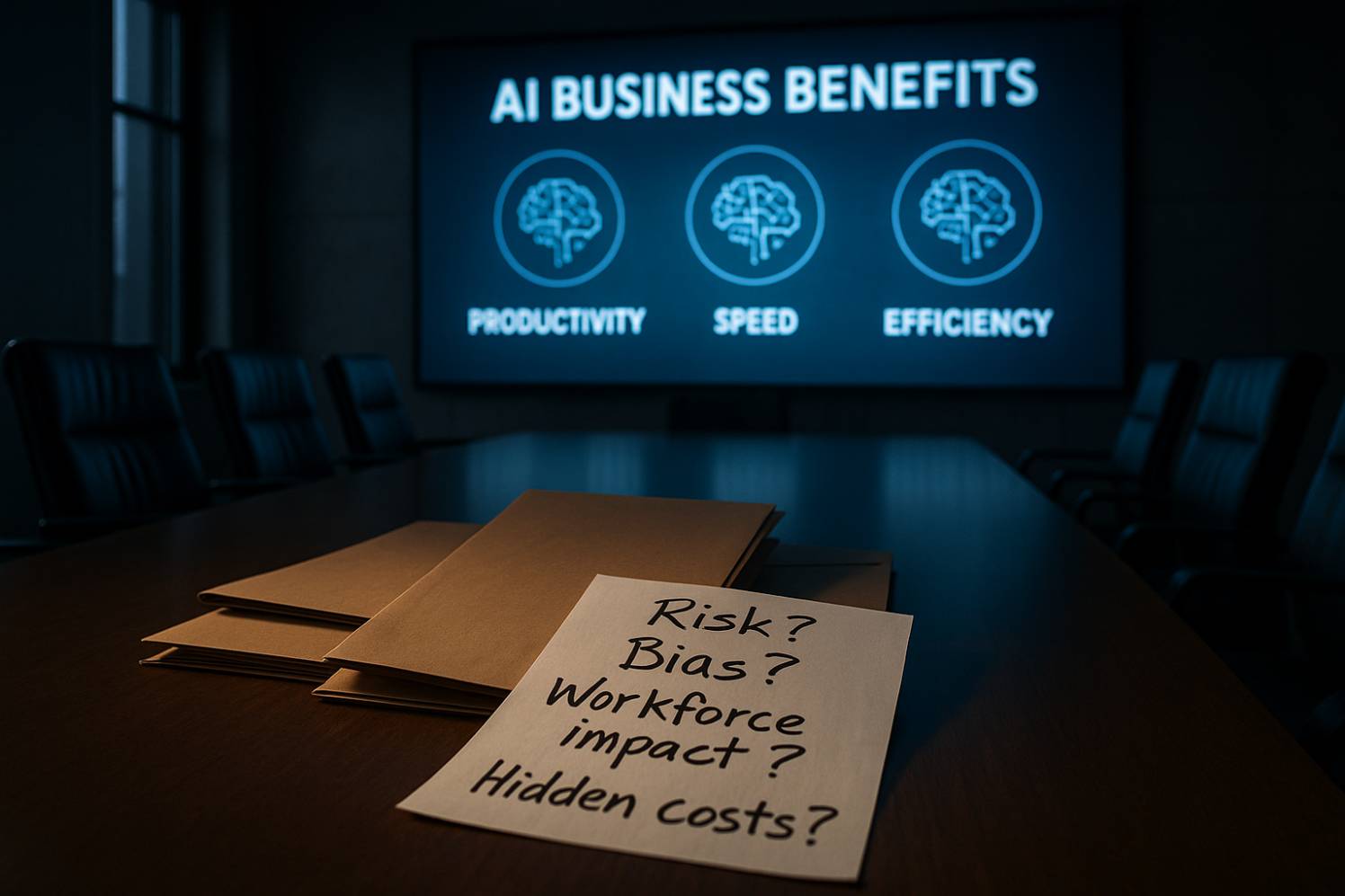
Will AI actually reduce headcount, or is that overstated? Based on task-level data from real organisations, the round numbers being pitched in vendor demos - 20%, 30% off headcount within a year - are overstated. What's actually recoverable is smaller, slower, and a lot more specific than the pitch decks suggest.
That's not a comforting story to tell a board that's been fed a bigger one, but it's the one the data supports. It turns out boards would rather have an accurate, defensible number than an exciting, unfounded one (and risk embarrassment later).
The pitch versus the projection
The AI-headcount pitch has a familiar shape: pick a big percentage, attach it to a role or function, and let the number do the persuading. It's compelling precisely because it's vague enough to sound inevitable and specific enough to sound real.
One senior leader we worked with used task-level AI impact data to build something different: an extremely realistic projection of what capacity AI and automation would release over the next few years, and what they wouldn't. Not "AI will save us twenty million in headcount." Closer to: here's what's actually recoverable, here's the realistic timeline for it, and here's what still needs a human doing it regardless of what the vendor demo promised.
That projection went to the board as a corrective - not to kill the AI conversation, but to replace an inflated one with a defensible one. It's the same underlying move as turning an AI gut feeling into board-ready evidence: task-level detail standing in for a top-down guess.
Why the big round numbers don't hold up
Role-level automation claims - "this function is 40% automatable" - are built for headlines, not for planning. They collapse a huge range of individual tasks, some genuinely automatable now, some technically possible but operationally far off, some not automatable in any near-term sense, into a single confident-sounding figure.
Task-level data breaks that number back apart, and what falls out tends to look like this:
- Some capacity is recoverable now. A real, if modest, slice of task volume is genuinely ready to be automated with current tools.
- Some is recoverable later. Technically possible, but gated by integration work, data quality, change management, or plain organisational readiness - not "next year" by any honest timeline.
- Some isn't recoverable at all, at least not without a fundamentally different tool than what's on the market. Judgment-heavy, relationship-heavy, and context-heavy work keeps needing a human, vendor promises notwithstanding.
Stack those three categories up and the honest total is almost never the clean 20-30% being sold. It's usually smaller, staged over a longer runway, and unevenly distributed across roles rather than a flat percentage lopped off every function.
What a realistic projection actually buys you
A defensible, task-level capacity projection isn't a smaller, sadder version of the exciting number. It's a more useful one, because it does things the vendor pitch can't:
- It survives scrutiny. A board that pokes at "30% by next year" will find it collapses immediately. A staged, task-level projection holds up because it's built from specifics, not a top-down guess.
- It sets a real timeline for planning. Reskilling, redeployment, and hiring decisions can be sequenced against an actual recovery curve instead of an assumed cliff-edge.
- It protects credibility the second time around. Organisations that promise the big number and miss it spend the next planning cycle explaining why. Organisations that under-promise on a realistic number and hit it don't have that conversation.
The corrective, not the killjoy
None of this is an argument that AI won't matter, or that transformation planning should slow down. It's an argument that the planning should be built on what the task-level data actually shows, rather than on the number a demo needed to close. AI is not a magic wand you wave over an org chart. It's a set of specific, unevenly distributed capacity gains - and the organisations getting real value out of it are the ones willing to plan against the smaller, real number instead of the bigger, borrowed one.
If your board has been sold the big round number, the more useful move isn't to argue AI matters less. It's to bring the task-level data that shows exactly where the real capacity is, and where it isn't - yet.
This isn't the only place task-level data has cut against the prevailing AI narrative. It's also what's behind the mixed, more human reaction employees have when they see their own AI exposure - fear for some, a personal challenge for others, depending on how specific the data is.
See what's actually recoverable in your organisation
Round numbers from a vendor demo aren't a plan. A task-level AI Impact Assessment is. If you want the real, defensible version of this projection for your own workforce rather than someone else's case study, see how GoFIGR builds it.

Helena Turpin spent 20 years in talent and HR innovation where she solved people-related problems using data and technology. She left corporate life to create GoFIGR where she helps mid-sized organizations to develop and retain their people by connecting employee skills and aspirations to internal opportunities like projects, mentorship and learning.
.jpg)