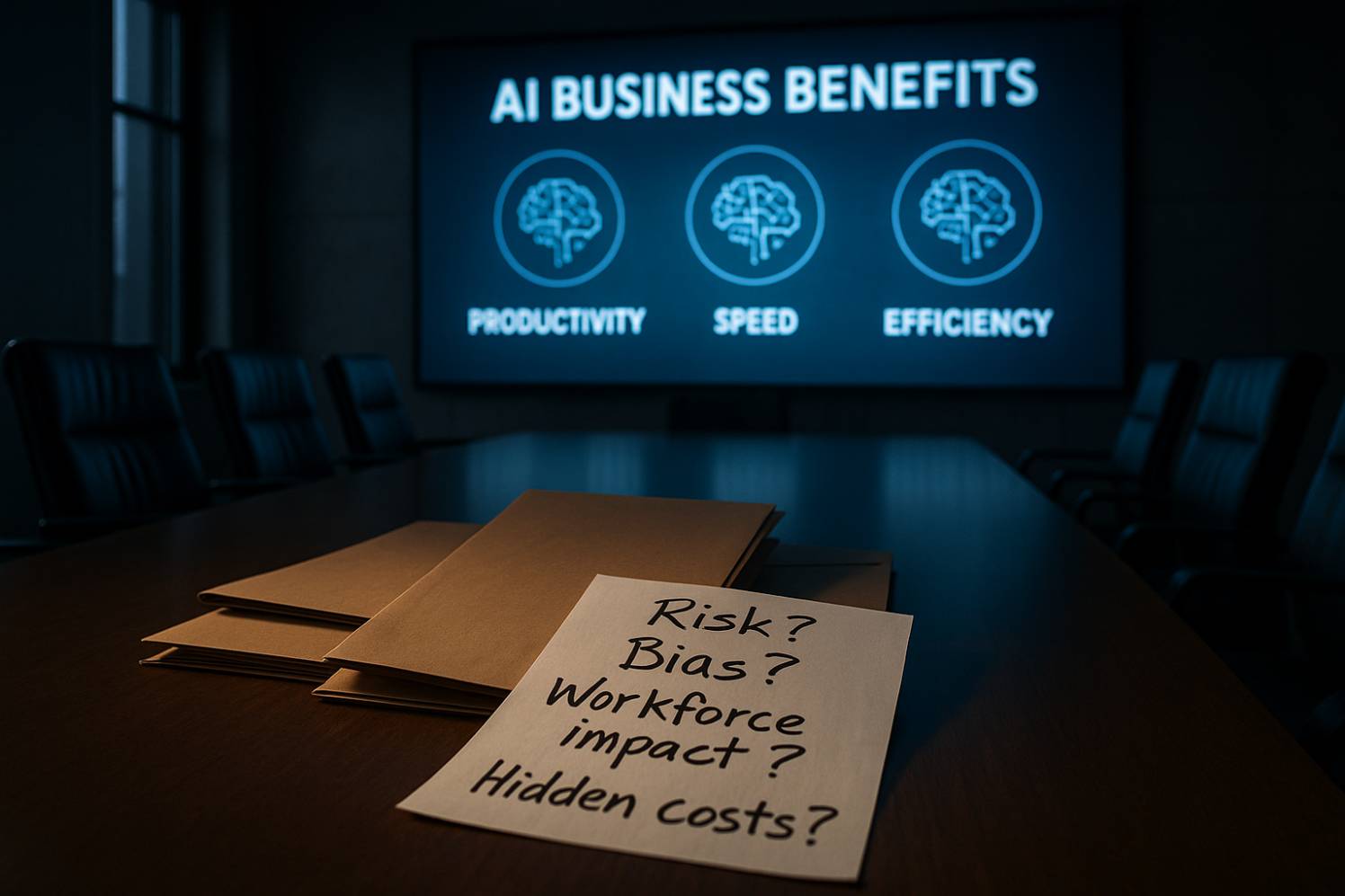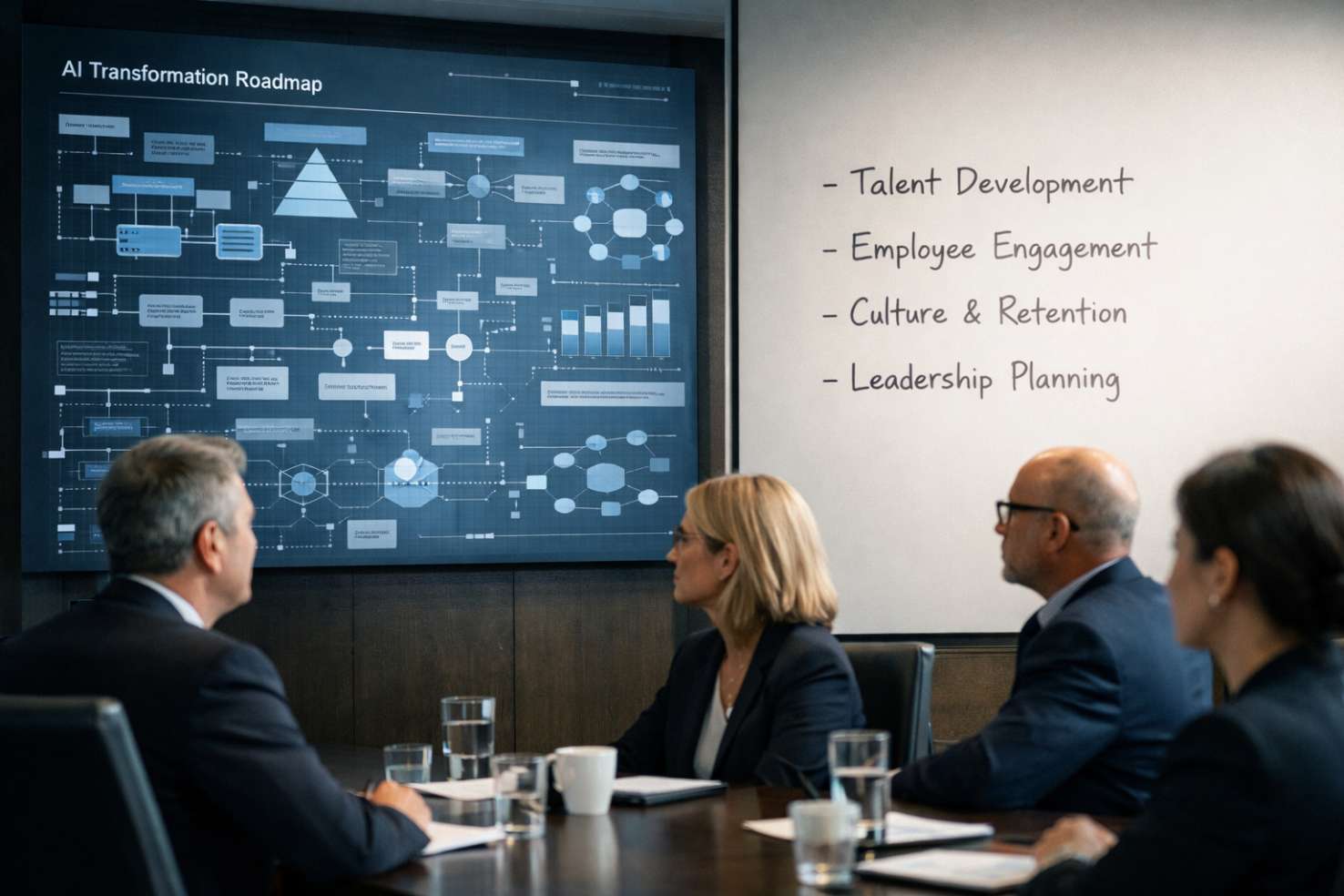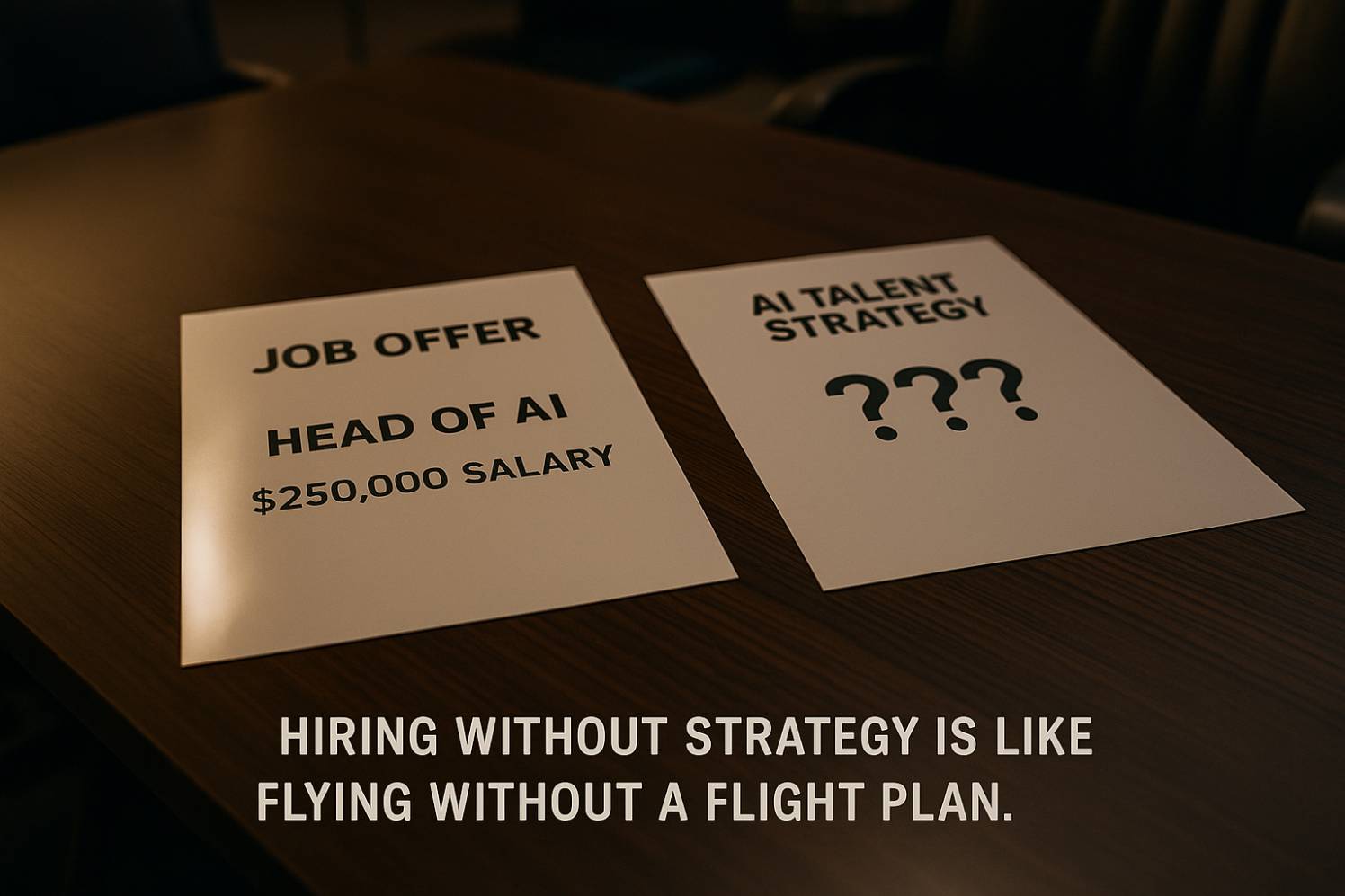
Think hiring a Head of AI Officer is bold? Wait until you see what comes next!
I get it. Announcing a Head of AI (or something of that title) feels like a milestone. It signals commitment. To employees, competitors, the board and the market – you’re serious about transformation.
But here’s the thing most companies overlook:
hiring an AI leader is symbolic.
But actual transformation? That’s operational.
Most organisations:
- haven’t mapped the work
- haven’t trained the workforce
- haven’t redesigned processes.
And yet they expect magic to happen
once AI tools land. Spoiler: it won’t.
The contradiction is obvious and, honestly, a little absurd in hindsight. Leaders want the signal of AI commitment without the hard work of operational readiness.
And trust me, your employees see it long before you explain it. Let me take you through this issue.
Your employees are already asking the hard questions with AI
I’ve watched it happen in every organisation I step into. The instant a Head of AI joins, employees are thinking:
- Which of my tasks will change?
- What should I learn to stay relevant?
- Will my job evolve or shrink?
- Is this redeployment or redundancy?
- Does anyone actually have a plan?
These aren’t panicked questions. They’re rational and they’re immediate. The irony?
Leaders are often two steps behind, scrambling to answer questions they don’t have answers.
And the silence? It destabilises.
Stop thinking POCs are a shortcut – they’re not!
Here’s a pattern I see everywhere: pilot this, trial that, hackathon here, proof-of-concept there. Vendor demos, isolated automation islands and little to no understanding of how work actually changes.
It’s seductive, but operationally useless.
You cannot modernise a workforce by demoing tools.
And then the numbers come in:
- 83% of CEOs are increasing AI investment. Without analysing work first, that’s blind spending.
- CFOs expect 7.5% revenue growth with zero headcount growth. Productivity gains aren’t magic; they require operational redesign.
- Organisations that redesign work outperform by 2x. Not because they buy more tech, but because they understand the tasks beneath the roles.
We’re entering the world’s largest Talent Remix. Roles are evolving faster than org charts. Skills mobility and redeployment are survival mechanisms.
Ignore this at your peril.
Here’s what nobody warned you about with AI in business
Hiring a Head of AI isn’t just one change in one area. It ripples across every workflow, every team, every skill set:
- Workflows unravel: AI automates tasks that were the glue holding processes together. One small task disappears and the whole workflow can collapse. Operational debt spikes, risk grows, quality varies.
- Roles blur: AI automates pieces, not entire jobs. This creates half-jobs, stretched jobs, bloated jobs, ambiguous jobs and ghost skill gaps nobody owns.
- Capability gaps widen silently: people adopt tools, but not behaviours. Knowledge fragments across teams.
- Redeployment becomes essential: without a skills baseline, moving people is guesswork. And guesswork during economic pressure? Catastrophic.
- Manager capability suddenly matters 10x: managers must coach through change, reallocate tasks, redesign workflows and provide clarity they don’t have. Most aren’t equipped.
- Communication complexity explodes: employees want answers. Leaders don’t have them. Silence becomes destabilising.
All this starts the day a Head of AI joins, long before any AI tool is fully deployed.
Want to beat your competitors? Map the work first
Take this example: two companies invest the same amount in AI.
One maps work and capability, redeploys talent, equips managers, experiments responsibly and communicates transparently. The other doesn’t.
Guess who pulls ahead? The first company – every single time.
Redesigning work, reducing duplication, building future skills, aligning CHRO and CIO, measuring capability uplift – these aren’t just checkboxes.
They are the difference between 2x revenue and wasted AI investment.
Stop celebrating titles. Focus on transformation
Hiring a Head of AI is just the headline.
The real work is
- mapping tasks,
- redesigning roles and
- creating capability baselines.
Skip these steps and you’ve bought a title, not results.
This is where companies stumble: they celebrate the hire but neglect the work and the workforce.
The impact? Expensive, destabilising and completely avoidable.
Here’s where the impact of AI diagnostics actually changes the game
Most companies stumble here – they invest in AI without truly understanding how it will land. That’s where the Impact of AI Diagnostic comes in.
This isn’t a nice-to-have report. It’s your playbook for turning AI investment into real transformation.
It gives you:
- Task-level truth: see exactly what’s changing, what stays and where the gaps are
- Ripple-effect maps: know how one shift affects every team upstream and downstream
- Capability baselines: understand current skills before you plan the future
- Role evolution forecasts: anticipate which jobs morph, shrink or expand
- Redeployment engines: move talent strategically instead of guessing
- CHRO–CIO shared roadmap: align leadership so decisions actually stick
- “Before you invest” clarity: make decisions with confidence, not hope
Without this, AI transformation is guesswork. With it, you see the dominoes before they fall, you act with precision and you turn hype into measurable results.
Stop talking about AI – let’s make transformation happen
The future of AI transformation isn’t coming – it’s already here. Hiring a Head of AI is just the start. The real work begins when you map roles, redeploy talent and equip managers to lead through change.
AI isn’t about replacing people. It’s about giving teams the tools, clarity and support to work smarter, adapt faster and thrive in a rapidly evolving landscape.
At GoFIGR, we believe the future of work is about insight, agility and empowerment. That starts by understanding the tasks beneath the roles, spotting capability gaps early and building a workforce ready for the AI-powered world.
Because the truth is simple: every organisation deserves to transform successfully. And now, every organisation can.
Contact GoFIGR today and see how we can help you lead workforce transformation with confidence.
FAQs around AI and business transformation
Isn’t hiring a Head of AI enough to show we’re modernising?
No. A title shows intent, but transformation happens when you map work, build skills and redesign roles. Without that, nothing changes.
How soon will employees notice changes?
Immediately. They’ll ask which tasks will shift, what skills they need and if their roles will change.
Can AI pilot programs replace full work mapping?
No. Pilots create noise not clarity. You need a task-level view to transform work effectively.
How does the Workplace Impact of AI Diagnostic help?
It shows task-level truths, ripple effects, capability gaps, redeployment needs and role forecasts before any AI investment. It turns guesswork into measurable action. For more, see: https://www.gofigr.ai/impact-of-ai
What’s the real advantage of redesigning work with AI?
Companies that map work, redeploy talent and equip managers consistently outperform others. It’s the difference between 2x results and wasted investment.

Helena Turpin spent 20 years in talent and HR innovation where she solved people-related problems using data and technology. She left corporate life to create GoFIGR where she helps mid-sized organizations to develop and retain their people by connecting employee skills and aspirations to internal opportunities like projects, mentorship and learning.