AI IMPACT

Will AI replace teachers

Task-level analysis of which teacher tasks are being automated, which are being augmented, and which stay human, grounded in GoFIGR's assessment data.

Education
6 min read
Will AI replace teachers
5 second summary

AI has already absorbed the admin half of teaching. Lesson planning, quiz generation, rubric writing, parent emails - tools like MagicSchool handle all of it in minutes. That time is yours to redirect.

The classroom itself is stubbornly human. The research is clear: AI tutors outperform passive instruction, but they can't read a room, spot the kid who's struggling under the surface, or hold a class's trust through a rough week.

The teachers getting left behind aren't being replaced by AI. They're being compared to colleagues who use AI. The gap isn't human vs. machine - it's prepared vs. unprepared.

GOFIGR AI IMPACT FOR TEACHERS
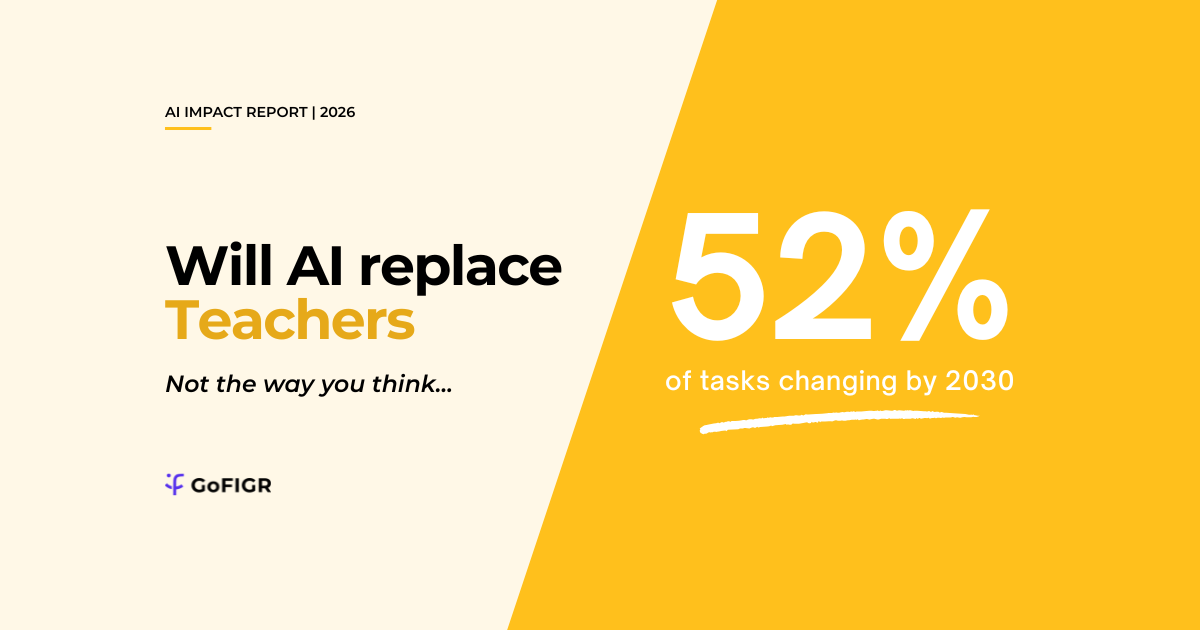
52%
of tasks changing by 2030
Task Breakdown
How AI changes each task in your role

[FULLY-AUTOMATED] Generating differentiated worksheets and leveled reading materials

[FULLY-AUTOMATED] Drafting rubrics and grading criteria for assignments

[AI-LEADS] Writing first-draft lesson plans from curriculum standards

[AI-LEADS] Drafting parent communication and progress updates

[YOU-LEAD] Delivering and adapting instruction in real time based on class response

[STAYS-WITH-YOU] Identifying students experiencing emotional or personal difficulties

[STAYS-WITH-YOU] Mentoring students through academic setbacks and confidence issues

Skills Outlook
Which skills to double down on, develop, or let AI handle
Double DOWN
  • Classroom Presence
  • Student Mentorship
  • Curriculum Judgment
  • Emotional Intelligence
+ Develop New
  • AI-Assisted Lesson Design
  • Learning Analytics Interpretation
  • Personalised Instruction at Scale
  • Prompt Engineering for Educational Contexts
↓ Let AI Handle
  • Worksheet Generation
  • Rubric Writing
  • Parent Communication Drafting
  • Routine Assessment Creation
Get your personalised breakdown
This is the general picture for the above job title. Your personalised assessment takes 3 minutes, based on what you actually do, not just your job title.
Run my free assessment →
Source: GoFIGR AI Impact Assessment
Updated May 2026

AI is already inside the teaching profession. It's writing lesson plans, generating differentiated worksheets, drafting parent communications, and producing rubrics - jobs that used to eat hours every week. The question isn't whether this is happening; it's whether you're on the side of the role that's growing or the side that's shrinking.

What's already being automated

MagicSchool AI is the broadest all-in-one classroom toolkit in 2026 - it handles rubric creation, IEP adjustments, parent emails, and behavior reports, shrinking each task from twenty minutes to two. Khanmigo from Khan Academy tutors students one-to-one using Socratic questioning and provides teachers with real-time dashboards showing exactly where the class is stuck. Diffit takes any text and generates leveled reading materials across multiple grade levels instantly, a task that used to require significant teacher time per student group.

What the research actually says

Teachers who use AI tools weekly save an average of 5.9 hours per week - the equivalent of six full weeks reclaimed across a school year, according to a 2025 Walton Family Foundation and Gallup study of over 2,200 U.S. public school teachers. A separate McKinsey analysis found that 50% of teacher tasks can be partially automated. But a Harvard University physics study found that while AI tutors outperformed passive classroom instruction, human teachers still lead where active learning, emotional attunement, and relationship management are involved.

The teachers who feel most threatened by AI are often the ones whose core value was delivering information. The ones who feel energised are the ones whose core value was connecting with students.

Two people. Same title. Completely different week.

Teacher A spends Sunday night building three differentiated versions of the same worksheet, drafting a progress report for a parent meeting on Monday, and writing quiz questions for Thursday's chapter test. Monday arrives and there's barely enough time to actually teach. The admin is the job.

Teacher B ran those same tasks through MagicSchool on Friday afternoon in 40 minutes. Sunday is free. Monday's lesson is built around the Khanmigo data showing exactly which three concepts the class hasn't retained. The conversation in class goes somewhere real because there's time and energy for it.

If you're spending more than a quarter of your week on tasks that a tool could do in minutes, that's the place to start. Pick one admin category - lesson planning or rubric writing or parent comms - and trial a dedicated tool for two weeks. The skills that will carry you forward aren't administrative. They're the ones no dashboard can replicate.

5.9 hrs

Average weekly time saved by teachers who use AI tools, equivalent to six reclaimed weeks per school year, according to the 2025 Walton Family Foundation and Gallup study of 2,232 U.S. public school teachers.

20-40%

Share of current teacher hours spent on activities that could be automated using existing technology -- equivalent to approximately 13 hours per week that teachers could redirect toward activities that lead to higher student outcomes, according to McKinsey Global Institute research on AI's impact on K-12 teachers.

2x

Students using AI tutors learned more than twice as much in less time compared to those in traditional passive-learning classrooms, per a 2025 Harvard University physics study.

The two teachers problem

Two people. Same title. Same school. Completely different AI exposure. This is why a single automation risk score for "teachers" is only half the picture.

Teacher A - task-heavy

Generating worksheets and leveled materials, writing rubrics and assessments, drafting parent communication, grading routine assignments, logging attendance and admin records. Work that AI tools can now do faster.

Role shrinking

Teacher B - judgment-heavy

Reading classroom dynamics and adjusting in real time, identifying students struggling beneath the surface, mentoring and motivating through setbacks, curriculum design for specific cohorts, professional judgment calls on student welfare. Uses systems as inputs to judgment, not as the work itself.

Role growing

What to actually do about this

If most of your week is strategic and student-facing

You're well-positioned. Use AI tools to speed up the routine parts of your work so you can go deeper where it counts.

If most of your week is process and execution

Start shifting now - not in panic, but deliberately. Pick up the skills in the Develop New list. The processing work isn't disappearing overnight, but it's shrinking.

If you're early in your career

The traditional learning path is being disrupted. Develop judgment and critical thinking earlier than your predecessors had to. Your advantage over AI isn't speed -- it's knowing when something doesn't look right.

Frequently asked questions

Curious about something else?
Drop us a question and we’ll get back to you!

Will AI actually replace teachers in the next 10 years?
Full replacement isn't happening. AI tutors have shown they can outperform passive classroom instruction on test scores, but they can't replace the relational and motivational work that keeps students engaged over time. The role is being reshaped, not eliminated -- with admin tasks shrinking and human judgment becoming more central.
What should teachers learn right now to stay relevant?
Start with the tools already in your sector: MagicSchool for admin, Khanmigo for understanding student progress data, Diffit for differentiation. The underlying skill isn't tool fluency -- it's learning how to interpret what the data tells you and use that to teach better.
Does teaching experience protect you from AI disruption?
Experience in classroom management, student mentorship, and curriculum judgment protects you well. Experience in producing worksheets, writing rubrics, or drafting parent emails does not -- those tasks are already largely automatable. The question is which kind of experience fills most of your week.
Are primary school teachers more or less at risk than secondary teachers?
Primary teachers are generally less exposed because the relational and developmental work is proportionally larger. Secondary teachers in content-heavy subjects face more pressure as AI tutors become increasingly capable of delivering subject instruction at scale. The human anchoring work -- pastoral care, motivation, classroom culture -- remains across both.
What should I do if my school hasn't given me any AI training?
Don't wait for institutional training -- it may not arrive in time to be useful. MagicSchool has a free tier and takes under an hour to learn. Khanmigo is free for U.S. K-12 teachers through Khan Academy. Start with one task you find tedious and run it through a tool this week.

Bring evidence to the workforce conversation

Book a conversation with our team to scope the full analysis for your organisation. Initial findings in 1 to 3 days.