AI IMPACT

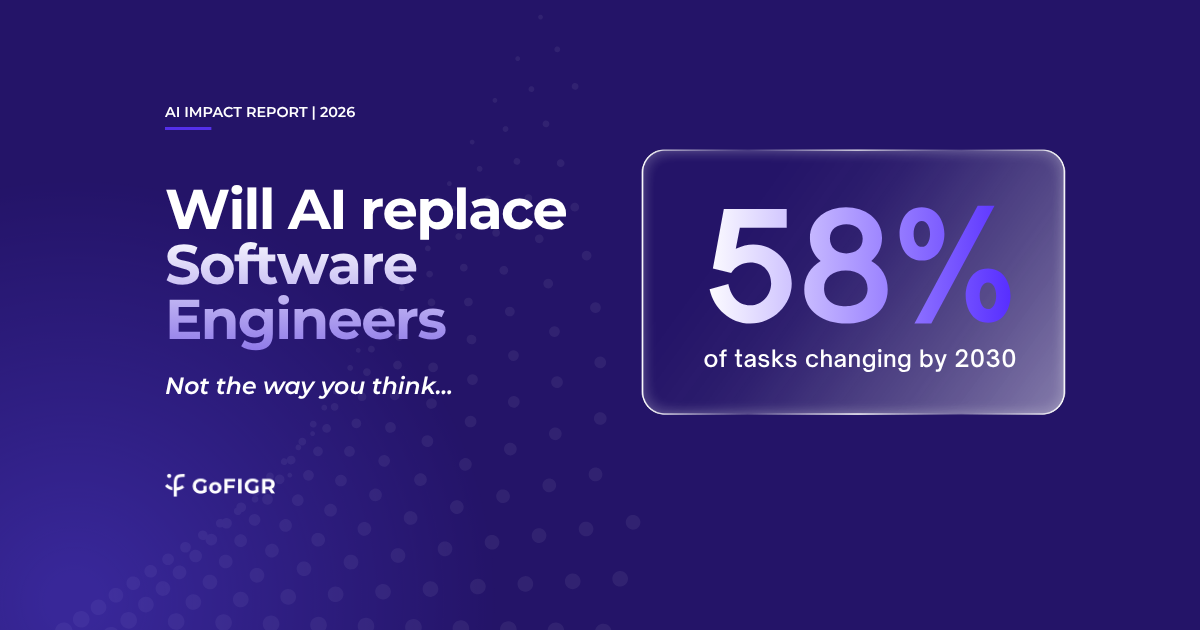
Will AI replace Software Engineers

Task-level analysis of which Software Engineer tasks are being automated, which are being augmented, and which stay human, grounded in GoFIGR's assessment data.

Technology
6 min read
Will AI replace Software Engineers
5 second summary

AI already writes 41% of the code on GitHub. That number is heading toward 60% by the end of 2026, according to Gartner. If your job is producing lines of code, the ground is shifting under you right now.

Entry-level postings are down 28% since 2022 and haven't recovered. The traditional path into software engineering, starting with boilerplate and working your way up, is being disrupted faster than most people expected. Developing judgment early isn't optional anymore.

Developers with AI skills command up to 56% higher wages than peers without them. The question isn't whether to adopt these tools. It's whether you're using them to go deeper on architecture and systems, or just to write faster code you'll have to review anyway.

GOFIGR AI IMPACT FOR SOFTWARE ENGINEERS
58%
of tasks changing by 2030
Task Breakdown
How AI changes each task in your role

[FULLY-AUTOMATED] Write boilerplate and scaffolding code for new features

[FULLY-AUTOMATED] Generate unit and integration test cases from existing code

[AI-LEADS] Debug routine bugs and trace error messages in known codebases

[AI-LEADS] Write and update inline code documentation

[YOU-LEAD] Review AI-generated pull requests for correctness, security, and maintainability

[YOU-LEAD] Design system architecture and evaluate technology trade-offs

[STAYS-WITH-YOU] Diagnose and resolve complex production incidents with ambiguous root causes

Skills Outlook
Which skills to double down on, develop, or let AI handle
Double DOWN
  • Systems Architecture
  • Security and Code Review
  • Production Debugging
  • Technical Communication
+ Develop New
  • AI-Assisted Development Governance
  • Agentic Workflow Design
  • AI Output Validation
  • ML Integration Engineering
↓ Let AI Handle
  • Boilerplate Code Generation
  • Test Case Writing
  • Documentation Drafting
  • Routine Bug Fixing
Get your personalised breakdown
This is the general picture for the above job title. Your personalised assessment takes 3 minutes, based on what you actually do, not just your job title.
Run my free assessment →
Source: GoFIGR AI Impact Assessment
Updated May 2026

AI is inside software engineering now. It's generating boilerplate, writing tests, catching bugs, and producing pull requests faster than any individual developer can. The question isn't whether this is happening. It's which half of the job you're in.

What's already being automated

GitHub Copilot autocompletes and generates code inline across 20 million users, now accounting for 46% of code written by developers on the platform.

Cursor is an AI-native code editor that can understand entire codebases, suggest multi-file edits, and execute autonomous coding tasks, now used by over half of Fortune 500 companies.

Claude Code is an agentic coding tool that operates in the terminal, can plan and execute complex engineering tasks across a full repository, and became the most-used AI coding tool among developers within eight months of launch.

What the research actually says

Controlled experiments show developers complete tasks 55% faster using GitHub Copilot. But METR's rigorous randomised controlled trial found that for complex, real-world tasks, the time saved on generation was often offset by review overhead, meaning speed gains depend heavily on the type of work. Entry-level software engineering job postings are down 36% versus February 2020, according to Indeed Hiring Lab data.

AI makes average engineers faster and great engineers more powerful. It also makes it harder than ever to hide in the middle, because the gap between someone who understands systems and someone who just produces code is now visible in every sprint.

Two people. Same title. Completely different week.

Software Engineer A spends most of their time writing boilerplate, generating test cases, fixing routine bugs, and updating documentation. They use AI tools reactively, asking for a code snippet here, a function there. The output volume is high. But when something breaks in production or an architecture decision needs to be made, they struggle to explain why the system works the way it does.

Software Engineer B uses AI to compress the implementation layer entirely. They define the architecture, set the constraints, review AI-generated code critically, and spend their real energy on system design, security decisions, and the parts of the problem that require judgment about trade-offs. They ship faster and understand the codebase better than anyone using AI without that underlying foundation.

If your week is mostly implementation work, start building the architectural judgment that makes you a better reviewer of AI output, not just a faster producer of it. The value in engineering is moving from writing code to knowing what the code should do and why.

41%

41% of all code written on GitHub is now AI-generated, with Gartner projecting this will reach 60% of all new code by end of 2026.

55%

Developers complete tasks 55% faster when using GitHub Copilot, according to research involving 4,800 developers cited by GitHub.

28%

Entry-level software engineering job postings are down 28% from 2022 peaks and have not recovered as of 2026, per Stanford Digital Economy Lab research using ADP payroll data.

The two Software Engineers problem

Two people. Same title. Same firm. Completely different AI exposure. This is why a single automation risk score for "Software Engineers" is only half the picture.

Software Engineer A: task-heavy

Writing boilerplate code, generating unit tests, fixing routine bugs, writing inline documentation, updating configuration files. Work that AI tools can now do faster.

Role shrinking

Software Engineer B: judgment-heavy

Designing system architecture, conducting security and code review, making technology selection decisions, debugging complex production incidents, mentoring junior engineers. Uses systems as inputs to judgment, not as the work itself.

Role growing

What to actually do about this

If most of your week is strategic and client-facing

You're well-positioned. Use AI tools to speed up the routine parts of your work so you can go deeper where it counts.

If most of your week is process and execution

Start shifting now. Not in panic, but deliberately. Pick up the skills in the Develop New list. The processing work isn't disappearing overnight, but it's shrinking.

If you're early in your career

The traditional learning path is being disrupted. Develop judgment and critical thinking earlier than your predecessors had to. Your advantage over AI isn't speed. It's knowing when something doesn't look right.

Frequently asked questions

Curious about something else?
Drop us a question and we’ll get back to you!

Will AI replace software engineers entirely?
Not entirely, but it's already replacing significant portions of the work, especially for junior engineers doing implementation and boilerplate tasks. The BLS still projects 15% job growth for software developers through 2034, but those are different jobs from the entry-level roles that defined the previous decade. Expect fewer total seats and higher skill requirements for each one.
What should I learn as a software engineer to stay ahead of AI?
System design, security, and the ability to review and validate AI-generated code critically are the high-value skills right now. Learning to work with agentic tools, setting constraints, reviewing outputs, and catching errors AI introduces, is becoming a core competency, not an optional extra. AI skills now appear in 42% of software job descriptions, up from 8% in 2022.
Does seniority protect software engineers from AI automation?
Senior engineers with strong architectural and systems judgment are significantly more protected than junior engineers doing implementation work. Stanford research found early-career software developers aged 22 to 25 saw nearly 20% employment decline from peak. Seniority buys you time only if it's paired with work that genuinely requires human judgment.
Are AI coding tools actually making engineers more productive?
For scoped, well-defined tasks, yes. Controlled experiments show 30 to 55% speed improvements. For complex, ambiguous real-world work, the picture is more complicated. METR's rigorous study found review overhead can offset generation speed on harder tasks. The productivity gain is real but uneven, and it depends heavily on how well engineers govern and validate what the tools produce.
What should a software engineer do right now to prepare?
Pick up Claude Code or Cursor and use them on a real project this month. Not a tutorial. The fastest way to understand where AI helps and where it makes mistakes is through direct use on work that matters to you. Then deliberately spend time on the parts of engineering that require judgment: architecture decisions, security reviews, and production debugging. That's where your value is growing.

Bring evidence to the workforce conversation

Book a conversation with our team to scope the full analysis for your organisation. Initial findings in 1 to 3 days.