AI IMPACT

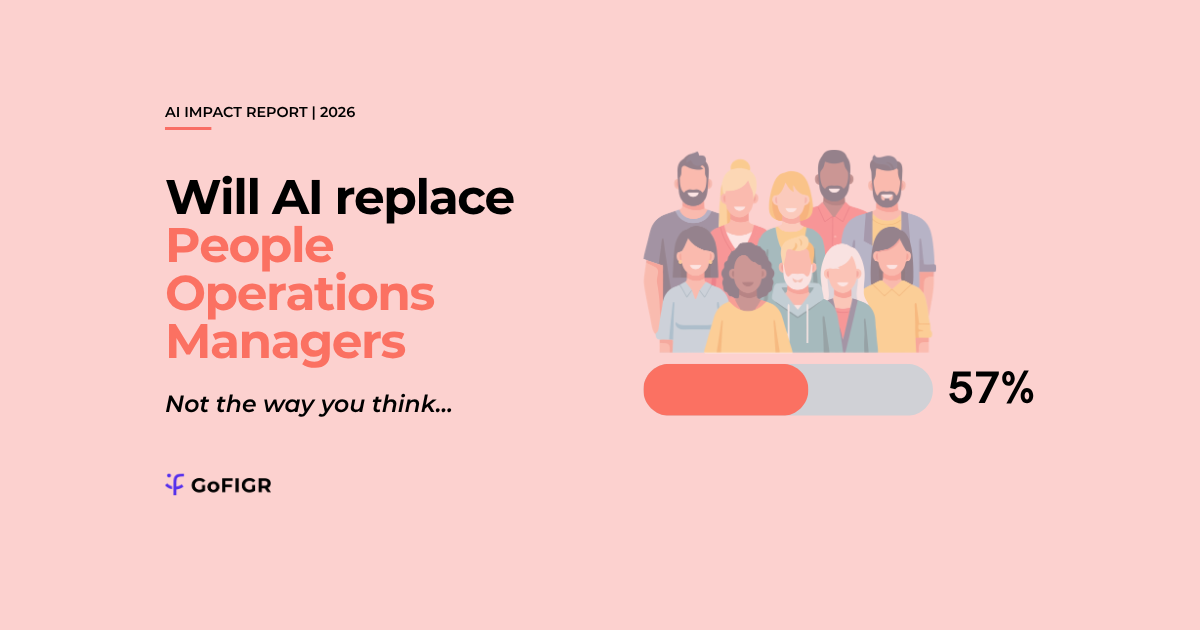
Will AI replace People Operations Managers

Task-level analysis of which people operations manager tasks are being automated, which are being augmented, and which stay human, grounded in GoFIGR's assessment data.

Human Resources
6 mins
Will AI replace People Operations Managers
5 second summary

The admin layer of people ops is being absorbed fast. Policy questions, onboarding workflows, and records management are exactly what agentic HR platforms were built to handle.

The judgment layer is getting more valuable, not less. Employee relations, manager coaching, and culture work still need a human who actually knows the organisation.

Your move is to become the person who runs the AI, not the person it replaces. Learn to configure, audit, and govern HR automation before someone else defines that job for you.

GOFIGR AI IMPACT FOR PEOPLE OPERATIONS MANAGER
57%
of tasks changing by 2030
Task Breakdown
How AI changes each task in your role

[FULLY-AUTOMATED] Answer routine employee policy and benefits questions

[AI-LEADS] Process onboarding and offboarding workflows

[NO-LONGER-NEEDED] Manually compile monthly HR metrics decks

[YOU-LEAD] Draft HR policies and employee communications

[STAYS-WITH-YOU] Coach managers through performance and conduct issues

[STAYS-WITH-YOU] Mediate employee relations cases and investigations

Skills Outlook
Which skills to double down on, develop, or let AI handle
Double DOWN
  • Employee Relations Judgment
  • Manager Coaching
  • Conflict Mediation
  • Culture Stewardship
+ Develop New
  • HR AI Orchestration
  • AI Governance in HR
  • People Data Interpretation
  • Change Facilitation
↓ Let AI Handle
  • Records Administration
  • Policy Query Handling
  • Compliance Report Compilation
  • Manual Metrics Reporting
Get your personalised breakdown
This is the general picture for the above job title. Your personalised assessment takes 3 minutes, based on what you actually do, not just your job title.
Run my free assessment →
Source: GoFIGR AI Impact Assessment
Updated May 2026

Will AI replace people operations managers? It's already inside the role. Routine policy questions, onboarding and offboarding workflows, records maintenance, and HR ticket resolution are being automated right now by agentic HR platforms. So the real question isn't whether this is happening. It's which half of the job you're in.

What's already being automated

Leena AI resolves routine HR tickets covering benefits, policy questions, letters, and employee records through a conversational assistant plugged into systems like Workday and SAP SuccessFactors. Rippling automates the full onboarding and offboarding chain, from contract signature to device provisioning, payroll setup, and benefits enrolment. Lattice uses an AI agent to summarise performance reviews, analyse engagement surveys, and flag disengagement risks for managers.

What the research actually says

SHRM's State of AI in HR 2026 report found that 87% of CHROs expect greater AI adoption within HR processes this year, and 39% of organisations already have AI deployed inside the HR function. Gartner adds the structural point: in a December 2025 survey, 78% of CHROs agreed that workflows and roles will need to change to get value from their AI investments. The tools aren't waiting for permission.

People ops was built to answer questions and process requests. AI now does both reliably. What's left is the part nobody ever wrote a workflow for: judgment about people.

Two people. Same title. Completely different week.

People Operations Manager A spends the week inside the queue. Answering policy questions, chasing onboarding paperwork, fixing HRIS records, assembling the monthly metrics deck. Every one of those tasks is now a product feature. Platforms like Leena AI report automating the large majority of routine HR tickets, and that share is growing.

People Operations Manager B spends the week on the messy human stuff. Coaching a struggling manager, mediating a conflict between two team leads, redesigning the performance process, and deciding what the engagement data actually means for this specific organisation. AI can prep the briefing, but it can't sit in the room, read the tension, and make the call.

So here's what to do. Audit your own calendar for a fortnight and sort every hour into queue work or judgment work. Then deliberately hand the queue work to a tool, learn to configure and govern that tool, and use the recovered hours on manager capability and employee relations. The people ops managers who own the automation will outlast the ones who compete with it.

87%

Share of CHROs forecasting greater AI adoption within HR processes in 2026, up from 83% the year before, according to SHRM's State of AI in HR 2026 report.

39%

Share of organisations that already have AI deployed within the HR function, per SHRM's December 2025 survey of 1,908 HR professionals.

78%

Share of CHROs who agree workflows and roles must change to get the most out of AI investments, from a December 2025 Gartner survey of 110 CHROs.

The two people operations managers problem

Two people. Same title. Same firm. Completely different AI exposure. This is why a single automation risk score for "people operations managers" is only half the picture.

People Operations Manager A: task-heavy

Answering routine policy and benefits questions, maintaining and auditing HRIS records, manually compiling monthly HR metrics decks. Work that AI tools can now do faster.

Role shrinking

People Operations Manager B: judgment-heavy

Coaching managers through performance and conduct issues, mediating employee relations cases, shaping culture initiatives, drafting policies with AI support, designing engagement programmes. Uses systems as inputs to judgment, not as the work itself.

Role growing

What to actually do about this

If most of your week is strategic and client-facing

You're well-positioned. Use AI tools to speed up the routine parts of your work so you can go deeper where it counts.

If most of your week is process and execution

Start shifting now, not in panic, but deliberately. Pick up the skills in the Develop New list. The processing work isn't disappearing overnight, but it's shrinking.

If you're early in your career

The traditional learning path is being disrupted. Develop judgment and critical thinking earlier than your predecessors had to. Your advantage over AI isn't speed. It's knowing when something doesn't look right.

Frequently asked questions

Curious about something else?
Drop us a question and we’ll get back to you!

How soon will AI change the people operations manager role?
It's already changing. Agentic HR platforms are resolving routine tickets and running onboarding workflows in production today, and SHRM data shows 87% of CHROs expect deeper AI integration in HR this year. Expect the admin share of the role to shrink noticeably within two to three years, not ten.
What skills should a people ops manager learn right now?
Learn to configure and govern the AI tools your company is buying, because someone will own that and it should be you. Pair that with deeper employee relations and coaching capability, since that's the work that grows as admin shrinks. Data interpretation matters more than data production.
Does experience protect senior people ops managers from AI?
Experience protects you only if it shows up as judgment, not as familiarity with processes. A senior manager who mostly supervises admin workflows is more exposed than a junior one handling difficult employee relations cases. Seniority tied to trust and influence holds its value.
Is people ops safer from AI in some industries than others?
Yes, but the gap is closing. Large enterprises are adopting HR AI at roughly double the rate of small and midsize organisations according to SHRM, so people ops managers at big companies will feel this first. Heavily regulated industries keep more human oversight in the loop, which slows full automation but doesn't stop task absorption.
What should I do right now if I'm a people ops manager?
Track your week for a fortnight and split it into queue work versus judgment work. Volunteer to lead your company's HR AI pilot rather than waiting for it to arrive. Then build a visible track record on the human problems AI can't touch, like manager capability and employee relations.

Bring evidence to the workforce conversation

Book a conversation with our team to scope the full analysis for your organisation. Initial findings in 1 to 3 days.