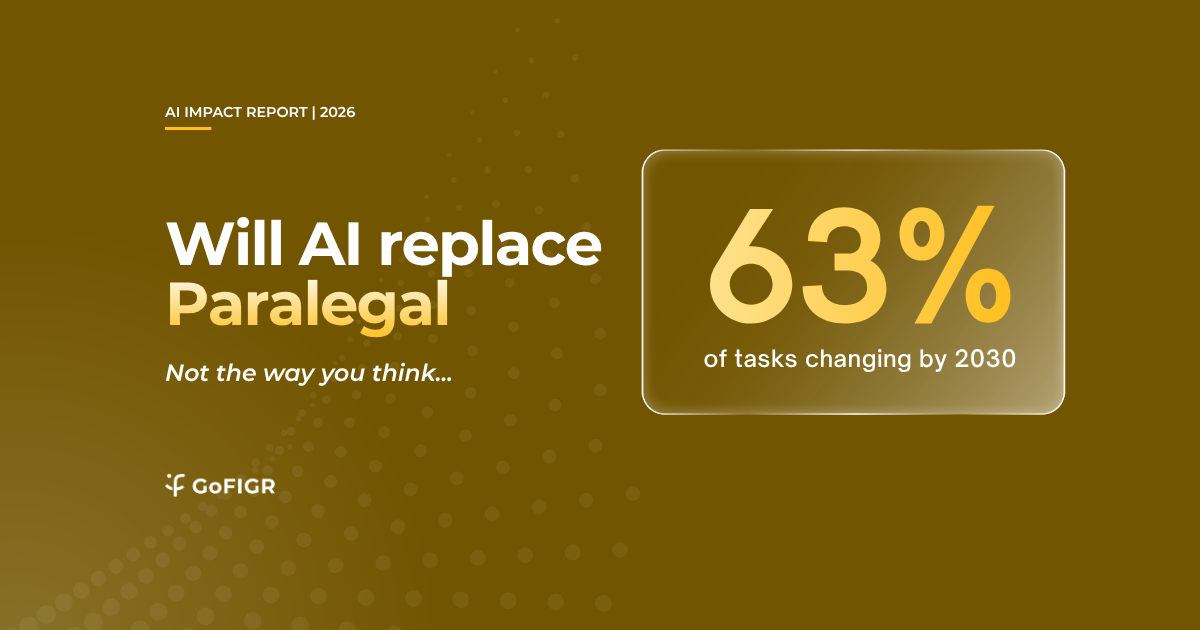
AI is processing legal documents at a scale that would have been unimaginable three years ago. In Q1 2026 alone, Harvey AI and CoCounsel processed over 10 million legal documents combined. That's not a pilot. That's production. The tasks those tools are absorbing - initial document review, case law research, contract summarisation - have historically been core paralegal work. Which side of that split you're on is the most important career question in this role right now.
What's already being automated
Harvey AI is used by 80 of the Am Law 100 firms and handles automated summarisation, document analysis, and legal research across thousands of documents - compressing work that previously took days into minutes
Thomson Reuters CoCounsel now serves over 20,000 law firms and performs first-pass legal research, contract analysis, deposition prep, and document review - built on the Westlaw database and integrated with OpenAI models.
Clio Manage AI automates daily practice management tasks including extracting deadlines from court documents, generating invoices from activity logs, and drafting client communications - the all-in-one platform for small and mid-size firms.
What the research actually says
Thomson Reuters' 2025 Future of Professionals Report found AI tools have the potential to save legal professionals up to 240 hours per year - roughly six weeks of working time. AI adoption among legal professionals more than doubled in a single year, with nearly 70% now using generative AI for work according to the 2026 Legal Industry Report from 8am. Document review tops the list of AI use cases at 77% of implementations.
The paralegal who thrives with AI isn't the one who uses it to do their old job faster. It's the one who uses it to do a job that didn't exist before - supervising AI outputs, catching errors, and applying judgment that the model genuinely doesn't have.
Two people. Same title. Completely different week.
Paralegal A spends most of their time on initial document review, pulling relevant case law, preparing standard filing templates, and summarising depositions. These tasks haven't gone away yet. But they're exactly what CoCounsel and Harvey are built to absorb. The billing hours attached to those tasks are under serious pressure across every firm using these tools.
Paralegal B works in the layer above AI output. They review what the tools produced, verify citations, flag anomalies, and make the judgment calls about what's complete, accurate, and usable. They help attorneys understand what the AI found and what it missed. They work directly with clients on sensitive matters where accuracy and confidentiality require a human. The tools make their work faster. But they're the quality control layer that makes the whole system work.
Get familiar with at least one major legal AI platform - CoCounsel if your firm uses Westlaw, Clio if you're in a smaller practice. The paralegals who understand how these tools fail are the ones who'll be trusted to use them unsupervised. That's where the career growth is sitting right now.