AI IMPACT

Will AI replace Lawyers

Task-level analysis of which Lawyer tasks are being automated, which are being augmented, and which stay human, grounded in GoFIGR's assessment data.

Legal
6 min read
Will AI replace Lawyers
5 second summary

AI is already saving lawyers nearly 240 hours a year. That's around six weeks of billable time being reclaimed from document review, legal research, and contract analysis. This is work that used to define entire associate roles.

80% of lawyers expect AI to fundamentally transform their profession within five years. The shift is already underway. GenAI adoption in legal organisations nearly doubled in a single year, jumping from 14% to 26%. Firms with a visible AI strategy are almost four times more likely to see ROI.

The 80/20 work ratio is flipping. Associates who once spent 60 to 80% of their time on routine research and document review are being freed up, but only if they're actively using the tools doing that work. Judgment, client relationships, and courtroom presence remain stubbornly human.

GOFIGR AI IMPACT FOR LAWYERS
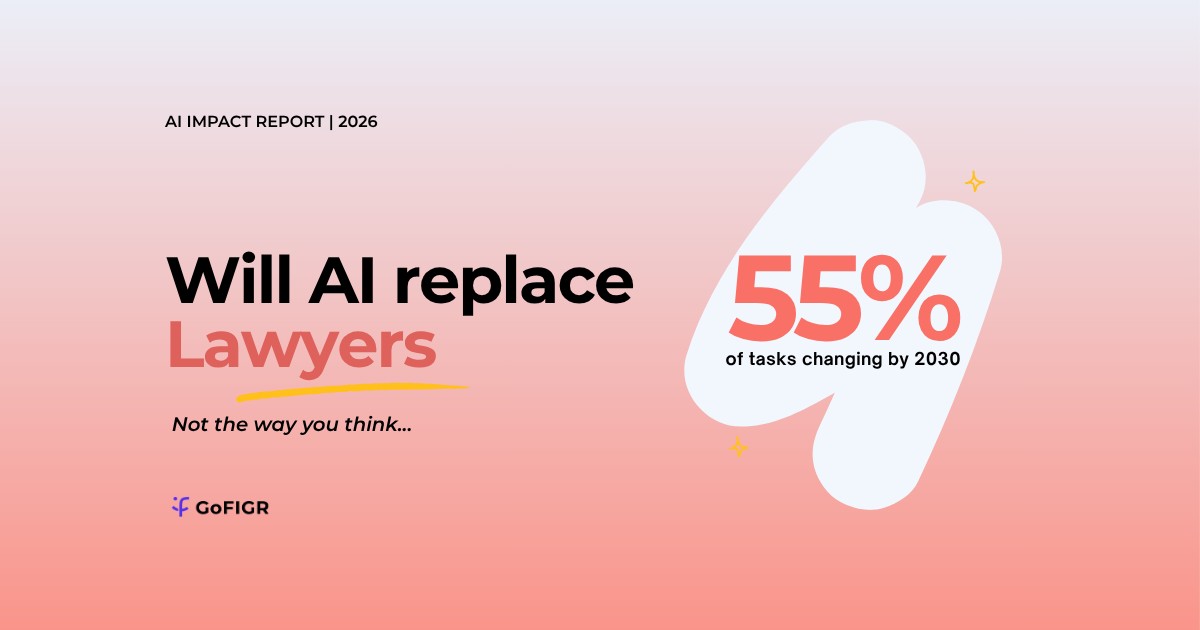
55%
of tasks changing by 2030
Task Breakdown
How AI changes each task in your role

[FULLY-AUTOMATED] Review and summarise documents for due diligence

[FULLY-AUTOMATED] Conduct initial legal research across case law and statutes

[AI-LEADS] Draft standard contracts, NDAs, and first-pass legal documents

[AI-LEADS] Extract and flag key clauses during contract review

[YOU-LEAD] Advise clients on legal strategy and risk in complex or novel matters

[YOU-LEAD] Negotiate commercial terms and resolve disputes

[STAYS-WITH-YOU] Advocate in court, tribunal, or high-stakes client settings

Skills Outlook
Which skills to double down on, develop, or let AI handle
Double DOWN
  • Client Advisory
  • Legal Negotiation
  • Courtroom Advocacy
  • Commercial Judgment
+ Develop New
  • Legal AI Tool Supervision
  • AI Output Verification
  • Legal Technology Strategy
  • Data-Driven Case Analysis
↓ Let AI Handle
  • Document Review
  • Legal Research
  • Standard Contract Drafting
  • Clause Extraction
Get your personalised breakdown
This is the general picture for the above job title. Your personalised assessment takes 3 minutes, based on what you actually do, not just your job title.
Run my free assessment →
Source: GoFIGR AI Impact Assessment
Updated May 2026

AI is already in the law firm. It's reviewing contracts, conducting case research, drafting first-pass documents, and flagging clauses faster than any junior associate could. The question isn't whether this is happening. It's which half of the job you're in.

What's already being automated

Harvey AI is an enterprise legal AI platform used by 42% of AmLaw 100 firms, handling contract analysis, clause extraction, legal research, and document drafting across complex matters at scale.

CoCounsel from Thomson Reuters is a professional-grade AI assistant used by 80% of the Am Law 100, built on authoritative Westlaw and Practical Law content to conduct deep legal research in minutes rather than hours.

Clio Manage AI automates routine practice management tasks including extracting deadlines, generating invoices, drafting client updates, and managing intake, directly inside the platform where most small-to-midsize firms already work.

What the research actually says

Thomson Reuters' 2025 Future of Professionals Report found AI tools have the potential to save lawyers nearly 240 hours per year, with junior associates currently spending 60 to 80% of their time on research and document review tasks that AI can now handle. Thomson Reuters CoCounsel case studies report up to 80% reduction in legal research time for firms actively using the platform.

The economics of legal work are being restructured. Routine tasks that billed at associate rates for decades are now being compressed into minutes. The lawyers who understand this are building practices around what AI can't touch: judgment, advocacy, and trust.

Two people. Same title. Completely different week.

Lawyer A spends the bulk of their time on document review, first-pass research, drafting standard contracts, and compiling due diligence reports. The work is thorough but largely mechanical. Clients value accuracy, which AI can now deliver faster. This lawyer is producing what a machine can produce, and billing for time the machine no longer needs.

Lawyer B uses AI to compress the research and drafting layer entirely. They're reviewing AI outputs critically, advising clients on strategy, handling negotiations and court appearances, and building the kind of trust that doesn't come from a well-structured NDA. They're spending more time on legal judgment and less on legal assembly. Their billing rate reflects that.

Identify the two or three tasks in your current week that take the most time and require the least judgment. Document review, standard contract drafting, basic research. Test an AI tool on them this month. The goal isn't to eliminate your work. It's to free up enough time to do more of the work only you can do.

240 hrs

AI tools have the potential to save lawyers nearly 240 hours per year, equivalent to around six working weeks, according to Thomson Reuters' 2025 Future of Professionals Report.

80%

Thomson Reuters CoCounsel case studies report up to 80% reduction in legal research time for firms actively using the platform.

26%

GenAI adoption in legal organisations nearly doubled from 14% to 26% in a single year, with 95% of legal professionals expecting AI to become central to their workflow within five years, per Thomson Reuters Institute 2025.

The two Lawyers problem

Two people. Same title. Same firm. Completely different AI exposure. This is why a single automation risk score for "Lawyers" is only half the picture.

Lawyer A: task-heavy

Document review and due diligence, first-pass legal research, standard contract drafting, billing time entry, compiling case summaries. Work that AI tools can now do faster.

Role shrinking

Lawyer B: judgment-heavy

Client strategy and advisory, courtroom advocacy, complex negotiation, novel legal argument, building and maintaining client relationships. Uses systems as inputs to judgment, not as the work itself.

Role growing

What to actually do about this

If most of your week is strategic and client-facing

You're well-positioned. Use AI tools to speed up the routine parts of your work so you can go deeper where it counts.

If most of your week is process and execution

Start shifting now. Not in panic, but deliberately. Pick up the skills in the Develop New list. The processing work isn't disappearing overnight, but it's shrinking.

If you're early in your career

The traditional learning path is being disrupted. Develop judgment and critical thinking earlier than your predecessors had to. Your advantage over AI isn't speed. It's knowing when something doesn't look right.

Frequently asked questions

Curious about something else?
Drop us a question and we’ll get back to you!

When will AI replace junior lawyers and associates?
It's already replacing the work, if not the titles. Junior associates who spend 60 to 80% of their time on document review and research are doing tasks AI can now handle faster and more accurately. Firms are hiring fewer associates for volume work and expecting those they do hire to operate at a higher level earlier. The timeline is compressed. This is happening now, not in a decade.
What legal skills are most protected from AI automation?
Courtroom advocacy, complex negotiation, client strategy on novel or high-stakes matters, and the kind of judgment that comes from years of understanding how courts and businesses actually work. These require contextual reading of situations, relationships, and human dynamics that AI can assist with but not replace. The closer your work is to these areas, the more protected you are.
Does being a senior partner protect you from AI disruption?
It helps, but the business model of large firms is being restructured around AI efficiency. Partners who built their practices on supervising associate document review work face a revenue model that no longer holds. The protected senior lawyers are those whose value comes from client relationships, courtroom track record, and strategic judgment. These are things that couldn't be leveraged in the first place.
Is it ethical for lawyers to use AI for legal research and drafting?
Yes, with appropriate oversight. Bar associations in the US, UK, and elsewhere have issued guidance confirming that AI use in legal practice is permissible provided lawyers maintain professional responsibility over outputs, which means reviewing, verifying, and taking accountability for everything the AI produces. Several courts have already sanctioned lawyers for submitting AI-generated research without verification. The ethical obligation is on the lawyer, not the tool.
What should a lawyer do right now to prepare for AI disruption?
Test one of the professional legal AI platforms, Harvey, CoCounsel, or Clio Manage AI, on a task you currently do manually. See how the output compares to what you'd produce and where it falls short. Then deliberately invest time in the work that requires your judgment: client strategy, novel arguments, relationship management. The lawyers building an AI-augmented practice now will look very different from the ones still avoiding it in 18 months.

Bring evidence to the workforce conversation

Book a conversation with our team to scope the full analysis for your organisation. Initial findings in 1 to 3 days.