AI IMPACT

Will AI replace Financial Analysts

Task-level analysis of which financial analyst tasks are being automated, which are being augmented, and which stay human, grounded in GoFIGR's assessment data.

Finance
6 min read
Will AI replace Financial Analysts
5 second summary

The model-building and data-gathering that used to take days now takes minutes. AlphaSense scans millions of documents in seconds. BloombergGPT answers research questions directly from live financial data. The time junior analysts once spent on grunt work is largely gone.

Gartner projects that by 2029, AI will replace 60% of finance's custom analysis work. That's the ad-hoc modelling, scenario analysis, and data aggregation that fills most analysts' weeks right now. This isn't a distant forecast; the tools doing this work are already deployed.

What AI still can't do is make the judgment call. Interpreting ambiguous signals, communicating findings to a sceptical CFO, recommending action in a politically complicated environment, and understanding what the numbers mean in business context are skills the analyst role is consolidating around.

GOFIGR AI IMPACT FOR FINANCIAL ANALYSTS
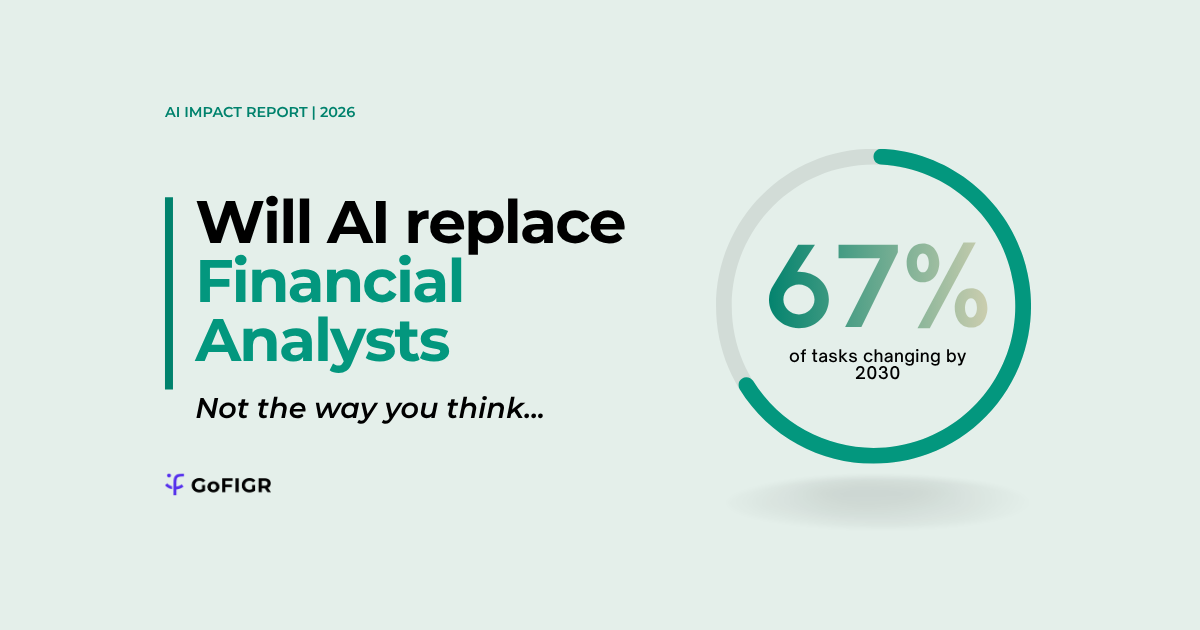
67%
of tasks changing by 2030
Task Breakdown
How AI changes each task in your role

[FULLY-AUTOMATED] Pulling and aggregating financial data from filings and multiple structured sources

[FULLY-AUTOMATED] Building comparable company analyses and standard valuation models

[AI-LEADS] Summarising earnings call transcripts and flagging sentiment shifts

[AI-LEADS] Running scenario analysis and financial forecast modelling

[YOU-LEAD] Interpreting model outputs in the context of business strategy and investment thesis

[STAYS-WITH-YOU] Communicating complex financial analysis to senior decision-makers

[STAYS-WITH-YOU] Making investment or capital allocation recommendations under uncertainty

Skills Outlook
Which skills to double down on, develop, or let AI handle
Double DOWN
  • Strategic Financial Interpretation
  • Executive Stakeholder Communication
  • Investment Thesis Development
  • Business Judgment Under Uncertainty
+ Develop New
  • AI-Augmented Financial Research
  • Prompt Engineering for Financial Modelling
  • Data Storytelling for Finance Audiences
↓ Let AI Handle
  • Manual Data Aggregation from Financial Sources
  • Comparable Company Model Construction
  • Earnings Transcript Summarisation
  • Routine Variance Analysis
Get your personalised breakdown
This is the general picture for the above job title. Your personalised assessment takes 3 minutes, based on what you actually do, not just your job title.
Run my free assessment →
Source: GoFIGR AI Impact Assessment
Updated May 2026

Financial analysis has always been data-intensive. Now the data processing, the research aggregation, and the routine model-building are being handled by AI tools at a speed and scale that changes the economics of the role. Buy-side desks are running Bloomberg's AI-powered document insights across 200 million company filings. AlphaSense is summarising earnings transcripts in real time. The analyst who spent three days building a comparable company model is being replaced by one who reviews the AI's output in three hours. It's not whether this is happening, it's which half of the job you're in.

What's already being automated

Bloomberg Terminal AI integrates generative AI directly into the terminal workflow, enabling natural-language queries across live market data, filings, and news, with analysts citing tasks that previously took 30 minutes now completed in seconds.

AlphaSense uses NLP to scan millions of filings, earnings call transcripts, and research reports, summarising long documents and surfacing sentiment shifts in management language, saving equity research teams significant hours during earnings season.

Kensho, under S&P Global, connects text data with structured financial information for event-driven and macroeconomic analysis, enabling investment banks and asset managers to model market reactions to economic events at scale.

What the research actually says

Gartner forecasts that by 2029, AI-driven decision tools will replace 60% of finance's custom analysis work, specifically the ad-hoc modelling and data aggregation that currently consumes analyst time (cited in AI in Accounting and Finance Statistics 2026). A Stanford and MIT study found that finance professionals using generative AI reallocated 8.5% of their working time from data entry toward client communication. And 95% of finance leaders are investing in AI, with 43% calling it critical to their operations by 2026 (Solvexia).

The financial analysts who are most exposed right now aren't the ones whose models are wrong. They're the ones whose entire value was in building the model in the first place.

Two people. Same title. Completely different week.

Financial Analyst A builds financial models from scratch, manually pulls data from multiple sources into Excel, runs comparable company analyses by searching through filings, and drafts research summaries that are largely descriptions of what the numbers show. The AI tools now available can do most of this faster. Their value is in the execution of analysis, and execution is exactly what's being automated.

Financial Analyst B uses AlphaSense to pull the research, lets the model run, and then spends their time on the part that requires judgment: what does this mean for the investment thesis, how does management credibility change the read on these numbers, and how do they communicate a nuanced view to a portfolio manager who's already made up their mind. The AI is their research assistant. The thinking is still theirs.

Get fluent with the AI tools that are already standard in your field, specifically AlphaSense, BloombergGPT, and whatever financial modelling AI your firm is evaluating. Then invest deliberately in the communication and strategic interpretation skills that make the analysis useful to actual decision-makers. Being able to build the model matters less every month. Being able to explain what it means still matters a lot.

60%

of finance's custom analysis work, including ad-hoc modelling and data aggregation, is projected to be replaced by AI-driven decision tools by 2029, according to Gartner.

95%

of finance leaders are investing in AI, with 43% viewing it as critical to their operations in 2026, according to Solvexia research.

8.5%

of working time reallocated from data entry to higher-value tasks such as client communication and quality assurance by accountants using generative AI, according to a Stanford and MIT Sloan study.

The two financial analysts problem

Two people. Same title. Same firm. Completely different AI exposure. This is why a single automation risk score for "financial analysts" is only half the picture.

Financial Analyst A: task-heavy

Building financial models from raw data, manually pulling figures from filings, running comparable company analyses, compiling research summaries from structured sources. Work that AI tools can now do faster.

Role shrinking

Financial Analyst B: judgment-heavy

Interpreting model outputs in business context, communicating investment theses to senior stakeholders, assessing management credibility, making buy or sell recommendations under ambiguity. Uses systems as inputs to judgment, not as the work itself.

Role growing

What to actually do about this

If most of your week is strategic and client-facing

You're well-positioned. Use AI tools to speed up the routine parts of your work so you can go deeper where it counts.

If most of your week is process and execution

Start shifting now. Not in panic, but deliberately. Pick up the skills in the Develop New list. The processing work isn't disappearing overnight, but it's shrinking.

If you're early in your career

The traditional learning path is being disrupted. Develop judgment and critical thinking earlier than your predecessors had to. Your advantage over AI isn't speed. It's knowing when something doesn't look right.

Frequently asked questions

Curious about something else?
Drop us a question and we’ll get back to you!

How quickly is the financial analyst role actually changing?
Faster than most people in the profession expected two years ago. The entry-level model-building and research aggregation work is already being absorbed at major banks and asset managers. The 2027 to 2028 window is when most analysts expect their day-to-day work to look meaningfully different from today.
What should financial analysts be learning right now?
Get genuinely proficient with AlphaSense and BloombergGPT if your firm has access. Then focus on the skills around communicating analysis to decision-makers and developing views on what the data means, not just what it shows. The analysts who survive the next wave will be the ones whose output is a recommendation, not a report.
Are senior analysts more protected than junior ones?
Generally yes, but it depends on what the seniority is built on. Senior analysts with strong client relationships, a track record of good calls, and the ability to develop original investment theses are well-protected. Senior analysts who are valued primarily for technical model-building expertise are more exposed than they'd like to think.
Does it matter whether I work in investment banking versus corporate finance?
It matters. Investment banking and equity research are seeing AI tools penetrate the core research and analysis workflows fastest. Corporate FP&A roles face similar pressure on routine reporting and modelling but retain more human involvement in business partnering and strategic planning. Both are changing, but at different rates.
Is it worth becoming a financial analyst now given AI's trajectory?
Yes, if you're entering with clear eyes about what the role is becoming. The market for financial judgment, client relationships, and strategic interpretation is not shrinking. The market for pure technical modelling execution is. Build toward the former from day one and don't get attached to the parts of the job that AI is systematically absorbing.

Bring evidence to the workforce conversation

Book a conversation with our team to scope the full analysis for your organisation. Initial findings in 1 to 3 days.