AI IMPACT

Will AI replace financial advisors

Task-level analysis of which financial advisor tasks are being automated, which are being augmented, and which stay human, grounded in GoFIGR's assessment data.

Finance
6 min read
Will AI replace financial advisors
5 second summary

The administrative half of wealth management is already gone. Portfolio reporting, meeting prep, CRM updates, compliance documentation - tools like Salesforce Agentforce are handling 60-70% of the admin that used to fill advisor days.

Robo-advisors handle the simple end of the market. Assets under robo-management are projected to reach $5.9 trillion by 2027. If your value proposition is portfolio allocation for straightforward clients, that's pressure you need to acknowledge.

The advisors growing fastest are those treating AI as a leverage multiplier. Less time on paperwork means more time on the complex, emotional, high-stakes conversations that clients actually pay a premium for.

GOFIGR AI IMPACT FOR FINANCIAL ADVISORS
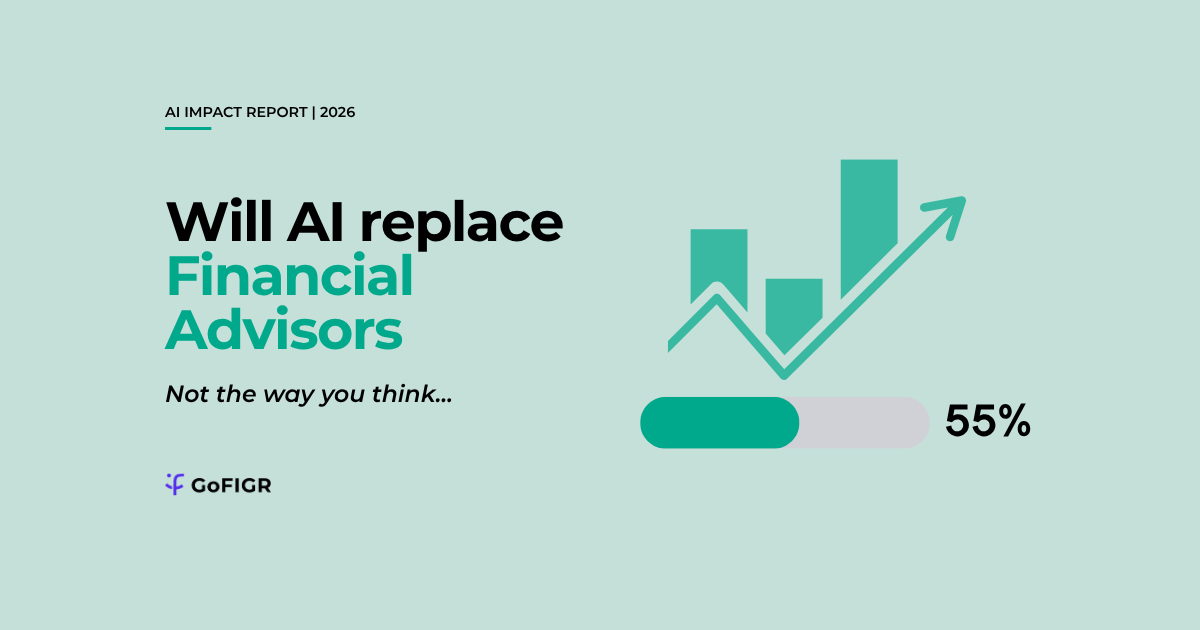
55%
of tasks changing by 2030
Task Breakdown
How AI changes each task in your role

[FULLY-AUTOMATED] Generating standard portfolio performance reports for clients

[FULLY-AUTOMATED] Updating CRM records and post-meeting notes

[AI-LEADS] Drafting initial financial plans and projections

[AI-LEADS] Producing rebalancing recommendations based on portfolio drift rules

[YOU-LEAD] Explaining complex tax or estate strategies to clients in plain terms

[STAYS-WITH-YOU] Advising clients navigating divorce, inheritance, or business exit

[STAYS-WITH-YOU] Building and maintaining long-term trust with high-net-worth clients

Skills Outlook
Which skills to double down on, develop, or let AI handle
Double DOWN
  • Client Relationship Management
  • Complex Financial Planning Judgment
  • Trust and Communication Under Pressure
  • Life Transition Advisory
+ Develop New
  • AI-Augmented Financial Planning Workflows
  • Robo-Advisory Platform Literacy
  • Behavioural Finance Application
  • Data Interpretation for Personalised Advice
↓ Let AI Handle
  • Portfolio Report Generation
  • CRM Data Entry and Updates
  • Compliance Document Preparation
  • Routine Rebalancing Execution
Get your personalised breakdown
This is the general picture for the above job title. Your personalised assessment takes 3 minutes, based on what you actually do, not just your job title.
Run my free assessment →
Source: GoFIGR AI Impact Assessment
Updated May 2026

AI is already embedded in wealth management. Portfolio analysis, compliance documentation, client onboarding paperwork, meeting summaries, rebalancing alerts - the tools are in production, not in pilot. The divide isn't between advisors who use technology and those who don't. It's between advisors whose value is in the transaction and those whose value is in the judgment.

What's already being automated

Salesforce Agentforce handles the administrative tasks that consume 60-70% of advisor time - meeting prep, documentation, CRM updates, follow-up emails - with autonomous AI agents operating within compliance guardrails. Orion Advisor Technology provides AI-driven portfolio reporting, natural language data queries, and a client dashboard assistant that generates plan summaries without analyst input. Conquest Planning uses AI to reduce financial plan creation from an average of ten hours to minutes, with its Strategic Advice Manager maintaining the auditable calculation engine regulators require.

What the research actually says

The 2026 Global AI in Financial Services Report from Cambridge Judge Business School found that 69% of front office and client-facing roles in finance are already reporting positive AI productivity impacts. The same report found that only 40% of firms report increased profitability from AI, largely because the productivity gains are concentrated in firms that have actually invested in workforce readiness alongside the tools. A PWC study projects assets managed by AI-enabled digital platforms will reach $6 trillion by 2027.

Financial advice is splitting into two markets: algorithmic allocation for clients with simple needs, and deeply human judgment for clients whose financial lives are complicated, emotional, or high-stakes. The advisors in the middle are the ones who should be paying attention.

Two people. Same title. Completely different week.

Financial Advisor A spends Tuesday morning pulling together a portfolio report the client could read themselves online, Wednesday afternoon updating CRM notes from Monday's meeting, and Thursday drafting a financial plan that Conquest could generate in 20 minutes. The work is real. It's also exactly the work that's automated now.

Financial Advisor B uses Agentforce to handle all of that before breakfast. Tuesday morning is a call with a client navigating a divorce and what it means for retirement. Wednesday is a multigenerational estate planning conversation where the emotional stakes are as high as the financial ones. Thursday is business development - explaining a nuanced tax strategy to a prospect no robo-advisor would touch.

The clients who need a human financial advisor aren't going anywhere. Life transitions, inheritance, business exits, complex tax situations - AI doesn't handle ambiguity and emotion well. Double down on those conversations. Let the tools carry everything else.

69%

Share of front office and client-facing financial services roles reporting positive AI productivity impacts, according to the 2026 Global AI in Financial Services Report from Cambridge Judge Business School.

$5.9T

Projected assets under robo-advisor management by 2027, up from $2.5 trillion in 2022, per a PWC study cited by MindBridge AI.

60-70%

Share of advisor time currently consumed by administrative tasks rather than client-facing activities, according to Salesforce Agentforce 2026 research across wealth management firms.

The two financial advisors problem

Two people. Same title. Same firm. Completely different AI exposure. This is why a single automation risk score for "financial advisors" is only half the picture.

Financial Advisor A - task-heavy

Generating portfolio performance reports, updating CRM records after client meetings, drafting standard financial plans, processing routine rebalancing trades, preparing compliance documentation. Work that AI tools can now do faster.

Role shrinking

Financial Advisor B - judgment-heavy

Advising clients through major life transitions, navigating emotionally complex inheritance or divorce scenarios, developing bespoke strategies for high-net-worth situations, building and maintaining long-term trust relationships, identifying risk exposure clients haven't articulated. Uses systems as inputs to judgment, not as the work itself.

Role growing

What to actually do about this

If most of your week is strategic and client-facing

You're well-positioned. Use AI tools to speed up the routine parts of your work so you can go deeper where it counts.

If most of your week is process and execution

Start shifting now -- not in panic, but deliberately. Pick up the skills in the Develop New list. The processing work isn't disappearing overnight, but it's shrinking.

If you're early in your career

The traditional learning path is being disrupted. Develop judgment and critical thinking earlier than your predecessors had to. Your advantage over AI isn't speed -- it's knowing when something doesn't look right.

Frequently asked questions

Curious about something else?
Drop us a question and we’ll get back to you!

Will robo-advisors make human financial advisors obsolete?
Robo-advisors are handling the simple, low-complexity end of the market very effectively -- straightforward portfolio allocation, passive investing, basic retirement planning. They're not equipped for life complexity: divorce, business exits, multigenerational wealth, or clients who need someone to talk them out of a bad decision in a volatile market. The market is bifurcating, not disappearing.
What skills should financial advisors build to stay competitive?
The skills with the highest return right now are those AI genuinely can't replicate: navigating emotionally loaded financial decisions, advising across complex life transitions, and building the kind of trust that survives a bad quarter. On the tool side, get fluent with AI-powered planning platforms like Conquest so you're not spending ten hours on a plan a competitor builds in twenty minutes.
Does having more years of experience protect advisors from AI?
Experience in relationship management, complex financial situations, and client trust absolutely protects you. Experience in producing reports, updating CRM systems, and generating standard plans does not -- those are the tasks tools are already handling. The question is which kind of experience has built up over your career.
Are junior financial advisors more at risk than senior ones?
Yes, in the short term. The traditional entry path into financial services involved learning the craft through administrative work -- report production, data entry, plan drafting. That learning path is being compressed. Junior advisors who adapt fastest will be the ones who deliberately seek out client-facing exposure earlier, not the ones who wait for it.
Should financial advisors be worried about AI-powered financial advice apps going directly to clients?
They should be aware, not panicked. Direct-to-consumer AI advisory platforms are growing fast and are genuinely good for clients with simple needs. The advisors who serve those clients on simple mandates should pay attention. Advisors whose clients have complex, evolving financial lives are in a much more defensible position -- that's a relationship, not a transaction.

Bring evidence to the workforce conversation

Book a conversation with our team to scope the full analysis for your organisation. Initial findings in 1 to 3 days.