AI IMPACT

Will AI replace Diversity & Inclusion Managers

Task-level analysis of which diversity & inclusion manager tasks are being automated, being augmented, & which stay human, grounded in GoFIGR's assessment data

Human Resources
5 mins
Will AI replace Diversity & Inclusion Managers
5 second summary

The reporting is automating. The persuading isn't. AI now compiles diversity metrics, audits language, and runs pay equity math in minutes, but making a sceptical executive act on the numbers is still entirely on you.

You're working the least automated corner of HR. SHRM found 2% or less of organizations use AI in inclusion and diversity work, which means the playbook is unwritten and early movers set it.

A new job is appearing inside your job. Someone has to audit the company's AI systems for bias, and D&I managers who build that skill become harder to cut, not easier.

GOFIGR AI IMPACT FOR DIVERSITY & INCLUSION MANAGER
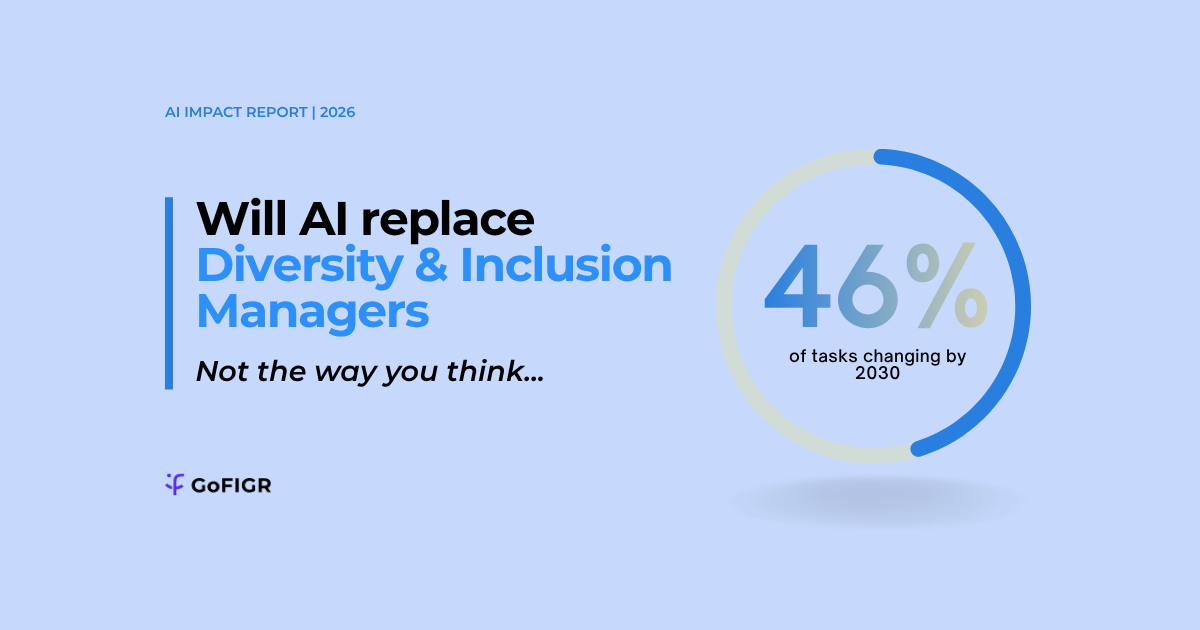
46%
of tasks changing by 2030
Task Breakdown
How AI changes each task in your role

[STAYS-WITH-YOU] Advise executives on representation goals and accountability

[STAYS-WITH-YOU] Build relationships with employee resource groups and community partners

[YOU-LEAD] Facilitate inclusive leadership training and workshops

[YOU-LEAD] Ensure DEI compliance with evolving state and federal regulations

[AI-LEADS] Run pay equity analyses across the workforce

[AI-LEADS] Monitor inclusion sentiment through surveys and listening tools

[FULLY-AUTOMATED] Compile diversity metrics and demographic reports

Skills Outlook
Which skills to double down on, develop, or let AI handle
Double DOWN
  • Executive Advising
  • Group Facilitation
  • Coalition Building
  • Community Partnership
+ Develop New
  • AI Bias Auditing
  • Inclusion Analytics Interpretation
  • Legal Risk Navigation
  • Behavioral Science Application
↓ Let AI Handle
  • Demographic Reporting
  • Language Auditing
  • Survey Verbatim Analysis
  • Pay Gap Calculation
Get your personalised breakdown
This is the general picture for the above job title. Your personalised assessment takes 3 minutes, based on what you actually do, not just your job title.
Run my free assessment →
Source: GoFIGR AI Impact Assessment
Updated May 2026

Not the parts that matter, but the reporting engine underneath it is already gone. AI now compiles demographic dashboards, flags biased language in job posts, and crunches pay equity analyses that used to take weeks. It's not whether this is happening, it's which half of the job you're in.

What's already being automated

Textio analyzes job descriptions, feedback, and communications in real time, flagging biased language and predicting how phrasing lands with different audiences. Syndio runs continuous pay equity analysis across the workforce, replacing the annual consultant-led audit with always-on statistical modeling. Culture Amp applies AI to engagement and inclusion surveys, turning thousands of comments into sentiment themes segmented by demographic group.

What the research actually says

SHRM's State of AI in HR 2026 report found inclusion and diversity is one of the least AI-adopted areas in all of HR, at 2% or less of organizations. Yet the stakes of the work keep climbing: McKinsey's Diversity Matters Even More series found top-quartile executive diversity carries a 39% higher likelihood of financial outperformance. The gap between how measurable this work has become and how little of it is automated is the whole story.

AI can count representation in seconds. It can't make a sceptical executive care about the number. That gap is the job now.

Two people. Same title. Completely different week.

Diversity & Inclusion Manager A spends the week producing artifacts. Pulling demographic reports, rewording job descriptions, formatting the ESG diversity section, summarizing survey verbatims. Every one of those outputs is now a button in Textio, Syndio, or Culture Amp. If your week is mostly assembly, the assembly line has arrived.

Diversity & Inclusion Manager B spends the week changing decisions. Sitting with an executive team to negotiate representation goals, coaching a leader whose team data looks bad, building trust with employee resource groups, navigating a shifting legal landscape state by state. AI hands B better evidence faster. It can't do the persuasion, the coalition building, or the judgment calls about what the organization can legally and culturally sustain.

The practical play: hand the metrics, language audits, and survey processing to the tools this quarter, and reinvest the hours in two places. First, executive advising backed by the sharper data you now have. Second, AI bias auditing, because as your company deploys AI in hiring and promotion, someone credible has to check it for disparate impact, and that someone should be you.
2%

Organizations or fewer using AI in the inclusion and diversity practice area, among the lowest of any HR function, per SHRM's State of AI in HR 2026 report.

39%

Higher likelihood of financial outperformance for companies with top-quartile gender or ethnic diversity on executive teams, per McKinsey's Diversity Matters Even More report.

51%

Employees who believe new technologies such as automation, AI, and robotics will help them be more efficient and effective at work, per Mercer's 2023-2024 Inside Employees' Minds Survey.

The two diversity & inclusion managers problem

Two people. Same title. Same firm. Completely different AI exposure. This is why a single automation risk score for "diversity & inclusion managers" is only half the picture.

Diversity & Inclusion Manager A: task-heavy

Compiling diversity metrics and demographic reports, auditing job descriptions and communications for biased language. Work that AI tools can now do faster.

Role shrinking

Diversity & Inclusion Manager B: judgment-heavy

Designing and leading DEI strategy tied to business outcomes, advising executives on representation goals and accountability, building relationships with employee resource groups and community partners, facilitating inclusive leadership training, ensuring DEI compliance with evolving regulations. Uses systems as inputs to judgment, not as the work itself.

Role growing

What to actually do about this

If most of your week is strategic and client-facing

You're well-positioned. Use AI tools to speed up the routine parts of your work so you can go deeper where it counts.

If most of your week is process and execution

Start shifting now, not in panic, but deliberately. Pick up the skills in the Develop New list. The processing work isn't disappearing overnight, but it's shrinking.

If you're early in your career

The traditional learning path is being disrupted. Develop judgment and critical thinking earlier than your predecessors had to. Your advantage over AI isn't speed. It's knowing when something doesn't look right.

Frequently asked questions

Curious about something else?
Drop us a question and we’ll get back to you!

Is AI or budget cuts the bigger threat to D&I manager jobs?
Budget cuts, by a wide margin. AI adoption in inclusion and diversity sits at 2% or less of organizations, the lowest in HR, while political and funding pressure has eliminated far more roles. AI is actually the tool that lets a smaller team keep the function credible with data.
What skills should a D&I manager learn in 2026?
AI bias auditing first, because companies deploying AI in hiring and promotion need someone to test those systems for disparate impact. Then inclusion analytics interpretation, so you can turn tool output into decisions executives actually make.
How fast will AI take over DEI reporting and analytics?
The capability is already here. Tools like Syndio and Culture Amp automate pay equity math and survey analysis today, and demographic reporting follows wherever they're installed. Expect the reporting layer of the role to be mostly automated within two to three years at companies that keep investing.
Does seniority protect DEI professionals from automation?
Seniority built on executive relationships, facilitation, and navigating legal risk holds up well, because none of that automates. Seniority built on owning the reporting calendar doesn't. The title matters less than which half of the work fills your week.
What should I do right now if I run D&I at my company?
Automate one reporting workflow this quarter and redirect the saved hours into executive advising, where the data now backs you up. At the same time, propose an audit of your company's AI hiring tools for bias. It solves a real legal exposure and positions you inside the AI conversation instead of adjacent to it.

Bring evidence to the workforce conversation

Book a conversation with our team to scope the full analysis for your organisation. Initial findings in 1 to 3 days.