AI IMPACT

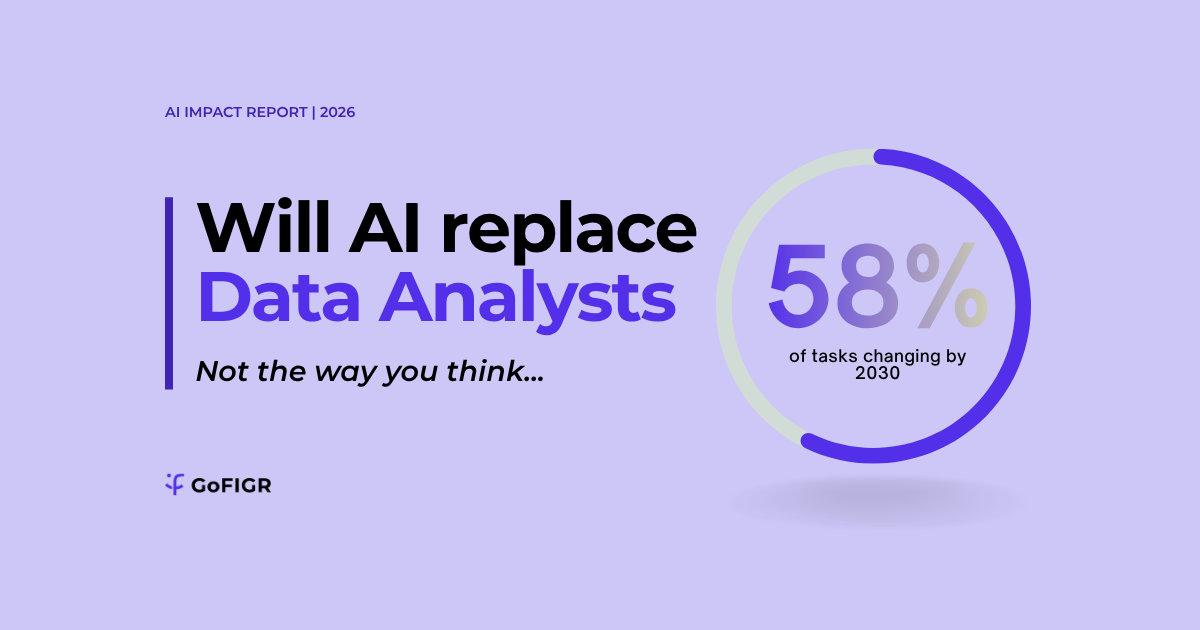
Will AI replace data analysts

Task-level analysis of which data analyst tasks are being automated, which are being augmented, and which stay human, grounded in GoFIGR's assessment data.

Technology
6 min read
Will AI replace data analysts
5 second summary

AI has absorbed the query-and-dashboard half of data analysis. Tools like ThoughtSpot and Power BI Copilot let non-technical stakeholders pull their own insights, which means the analyst who existed to build reports is under real pressure.

70% of routine data processing tasks are expected to be automatable - the work isn't gone, but it's no longer where the value sits. The analysts growing in seniority are the ones framing the questions, not answering them.

McKinsey finds 78% of companies are using AI to augment analytics teams, not replace them. The ceiling on what analysts can do is rising. The floor - basic reporting -- is being pulled away.

GOFIGR AI IMPACT FOR DATA ANALYSTS
58%
of tasks changing by 2030
Task Breakdown
How AI changes each task in your role

[FULLY-AUTOMATED] Writing standard SQL queries for recurring business reports

[FULLY-AUTOMATED] Building and formatting dashboard views for stakeholders

[AI-LEADS] Detecting anomalies and generating alert narratives in metric data

[AI-LEADS] Cleaning and reshaping structured datasets for analysis

[YOU-LEAD] Interpreting unexpected results and explaining business implications

[STAYS-WITH-YOU] Designing measurement frameworks for new products or initiatives

[STAYS-WITH-YOU] Advising leadership on what the data can and cannot support

Skills Outlook
Which skills to double down on, develop, or let AI handle
Double DOWN
  • Business Insight Communication
  • Analytical Problem Framing
  • Stakeholder Influence
  • Statistical Thinking
+ Develop New
  • Agentic BI Tool Configuration
  • AI Output Validation and Auditing
  • Data Strategy Advisory
  • Natural Language Query Design
↓ Let AI Handle
  • Recurring Report Generation
  • Dashboard Template Building
  • Data Cleaning and Transformation
  • Standard SQL Query Writing
Get your personalised breakdown
This is the general picture for the above job title. Your personalised assessment takes 3 minutes, based on what you actually do, not just your job title.
Run my free assessment →
Source: GoFIGR AI Impact Assessment
Updated May 2026

Data analysis has always been two jobs wearing the same title: one is query writing, dashboard building, and report production; the other is knowing which question to ask and what the answer actually means for the business. AI has arrived firmly in the first half. The second half is where the role goes next.

What's already being automated

ThoughtSpot Spotter is an agentic analytics platform that lets users ask natural language questions and get full dashboards, anomaly detection, and insight narratives -- without an analyst in the loop. Microsoft Power BI Copilot generates report summaries, suggests visualisations, writes DAX formulas, and answers natural language queries across the Microsoft enterprise ecosystem. Tableau Pulse proactively pushes AI-generated metric updates and anomaly alerts to stakeholders via Slack and email, without waiting for someone to build a report.

What the research actually says

McKinsey finds that 78% of companies use AI to augment analytics teams for increased productivity rather than replacing them - the interpretation work is expanding even as the production work contracts. Research.com's 2026 analysis of data analytics careers puts 70% of routine data processing tasks in scope for automation by 2025, with the premium shifting decisively toward business context, stakeholder communication, and model validation. Workers using AI tools see throughput on realistic daily tasks increase by 66%, per a Vena Solutions analysis of multiple productivity studies.

The data analyst who built value from being the only person who could run the query is in trouble. The analyst who built value from knowing what question to ask and why the answer matters is having the best career of their life.

Two people. Same title. Completely different week.

Data Analyst A spends Monday pulling last week's sales data into a pivot table, Tuesday building the same performance dashboard for a third time after a stakeholder changed the date range, and Wednesday writing SQL to answer a question a product manager asked that Power BI Copilot would have answered in forty seconds. The output is real. The value is contested.

Data Analyst B set up ThoughtSpot access for the product team last quarter. Stakeholders pull their own standard reports now. Tuesday is a deep-dive into why conversion dropped in a specific cohort - something the automated tools flagged but couldn't explain. Wednesday is presenting a recommendation to the leadership team about what the data means for Q3 strategy. The work is irreplaceable.

If your week is dominated by production work - building reports others could now pull themselves - start the shift now. The analysis skills that AI can't replicate are interpretation, business framing, and stakeholder influence. Start practising them deliberately. The tools will handle the rest.

70%

Share of routine data analytics tasks expected to be automatable, with AI shifting the premium toward strategic interpretation and decision-making, per Research.com's 2026 analysis of data analytics careers.

78%

Share of companies using AI to augment analytics teams for increased productivity rather than to replace analysts, according to McKinsey research cited by Improvado's 2026 analysis.

66%

Increase in worker throughput on realistic daily tasks when using AI tools - equivalent to 47 years of natural productivity gains in the U.S. - per a multi-study analysis by Vena Solutions (2026).

The two data analysts problem

Two people. Same title. Same company. Completely different AI exposure. This is why a single automation risk score for "data analysts" is only half the picture.

Data Analyst A - task-heavy

Writing standard SQL queries for recurring reports, building and maintaining dashboards, formatting data exports for stakeholders, conducting routine performance reporting, cleaning and reshaping structured datasets. Work that AI tools can now do faster.

Role shrinking

Data Analyst B - judgment-heavy

Framing the right business questions for investigation, interpreting anomalies and explaining what they mean strategically, advising stakeholders on what data can and cannot tell them, validating AI-generated model outputs, designing measurement frameworks for new initiatives. Uses systems as inputs to judgment, not as the work itself.

Role growing

What to actually do about this

If most of your week is strategic and stakeholder-facing

You're well-positioned. Use AI tools to speed up the routine parts of your work so you can go deeper where it counts.

If most of your week is process and execution

Start shifting now - not in panic, but deliberately. Pick up the skills in the Develop New list. The processing work isn't disappearing overnight, but it's shrinking.

If you're early in your career

The traditional learning path is being disrupted. Develop judgment and critical thinking earlier than your predecessors had to. Your advantage over AI isn't speed -- it's knowing when something doesn't look right.

Frequently asked questions

Curious about something else?
Drop us a question and we’ll get back to you!

How soon will AI make data analyst jobs redundant?
The production end of the role - query writing, report building, dashboard maintenance -- is already under pressure from tools available today. Full redundancy for analysts who focus on interpretation, strategy, and stakeholder communication isn't a near-term risk. The transition is happening now, not in five years.
What should data analysts learn to stay competitive?
Prioritise two things: the ability to configure and validate AI-powered analytics tools (ThoughtSpot, Power BI Copilot, Tableau Pulse), and the business communication skills to translate what data means into decisions stakeholders will act on. SQL will still be useful. It's just no longer sufficient.
Does seniority protect data analysts from AI disruption?
It depends on what made you senior. If seniority came from being the fastest query writer or the most reliable dashboard builder, AI is already competitive with that. If seniority came from business acumen, stakeholder trust, and knowing which questions are worth answering -- that's a much stronger position.
Are data analysts in specific industries more at risk?
Analysts in marketing, e-commerce, and standard business reporting face the most immediate pressure -- those domains have the highest adoption of self-serve AI analytics tools. Analysts in regulated industries, research, or domains where data interpretation carries legal or strategic weight have more runway, though the tools are arriving there too.
What should I do if my company is already rolling out AI analytics tools?
Get in front of it rather than waiting to be displaced by it. Volunteer to be the person who configures and validates the tools, trains stakeholders to use them, and flags when AI-generated outputs are wrong. That puts you on the right side of the transition and builds exactly the skills the role is evolving toward.

Bring evidence to the workforce conversation

Book a conversation with our team to scope the full analysis for your organisation. Initial findings in 1 to 3 days.