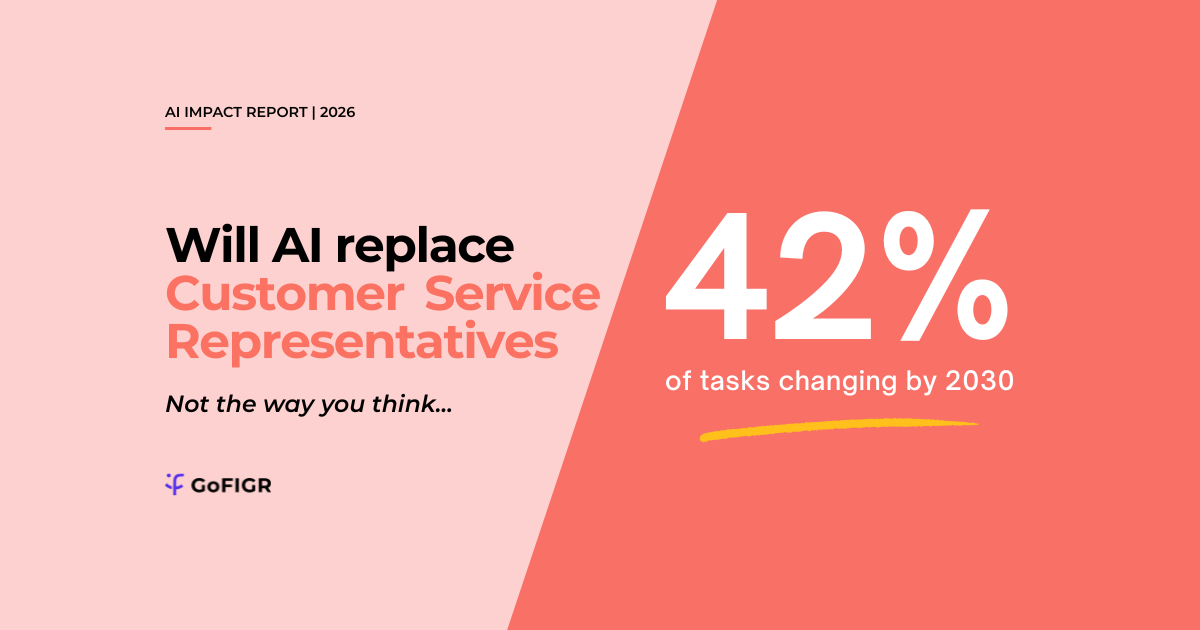
AI is already handling the majority of what used to fill a customer service rep's day. Routine FAQs, order tracking, password resets, basic refunds - these are being resolved by AI agents at scale, without a human touching them. The question for anyone in this role right now isn't whether this is happening. It's which half of the job you're sitting in.
What's already being automated
Intercom Fin is an AI agent that resolves customer queries directly from your help centre and knowledge base - Intercom reports it handles an average of 50% of support volume for teams that turn it on.
Zendesk AI handles intent detection, automated replies, ticket summarisation, and routing - mature deployments report up to 80% of routine queries resolved without a human.
Salesforce Agentforce operates as an autonomous AI agent that completes end-to-end customer interactions across chat, email, and messaging channels inside the Salesforce ecosystem.
What the research actually says
AI tools are already resolving 65% of incoming support queries without human intervention, up from 52% in 2023. Agent productivity gains are real but uneven - newer and lower-skilled workers see the biggest boost from AI assistance, while experienced reps are largely unaffected. The economic pressure is significant: Gartner projects conversational AI will reduce contact centre labour costs by $80 billion by the end of 2026.
The routine query is a solved problem in customer service. The unresolved challenge is the escalation - the angry customer, the edge case, the situation that requires someone to actually care about the outcome.
Two people. Same title. Completely different week.
Customer Service Rep A spends most of their shift handling FAQs, processing refund requests, resetting passwords, and updating account details. Some of this is already automated. The rest will be. Their value is mostly in volume, and AI has more volume capacity than any human team.
Customer Service Rep B works almost entirely in escalations. They handle the customers AI couldn't resolve, the complaints that are emotionally complex, the edge cases that require actual judgment. They're getting faster because AI handles the routine before it reaches them. Their caseload is harder but smaller, and the skill ceiling is much higher.
If you're in a customer service role right now, look at your last 20 interactions. Count how many were genuinely complex versus routine. That ratio tells you more about your AI exposure than any industry report. Move toward the judgment work - not eventually, starting now.