AI IMPACT

Will AI replace Construction Workers

See which Construction Worker tasks AI is automating, augmenting, or leaving human - based on GoFIGR's real workforce assessment data.

Construction
6 min read
Will AI replace Construction Workers
5 second summary

AI is on the job site, but it's not swinging the hammer. Autonomous machinery, computer vision safety systems, and AI-assisted project management are already active on major sites. The work is changing. The physical craft isn't going anywhere.

The industry needs 499,000 additional workers in 2026 while 41% of existing workers approach retirement age. AI is being deployed to fill productivity gaps, not to eliminate workers. The shortage problem is bigger than the automation problem right now.

AI-powered digital solutions could increase construction productivity by 31% by 2030. Workers who understand how to operate alongside autonomous equipment and use AI safety and scheduling tools will be the most valuable people on site.

GOFIGR AI IMPACT FOR CONSTRUCTION WORKERS
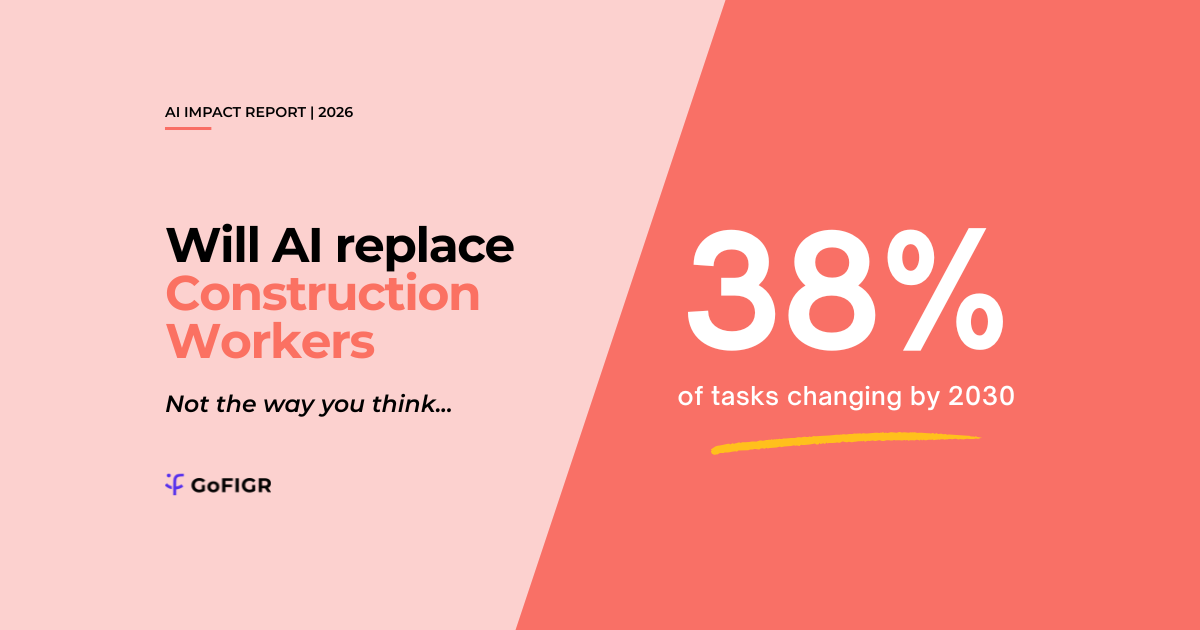
38%
of tasks changing by 2030
Task Breakdown
How AI changes each task in your role

[FULLY-AUTOMATED] Conduct repetitive material transport between fixed site locations

[FULLY-AUTOMATED] Perform standard earthmoving and trenching with autonomous equipment

[AI-LEADS] Monitor site safety compliance via computer vision and wearable sensors

[AI-LEADS] Track progress against project schedule using site camera systems

[YOU-LEAD] Operate and supervise autonomous construction equipment on site

[STAYS-WITH-YOU] Perform complex structural, finishing, and joinery tasks requiring adaptive craft

[STAYS-WITH-YOU] Diagnose and solve on-site problems when conditions diverge from the plan

Skills Outlook
Which skills to double down on, develop, or let AI handle
Double DOWN
  • Skilled Trade Craft
  • On-Site Problem Solving
  • Multi-Trade Coordination
  • Structural Interpretation
+ Develop New
  • Autonomous Equipment Operation
  • AI Safety System Monitoring
  • Digital Site Progress Tracking
  • Construction Technology Literacy
↓ Let AI Handle
  • Repetitive Material Handling
  • Standard Earthmoving
  • Routine Progress Reporting
  • Basic Safety Inspection Logging
Get your personalised breakdown
This is the general picture for the above job title. Your personalised assessment takes 3 minutes, based on what you actually do, not just your job title.
Run my free assessment →
Source: GoFIGR AI Impact Assessment
Updated May 2026

AI is on construction sites now. It's monitoring safety in real time, operating autonomous excavators, and flagging schedule risks before delays happen. The question isn't whether this is happening. It's which half of the job you're in.

What's already being automated

Buildots uses 360-degree cameras worn by site workers to automatically track construction progress against BIM models, replacing manual inspection walkthroughs and flagging deviations in real time.

Versatile attaches sensors to cranes and uses AI to track every lift, analyse site productivity, and surface bottlenecks across an entire project, eliminating manual crane log reporting.

DroneDeploy uses AI-powered drones to conduct site surveys, generate progress reports, and monitor safety compliance from above, cutting the time site managers spend on manual inspections.

What the research actually says

A 2025 study found autonomous construction robotics reduce repetitive labor by up to 90% and cut worker exposure to hazardous work by 72%. AI-powered digital solutions are projected to increase construction productivity by 31% by 2030, according to research cited by Mastt. And 87% of contractors predict AI will meaningfully impact construction, while only 19% have adapted their workflows yet, creating a significant first-mover advantage for sites that act now.

Construction is one of the least automated major industries on earth. That's changing fast. The workers who understand AI tools on site won't be replaced by them. They'll be running them while everyone else catches up.

Two people. Same title. Completely different week.

Construction Worker A handles repetitive, physically standardised tasks: laying consistent brickwork, digging trenches, hauling materials between locations. These tasks have defined paths, predictable environments, and measurable outputs. They're exactly what autonomous equipment and robotics are designed to absorb first.

Construction Worker B operates in the unpredictable, judgment-heavy layer of site work. Complex joinery, problem-solving when conditions don't match the plan, coordinating with subcontractors, reading a site and knowing what needs doing before anyone tells them. AI can monitor this work. It can't do it.

Start paying attention to the AI tools arriving on your site. Workers who can operate alongside autonomous equipment, interpret progress tracking data, and flag what the sensors miss will be in the most demand. The skill isn't disappearing. The context around it is changing.

31%

AI-powered digital solutions could increase construction productivity by 31% by 2030, according to research cited by Mastt's State of AI in Construction Project Management report.

72%

Autonomous construction robotics cut worker exposure to hazardous tasks by 72% and reduce repetitive labor by up to 90%, according to a peer-reviewed study by Brosque et al. published in Construction Robotics (2022) and cited in a 2025 MDPI review of AI in on-site construction robotics.

499,000

The construction industry needs 499,000 additional workers in 2026 while 41% of the existing workforce approaches retirement age, per the AGC 2025 Workforce Survey.

The two Construction Workers problem

Two people. Same title. Same site. Completely different AI exposure. This is why a single automation risk score for "Construction Workers" is only half the picture.

Construction Worker A: task-heavy

Repetitive material handling, standard excavation and earthmoving, routine bricklaying and block work, basic site cleanup and preparation. Work that AI tools and autonomous equipment can now do faster.

Role shrinking

Construction Worker B: judgment-heavy

Complex structural joinery, adaptive problem-solving when site conditions shift, supervising autonomous equipment, skilled finishing work, coordinating multi-trade sequences. Uses technology as input to craft judgment, not as the work itself.

Role growing

What to actually do about this

If most of your week is strategic and client-facing

You're well-positioned. Use AI tools to speed up the routine parts of your work so you can go deeper where it counts.

If most of your week is process and execution

Start shifting now. Not in panic, but deliberately. Pick up the skills in the Develop New list. The repetitive work isn't disappearing overnight, but it's shrinking.

If you're early in your career

The traditional learning path is being disrupted. Develop judgment and problem-solving skills earlier than your predecessors had to. Your advantage over autonomous equipment isn't speed. It's knowing when something doesn't look right.

Frequently asked questions

Curious about something else?
Drop us a question and we’ll get back to you!

How soon will robots replace construction workers on site?
Autonomous equipment is already active on some major sites for earthmoving, material transport, and bricklaying. But full site automation is nowhere close. Construction environments are too unpredictable, too variable, and too dependent on adaptive human judgment to be replaced systematically. The more realistic near-term shift is workers operating alongside autonomous machines rather than being replaced by them.
Which construction trades are most protected from AI automation?
Skilled finishing trades, complex joinery, specialist structural work, and any role requiring adaptive judgment in unpredictable conditions are the most protected. Repetitive, physically standardised tasks in controlled environments are most at risk. Electricians, plumbers, and carpenters doing bespoke or complex work are significantly better positioned than labourers on highly repetitive groundworks.
Does experience in construction protect you from automation?
Experienced workers with deep trade knowledge and problem-solving ability are significantly more protected than entry-level workers doing repetitive tasks. Years on site build the kind of contextual judgment, site-reading ability, and adaptive skill that AI can assist but cannot replicate. The risk concentrates at the routine end of the trade, not the skilled end.
Will AI make construction sites safer for workers?
Yes, and this is one of the clearest near-term benefits. Computer vision systems already flag PPE violations and proximity hazards in real time. Autonomous equipment removes workers from the most dangerous tasks. Wearable sensors monitor fatigue and environmental conditions. Workers who understand and trust these systems will benefit directly. Resistance to site safety tech is the bigger risk than the tech itself.
What should a construction worker do right now to prepare for AI on site?
Pay attention to the technology arriving on your current site. If there are drones doing surveys, progress tracking cameras, or AI safety systems, learn how they work and what they're measuring. Workers who can operate alongside this technology, interpret what it surfaces, and act on it are the ones sites will want most. The craft skills still matter. Pairing them with technology literacy is what separates you going forward.

Bring evidence to the workforce conversation

Book a conversation with our team to scope the full analysis for your organisation. Initial findings in 1 to 3 days.