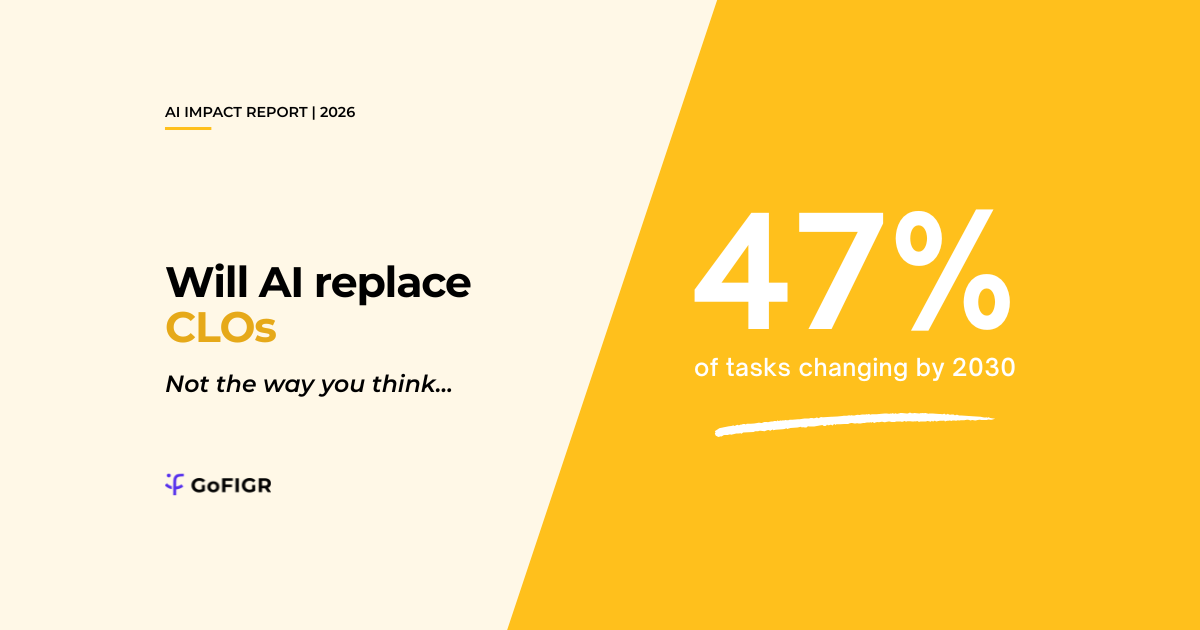
AI IMPACT

Will AI replace CLOs

Task level analysis of which CLO tasks are being automated, which are being augmented, and which stay human, grounded in GoFIGR's assessment data.

Executive Leadership
7 mins
Will AI replace CLOs
5 second summary

Contract review just got a lot faster, and clients expect you to know that. If your team is still manually extracting terms from vendor paper, you're paying billable-hour prices for software-speed work.

In-house teams are quietly gaining leverage over outside counsel. When your own AI tools can do first-pass research and review, you need law firms less for the routine stuff and more for genuine expertise.

AI governance just became a core legal deliverable, not a side project. Somebody has to own the company's AI risk policy. Increasingly, that somebody is you.

GOFIGR AI IMPACT FOR CLO
47%
of tasks changing by 2030
Task Breakdown
How AI changes each task in your role

[FULLY-AUTOMATED] Extracting key terms and dates from contract portfolios

[FULLY-AUTOMATED] Drafting routine NDAs and standard vendor agreements

[AI-LEADS] Reviewing and redlining routine commercial contracts

[AI-LEADS] Monitoring regulatory changes across jurisdictions

[YOU-LEAD] Managing outside counsel relationships and spend

[STAYS-WITH-YOU] Negotiating high-stakes M&A and litigation strategy

Skills Outlook
Which skills to double down on, develop, or let AI handle
Double DOWN
  • Board Advisory
  • Ethical Judgment
  • M&A Negotiation
  • Litigation Strategy
+ Develop New
  • AI Governance Policy Design
  • Legal AI Tool Oversight
  • Cross Border Regulatory Fluency
  • AI Output Verification
↓ Let AI Handle
  • Contract Term Extraction
  • Routine NDA Drafting
  • Regulatory Change Monitoring
  • First Pass Legal Research
Get your personalised breakdown
This is the general picture for the above job title. Your personalised assessment takes 3 minutes, based on what you actually do, not just your job title.
Run my free assessment →
Source: GoFIGR AI Impact Assessment
Updated May 2026

AI has moved fast inside legal departments, faster than in the law firms that used to serve them. Contract term extraction, first-pass legal research, and routine NDA drafting are increasingly handled by AI tools before a lawyer ever opens the document. What hasn't moved is the judgment behind board advisory, high-stakes negotiation, and the ethical calls executives bring to legal when nobody else will make the decision. The shift isn't whether AI belongs in the legal department. It's how much of the routine work you're still paying a person to do by hand.

What's already being automated

Ironclad manages contracts end to end, from request and drafting through negotiation, execution, and renewal tracking.

Thomson Reuters CoCounsel grounds legal research in Westlaw and Practical Law content, cutting hallucination risk compared to general-purpose AI tools.

Spellbook runs directly inside Microsoft Word, flagging contract risks and generating redlines without lawyers leaving the document they're already working in.

What the research actually says

Corporate legal AI adoption more than doubled in a single year, and a majority of in-house teams now expect to lean less on outside counsel because of the AI capabilities they're building internally, according to the ACC and Everlaw's joint GenAI survey. Separately, generative AI use inside legal departments nearly doubled year over year, reaching the large majority of departments surveyed.

The billable hour and AI efficiency are natural enemies. The GCs winning right now are the ones who figured out how to be paid for judgment instead of hours before their outside firms did.

Two people. Same title. Completely different week.

CLO A is still personally extracting key terms from vendor contracts, drafting routine NDAs from scratch, and running first-pass legal research the long way. All of it now has a tool that does the same work in a fraction of the time, with a clear audit trail attached.

CLO B spends the week advising the board on a regulatory risk nobody saw coming, negotiating the final terms of an acquisition, and deciding how far the company's AI governance policy should reach into product decisions. No tool makes that call for her.

Push the routine contract and research work onto AI tools now, deliberately. The GCs who wait are still billing partners for work a subscription could do faster, and their boards are starting to notice.

52%

of corporate legal departments now use generative AI, more than double the 23% reported a year earlier, per the ACC and Everlaw GenAI Survey

64%

of in-house legal teams expect to depend less on outside counsel because of the AI capabilities they are building internally, per the same ACC and Everlaw survey

87%

of legal departments now use generative AI tools, up from 44% the year before, per a 2026 legal operations analysis from Spellbook

The two CLOs problem

Two people. Same title. Same firm. Completely different AI exposure. This is why a single automation risk score for CLOs is only half the picture.

CLO A - task-heavy

Extracting key terms and dates from contracts, Drafting routine NDAs and standard vendor agreements. Work that AI tools can now do faster.

Role shrinking

CLO B - judgment-heavy

Advising the board on enterprise legal risk, Negotiating high-stakes M&A and litigation strategy, Building the company's AI governance policy, Counseling executives on ethical judgment calls. Uses systems as inputs to judgment, not as the work itself.

Role growing

What to actually do about this

If most of your week is strategic and client-facing

You're well-positioned. Use AI tools to speed up the routine parts of your work so you can go deeper where it counts.

If most of your week is process and execution

Start shifting now, not in panic, but deliberately. Pick up the skills in the Develop New list. The processing work isn't disappearing overnight, but it's shrinking.

If you're early in your career

The traditional learning path is being disrupted. Develop judgment and critical thinking earlier than your predecessors had to. Your advantage over AI isn't speed, it's knowing when something doesn't look right.

Frequently asked questions

Curious about something else?
Drop us a question and we’ll get back to you!

Will AI replace corporate lawyers and general counsel?
Not the strategic layer. Research from Harvard Law School found none of the top hundred law firms plan to reduce attorney headcount even where AI delivers dramatic productivity gains on specific tasks. What's shrinking is the routine, high-volume work, not legal judgment itself.
What AI skill matters most for legal leaders right now?
AI output verification. Every legal AI tool can hallucinate a citation or miss a jurisdictional nuance. The lawyers who thrive are the ones who know exactly where to double-check the machine, not the ones who trust it blindly or ignore it entirely.
Does years of legal experience protect you from this shift?
It protects you if your experience is in negotiation, risk judgment, and advising executives under pressure. It protects you less if your value was mainly speed and volume on routine contract work, since that's precisely what AI now does faster.
Is in-house legal AI adoption different from law firm adoption?
Yes, and notably faster. In-house teams are adopting AI more quickly than the outside firms that traditionally served them, which is shifting negotiating leverage and reducing reliance on outside counsel for routine matters.
What should a CLO actually do this quarter?
Move one high-volume, low-judgment workflow, contract term extraction or routine NDA drafting, fully onto an AI tool with human spot-checks. Then start drafting the company's AI governance policy before regulators or a lawsuit forces the timeline.

Bring evidence to the workforce conversation

Book a conversation with our team to scope the full analysis for your organisation. Initial findings in 1 to 3 days.