AI IMPACT

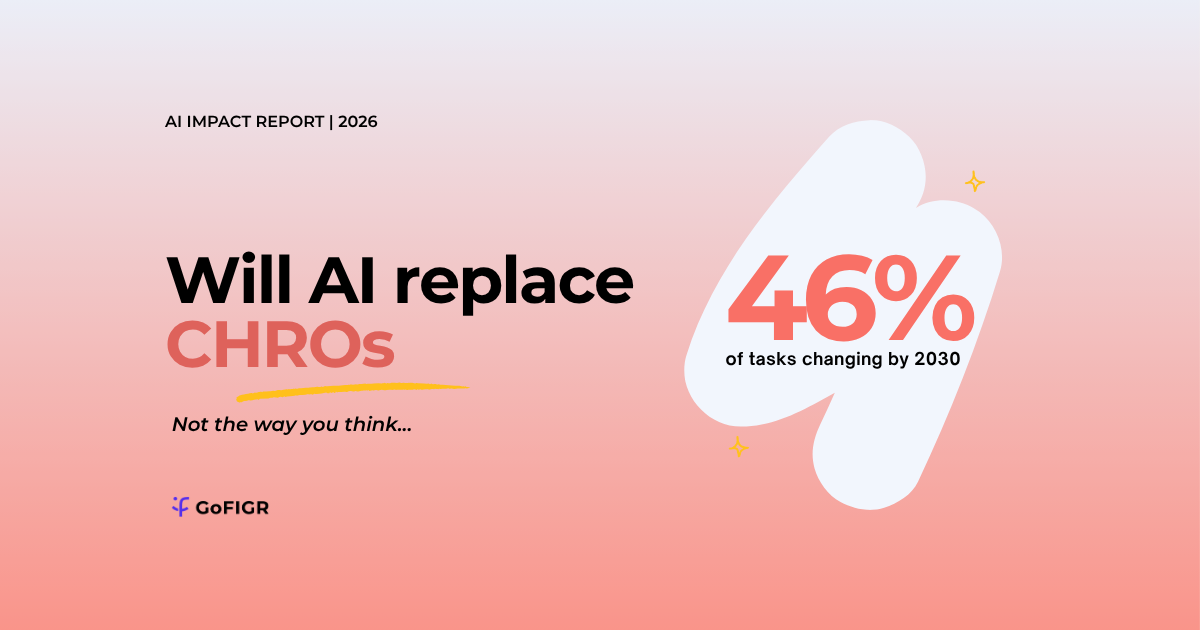
Will AI replace CHROs

Task level analysis of which CHRO tasks are being automated, which are being augmented, and which stay human, grounded in GoFIGR's assessment data.

Executive Leadership
7 mins
Will AI replace CHROs
5 second summary

Resume screening and scheduling are basically solved problems now. If your recruiters are still doing this by hand, that's hours you could hand back to actual candidate conversations.

Nearly half of CHROs can't yet prove AI is working. Ambition is outrunning measurement. Fix that gap before your CFO asks the question you can't answer.

Employment law hasn't caught up to hiring AI, and that's on you now. Bias audits and compliance for AI hiring tools are becoming a core CHRO responsibility, not a legal department afterthought.

GOFIGR AI IMPACT FOR CHRO
46%
of tasks changing by 2030
Task Breakdown
How AI changes each task in your role

[FULLY-AUTOMATED] Screening and ranking resumes for open roles

[FULLY-AUTOMATED] Scheduling interviews and managing onboarding logistics

[AI-LEADS] Analyzing workforce and attrition risk data

[YOU-LEAD] Designing compensation and benefits frameworks

[YOU-LEAD] Ensuring AI hiring tools comply with employment law

[STAYS-WITH-YOU] Handling employee relations and conflict resolution

Skills Outlook
Which skills to double down on, develop, or let AI handle
Double DOWN
  • Employee Relations
  • Change Management Coaching
  • Executive Succession Planning
  • Culture Stewardship
+ Develop New
  • AI Employment Law Compliance
  • People Analytics Interpretation
  • AI Hiring Governance
  • Workforce Scenario Planning
↓ Let AI Handle
  • Resume Screening
  • Interview Scheduling
  • Job Description Drafting
  • Onboarding Logistics
Get your personalised breakdown
This is the general picture for the above job title. Your personalised assessment takes 3 minutes, based on what you actually do, not just your job title.
Run my free assessment →
Source: GoFIGR AI Impact Assessment
Updated May 2026

AI has already taken over the most mechanical parts of human resources. Resume screening, interview scheduling, and onboarding logistics are increasingly automated end to end. What's expanding instead is the harder, more human half of the job: employee relations, succession planning, and making sure the AI tools your own team relies on don't quietly create a discrimination problem. The question isn't whether AI belongs in HR. It's whether you're the one setting its guardrails.

What's already being automated

Workday automatically builds and maintains employee skills profiles and now includes an AI recruiting agent that surfaces in-platform candidate recommendations.

Eightfold AI runs a single talent intelligence layer across recruiting, internal mobility, and workforce planning for large organizations.

Visier turns raw HR data into predictive workforce analytics, flagging attrition risk before it shows up in an exit interview.

What the research actually says

SHRM's State of AI in HR 2026 report found most organizations are already using AI somewhere, though adoption inside the HR function itself still lags other departments. The CHRO Association's 2026 survey found AI and workplace digitization is now the single most urgent concern for CHROs, ahead of engagement or talent, but nearly half admit they haven't built clear ways to measure whether it's actually working.

HR spent a decade proving its seat at the strategy table. AI is the test of whether that seat was earned, because now the CHRO has to govern the very tools reshaping every other function too.

Two people. Same title. Completely different week.

CHRO A is still personally reviewing resumes, coordinating interview calendars, and drafting job descriptions from a blank template. Every one of those tasks has a tool that does it faster and with less bias risk than a tired hiring manager on a Friday afternoon.

CHRO B spends the week walking an executive through a difficult succession decision, mediating a conflict between two department heads, and deciding whether a new AI hiring tool's bias audit is good enough to deploy company-wide. No algorithm makes those calls.

Move the mechanical work onto tools now, deliberately, with clear oversight. And build your AI hiring compliance framework before a regulator or a lawsuit builds it for you.

62%

of organizations are currently deploying AI somewhere in their operations, with 39% having adopted it directly within the HR function, per SHRM's State of AI in HR 2026 report

91%

of CHROs rank AI and workplace digitization as their most immediate concern, ahead of engagement, governance, and talent combined, per the 2026 CHRO Survey from the CHRO Association

47%

of CHROs report they have not yet established clear productivity measures for their AI investments, per the same 2026 CHRO Survey

The two CHROs problem

Two people. Same title. Same firm. Completely different AI exposure. This is why a single automation risk score for CHROs is only half the picture.

CHRO A - task-heavy

Screening and ranking resumes, Scheduling interviews and onboarding logistics, Drafting job descriptions and offer letters. Work that AI tools can now do faster.

Role shrinking

CHRO B - judgment-heavy

Setting workforce strategy and organizational design, Handling employee relations, Coaching senior leaders on change management, Leading executive succession planning. Uses systems as inputs to judgment, not as the work itself.

Role growing

What to actually do about this

If most of your week is strategic and client-facing

You're well-positioned. Use AI tools to speed up the routine parts of your work so you can go deeper where it counts.

If most of your week is process and execution

Start shifting now, not in panic, but deliberately. Pick up the skills in the Develop New list. The processing work isn't disappearing overnight, but it's shrinking.

If you're early in your career

The traditional learning path is being disrupted. Develop judgment and critical thinking earlier than your predecessors had to. Your advantage over AI isn't speed, it's knowing when something doesn't look right.

Frequently asked questions

Curious about something else?
Drop us a question and we’ll get back to you!

Is the CHRO role becoming less important as HR automates?
The opposite. AI is pulling CHROs deeper into enterprise strategy and legal exposure at the same time. The administrative version of the job is shrinking. The governance and culture version is expanding fast.
What AI skill should HR leaders prioritize first?
AI hiring compliance. Employment law hasn't fully caught up with automated screening tools, and the liability for a biased AI hiring process sits squarely with the organization that deployed it, not the vendor.
Does seniority protect HR professionals from this shift?
It protects you if your value is judgment, negotiation, and culture work. It doesn't protect you if your role is mostly coordinating logistics, since that's exactly what's being automated first.
Is this playing out differently across industries?
Yes. Regulated industries with strict employment law exposure are moving cautiously on automated hiring decisions. Fast-growing tech and retail companies are scaling AI recruiting tools much faster, often ahead of their own compliance frameworks.
What should a CHRO actually do this quarter?
Audit every AI hiring tool currently in use for bias testing and documentation. Then pick one purely administrative HR workflow and move it fully onto an AI tool, freeing time for the succession and culture work that's piling up.

Bring evidence to the workforce conversation

Book a conversation with our team to scope the full analysis for your organisation. Initial findings in 1 to 3 days.