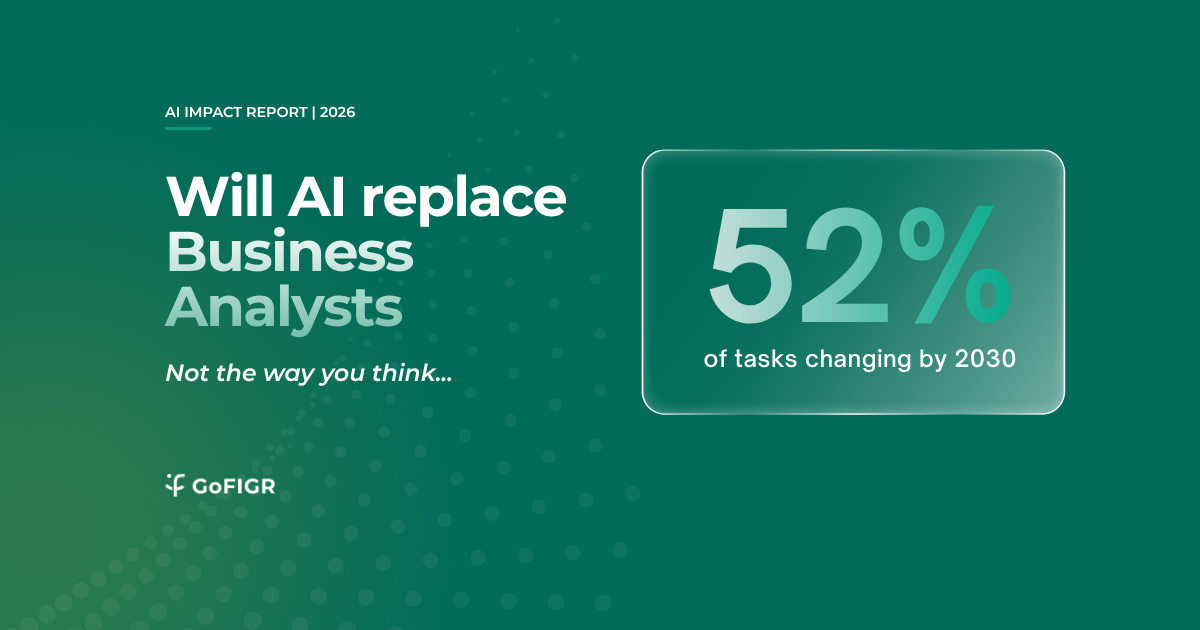
AI is taking on the mechanical side of business analysis at pace. Data gathering, requirements drafting, standard report generation, and basic process documentation. Tools like Microsoft Copilot and Tableau AI now handle these faster than any human. The BA role isn't disappearing. It's splitting, and which half you're in matters a great deal.
What's already being automated
Microsoft Copilot for M365 automates report generation and data analysis across Excel, Word, and Teams, turning raw data into structured outputs through natural language prompts without manual formatting.
Tableau with Einstein AI automatically identifies trends, outliers, and correlations in datasets, delivering narrative insights in plain English rather than requiring manual analysis of dashboards.
Microsoft Power BI with Copilot generates automated report narratives, answers analytical questions in natural language, and surfaces anomalies without a human setting up the query first.
What the research actually says
A Harvard Business School study found that management consultants using AI tools completed tasks 25.1% more quickly, finished 12.2% more tasks overall, and produced work rated over 40% higher in quality compared to a control group. The US Bureau of Labor Statistics, in a 2025 occupational analysis, concluded that analyst roles are likely to see productivity gains from AI but are unlikely to see employment eliminated. The McKinsey 2025 State of AI survey found 88% of organisations now regularly use AI in at least one business function, making AI literacy a baseline expectation for BAs.
Business analysts who spend most of their time on data manipulation and basic reporting are being repositioned. Not necessarily eliminated but made measurably less valuable than those delivering predictive insights and stakeholder-ready recommendations.
Two people. Same title. Completely different week.
Business Analyst A spends most of the week pulling data from multiple systems into spreadsheets, writing requirements documents from scratch, building standard dashboard reports, and updating process maps. Each of these tasks has an AI equivalent that's faster and increasingly accurate. The time cost of this work is collapsing.
Business Analyst B uses Copilot to handle the documentation and data pulling, and spends the majority of their week doing the work AI can only support. They're facilitating workshops to surface what stakeholders actually need, translating messy organisational realities into requirements that development teams can work with, and making the call on whether data trends mean what they appear to mean. AI gives them more time for this. It doesn't do it for them.
The most important shift you can make is moving from reporting on what happened to being the person who makes sense of it and knows what to do next. That transition is available to most BAs but it requires actively pushing toward stakeholder and strategic work rather than waiting for the data tasks to disappear around you.